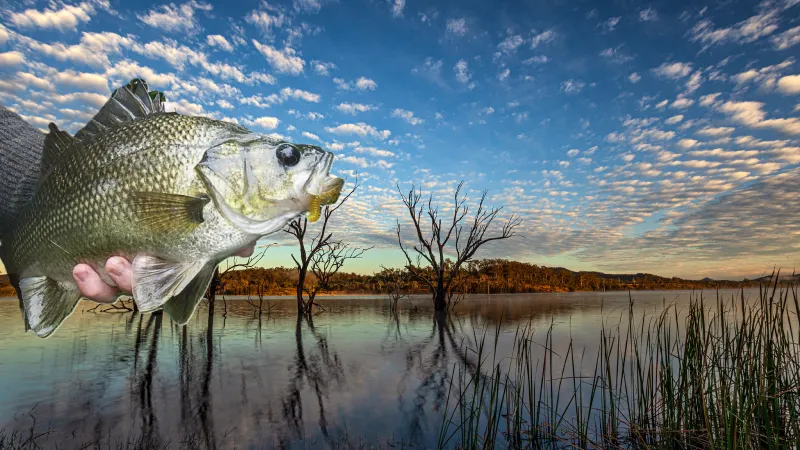
Target Species
Australian Bass
Australian Bass fishing at Wyaralong Dam offers a premier freshwater experience in South East Queensland, combining a thriving stocked fishery with a peaceful, electric-only boating environment. Anglers can target hard-fighting bass among extensive standing timber, submerged creek beds, and steep clay points.
Tucked away at the base of the spectacular Mt Joyce, Wyaralong Dam has rapidly established itself as a must-visit destination for freshwater anglers. Completed in 2011 on Teviot Brook, this relatively young impoundment is uniquely managed as a non-powered and electric-only waterway. The absence of noisy outboard motors creates a tranquil atmosphere, making it an absolute haven for kayak fishers, canoeists, and small electric-powered tinnies.
What makes this waterway truly special is the sheer volume of structure available. The lake is packed with standing drowned timber, submerged vegetation, and dramatic drop-offs along the old creek bed. Because the dam is regularly stocked under the Stocked Impoundment Permit Scheme (SIPS), the Australian Bass population is thriving. Whether you are looking to cast surface lures into the shadows at dawn, slow-roll spinnerbaits through the timber, or pinpoint deep schools using your sounder, this lake provides an exciting challenge.
In this guide, we will break down the seasonal movements of Wyaralong’s bass, the exact tackle and rigs you need to succeed, and the specific techniques local experts use to crack the code on this notoriously moody fishery. Before you pack your paddle, make sure you are familiar with the local fishing spots and have your freshwater permit sorted.
Getting There
Australian Bass
Macquaria novemaculeata
Always check current NSW DPI regulations before fishing. Bag and size limits may change.
Understanding Wyaralong Dam: Location Intelligence
Wyaralong Dam features a complex underwater landscape dominated by the original Teviot Brook creek channel, extensive stands of vertical drowned timber, shallow clay flats, and steep rocky banks. These varied structures provide excellent ambush points and shelter for Australian Bass at multiple depths.
To consistently catch fish here, you must understand how the dam’s physical characteristics dictate bass behaviour. Wyaralong is not a massive, sprawling lake like some of its Queensland counterparts, but it packs a lot of diverse habitat into its length. The lower section near the dam wall is relatively open and deep, with water depths reaching down past 15 metres. As you travel west up the impoundment, the water gradually shallows, and the density of standing timber increases dramatically.
The old Teviot Brook channel runs like a highway through the centre of the dam. Bass use this deeper channel to travel, particularly when water temperatures fluctuate or when they are schooling up. During the warmer months, the water column stratifies, and bass will often hold at a specific depth along the edges of this channel where the temperature and oxygen levels are most comfortable.
The standing timber is the most obvious structure, but it can be overwhelming. Successful local anglers do not just cast randomly at every tree. They look for key features within the timber, such as where a line of trees meets a sudden depth change, or where an old fence line or creek junction intersects the forest. The clay banks and rocky points also play a major role. During low-light periods, bass move out of the deep water and patrol these shallower edges looking for baitfish, shrimp, and terrestrial insects.
Water clarity at Wyaralong can vary from crystal clear near the wall to highly turbid in the upper reaches after a heavy downpour in the Teviot Brook catchment. When the water is clear, bass rely heavily on their eyesight, making them highly suspicious of heavy leaders and bright, unnatural colours. Conversely, when the water is dirty, they rely on their lateral line to detect vibrations, meaning you will need to adapt your lure selection to make more noise. For more details on adapting your approach to different species and conditions, check out our species guides.
Location Essentials
When Is the Best Time to Fish for Australian Bass at Wyaralong Dam?
The best time to fish for Australian Bass at Wyaralong Dam is during the low-light windows of dawn and dusk, when these predators move into the shallow margins and timber edges to feed actively. During these magic hours, bass are highly aggressive and will readily strike surface lures, shallow-running crankbaits, and unweighted soft plastics.
While the dawn and dusk periods are prime times, understanding how daily weather patterns, seasonal shifts, and barometric pressure affect bass behaviour will dramatically increase your catch rate. In the early morning, bass patrol the very edges of the dam, hunting for insects, frogs, and small gudgeon. As the sun rises and light penetrates the water column, these light-sensitive fish retreat into deeper water, seeking shelter in the submerged timber arms, old creek beds, or under thick weed domes.
To catch fish during the middle of the day, you must adapt your strategy. Instead of casting at the banks, use your fish finder to locate schools holding in six to ten metres of water. These deeper fish are often less active, but you can tempt them by slow-rolling metal blades, tailspinners, or soft vibes directly through the school.
Barometric pressure is another critical factor in this impoundment. A rising barometer, particularly before a summer storm front, triggers intense feeding activity. Conversely, a sudden drop in pressure or a sustained cold front can cause the fish to shut down completely. On these tough days, you will need to downsize your lures, use lighter leaders, and present your offerings right in front of their noses with a slow, vertical jigging technique.
Although Wyaralong Dam is a freshwater impoundment and does not experience ocean tides, the fish still respond to lunar cycles and wind-driven currents. Strong winds push warm surface water and plankton to one side of the dam, drawing in baitfish and active bass. Positioning your craft upwind of these wind-blown points and casting back towards the structure is a highly effective tactic.
Australian Bass Seasonal Calendar
Moon Phase & Solunar
Moon phases influence fish feeding behavior. New and full moons create spring tides with stronger currents and increased fish activity.
Best Phases
- New Moon: Peak feeding activity, spring tides, excellent fishing
- Full Moon: Strong tides, night feeding, great for nocturnal species
- 3 Days Either Side: Extended peak period for maximum results
Major/Minor Periods
- Major Periods: Moon overhead/underfoot (2-3 hours)
- Minor Periods: Moon rise/set (1-2 hours)
- Best Times: Major period + dawn/dusk = explosive action
Weather Conditions
Check current conditions before heading out. Wind, swell, and barometric pressure significantly affect fish behavior.
Official forecasts, warnings & radar
Hourly wind speed & direction
Swell height, period & direction
The Windward Edge Advantage
When the afternoon breeze picks up at Wyaralong, do not head for shelter. Look for clay points and grassy banks that are taking a direct beating from the wind. The wave action stirs up nutrients, disorients baitfish, and creates a muddy current line that bass use as ambush cover. Cast spinnerbaits or chatterbaits right into the dirty water for some of the most explosive bites of the day.
What Tackle Do You Need for Australian Bass at Wyaralong Dam?
The ideal tackle setup for targeting Australian Bass at Wyaralong Dam is a light, fast-action spinning rod rated at 2 to 4 kilograms, paired with a 2000 to 2500 size spinning reel spooled with 8 to 10-pound braided line. This combination provides the perfect balance of casting distance, lure control, and fighting power.
Having the right outfit is essential for casting light lures accurately and pulling stubborn bass away from the dam’s abundant submerged timber. A fast-action graphite rod allows you to feel the subtle taps of a bass inspecting your lure and provides the necessary stiffness to set the hook instantly. For more details on choosing your gear, see our tackle basics guide.
While a light 2 to 4 kilogram outfit is perfect for open water, flats, and light weed edges, you will need a heavier setup when fishing deep inside the standing timber of the upper arms. In these snag-ridden areas, a medium-heavy baitcasting outfit rated at 3 to 6 kilograms, paired with a low-profile baitcaster reel, is highly recommended. Spool this reel with 12 to 15-pound braid and a stiff 14 to 20-pound fluorocarbon leader. This heavier gear gives you the winching power needed to stop a trophy bass from diving back into a submerged branch and busting you off.
Your choice of leader material is critical in Wyaralong’s clear water. Always use a high-quality fluorocarbon leader, as it is virtually invisible underwater and offers excellent abrasion resistance against rough timber and weed. A leader length of 1.5 to 2 metres is standard, but you can increase this to 3 metres on bright, windless days when the fish are highly suspicious.
Complete Tackle Specifications for Wyaralong Bass
| Component | Specification |
|---|---|
| Finesse Spin Rod | 6.8 to 7.0 foot, light fast-action graphite, 2-4kg rating |
| Finesse Spin Reel | 2000 to 2500 size spinning reel with a smooth carbon drag system |
| Heavy Timber Rod | 6.0 to 6.6 foot, medium-heavy baitcaster, 3-6kg rating |
| Heavy Timber Reel | Low-profile baitcasting reel with high gear ratio (7.1:1 or higher) |
| Main Line (Spin) | 8lb to 10lb high-carrier PE braid for maximum casting distance |
| Main Line (Baitcast) | 12lb to 15lb low-stretch PE braid for immediate hooksets |
| Leader Material | 6lb to 10lb fluorocarbon for finesse; 14lb to 20lb for heavy timber |
| Terminal Snaps | Size 00 to 0 rolling snaps for quick lure changes without reducing action |
How Do You Rig for Australian Bass?
Rigging for Australian Bass at Wyaralong Dam requires a stealthy, low-profile presentation, using a strong braid-to-leader knot connected to a light fluorocarbon leader to ensure your lure or bait behaves naturally. A running sinker rig is the most effective setup when using live bait, as it allows the fish to take the bait without feeling any resistance.
When rigging for bass, your knots must be flawless. Because these fish live in and around heavy structure, a weak knot will result in lost fish and lost lures. For joining your braided main line to your fluorocarbon leader, the FG knot is the undisputed king. It is incredibly slim, allowing it to pass through micro-guides effortlessly, and retains nearly 100 percent of the line’s breaking strain. If you find the FG knot too complex to tie on a windy kayak, the Double Uni knot is a reliable and faster alternative. You can learn more about these connections in our fishing knots guide.
If you prefer bait fishing from the shore or a anchored kayak, the running sinker rig is your best option. This rig allows live shrimp or earthworms to drift naturally in the water column. The key is to use the absolute lightest sinker possible, just enough to get the bait down to the target depth. This prevents the bait from sinking too quickly into the thick bottom weed and ensures that when a bass inhales the bait, it can swim away freely without feeling the weight of the sinker.
For lure anglers, rigging soft plastics on weedless jig heads is a highly effective way to fish the dense timber and weed beds of Wyaralong. A weedless hook keeps the point hidden within the body of the plastic, allowing you to cast right into the thickest snags without getting hung up.
Building the Perfect Running Sinker Bait Rig
- 1
Thread the Sinker
Pass your braided main line through a small, size 1 or 2 ball sinker. Keep it as light as possible to ensure a natural presentation.
- 2
Add a Buffer Bead
Slide a small soft rubber bead onto the main line below the sinker. This protects your knot from being damaged by the sliding weight.
- 3
Tie on the Swivel
Secure the end of your main line to a small, high-quality size 10 rolling swivel using a Palomar knot or Uni knot.
- 4
Measure the Leader
Cut a 60 to 80 centimetre length of 8-pound fluorocarbon leader. A shorter leader helps control the bait around tight timber.
- 5
Connect Leader to Swivel
Tie one end of the fluorocarbon leader to the remaining eye of the rolling swivel using a standard Improved Clinch knot.
- 6
Attach the Hook
Tie a size 2 or 4 fine-wire bait holder hook to the end of the leader. Fine-wire hooks penetrate easily and keep live bait active.
- 7
Check and Test
Moisten all knots with saliva, pull them tight to ensure they are seated correctly, and trim the tag ends neatly.
What Bait Works Best for Australian Bass?
The best live baits for Australian Bass at Wyaralong Dam are fresh, locally caught freshwater shrimp and lively garden earthworms. These natural baits release powerful scent trails that draw bass out from the deepest timber and weed pockets.
While lure fishing is incredibly popular at Wyaralong, using live bait is an exceptionally productive method, especially for land-based anglers or when the bass are holding deep and refusing to strike artificial lures. Freshwater shrimp are the absolute premier bait for bass in South East Queensland. They form a major part of the natural diet of bass in the dam, and their active flicking motion on the hook is irresistible to hungry predators. You can catch fresh shrimp using a opera-house style trap (where legally permitted) baited with dry dog food or soap, set near the grassy margins of the dam.
Earthworms, particularly large scrubworms or lively garden redworms, are another outstanding bait option. They are highly active on the hook and work exceptionally well after rain when runoff washes terrestrial worms into the dam. When rigging worms, thread them onto the hook so that both ends are free to wriggle, creating maximum movement and vibration underwater.
For more detailed advice on collecting and presenting various baits, check out our bait guide.
Bait Performance Analysis for Wyaralong Bass
| Freshwater Shrimp | Garden Earthworms | Live Yabbies | |
|---|---|---|---|
| Effectiveness Rating | Excellent | Very Good | Good |
| Durability on Hook | Moderate | Low | High |
| Scent Dispersion | High | Excellent | Moderate |
| Availability | Must be trapped locally | Easy to buy or dig up | Can be caught or bought |
| Best Use Conditions | Fished live around deep timber and vertical structures | Fished after rain or in muddy water runoff areas | Fished on the bottom along rocky points and clay flats |
Keep Your Shrimp Alive for More Bites
Australian Bass are highly visual hunters and will often ignore a dead, limp shrimp. To keep your bait shrimp lively, use a small aerator in your bait bucket and keep the water cool by adding a small ice pack. When rigging, gently pass a fine-wire hook through the second tail segment, avoiding the dark spot (the brain and vital organs) near the head. This allows the shrimp to swim and flick naturally for hours.
How Do You Catch Australian Bass at Wyaralong Dam?
Catching Australian Bass at Wyaralong Dam requires a dual approach of targeting deep schooling fish in six to twelve metres of water during the day, and working shallow timber or weed edges during low light. Success relies on finding active fish with your sounder before casting, rather than blindly working the banks.
Casting Strategy and Bait Placement
When you are targeting schooled bass in the deeper parts of the dam, your boat or kayak positioning is everything. Avoid driving directly over the top of the school, as this can easily spook the fish in Wyaralong’s clear water. Instead, use your sounder to locate a school of fish holding around deep creek bends or flats, then position your craft upwind or uptide.
Cast your lure, such as a metal blade, tailspinner, or soft plastic, well past the school. Allow the lure to sink on a tight line, counting it down so that it runs at the exact depth where you marked the fish. A slow lift-and-drop retrieve or a slow-roll with brief pauses will keep your offering in the strike zone longer.
For early morning and late afternoon sessions, shift your focus to the edges. Cast your lures parallel to the weed lines, standing timber, and rocky points. Working parallel keeps your lure in the productive strike zone for the entire length of the retrieve, rather than just a fraction of it. You can learn more about these casting approaches in our guide on fishing techniques.
Bite Detection and Hookset
Australian Bass bites can range from subtle taps to aggressive, rod-shaking hits. When fishing with surface lures or spinnerbaits around timber, the strike is usually unmistakable. However, when jigging or slow-rolling lures through deep schools, the bite often feels like a light “tick” on the line or a sudden weightlessness as the fish grabs the lure and swims upward.
To detect these subtle bites, you must maintain a semi-tight line as your lure sinks. If you feel any unusual vibration or change in tension, wind up the slack quickly and set the hook with a firm, sweeping rod lift. Avoid violent, snapping hooksets, which can tear the hook out of the fish’s mouth or snap light fluorocarbon leaders. Ensuring your gear is joined with reliable connections is vital, so practice your setups using our guide on fishing knots.
Fighting and Landing Strategies
Once hooked, a Wyaralong bass will immediately head for the nearest structure, whether that is a submerged tree trunk, a standing timber branch, or a thick weed bed. You must react quickly to steer the fish into open water. Keep your rod tip high and use the power of your rod’s mid-section to turn the fish’s head.
If you are fishing around heavy timber, you may need to thumb your spool slightly or run a heavier drag setting to stop the fish from bricking you. Once the fish is in open water, ease off the pressure slightly and let your reel’s drag do the work. Always use a soft, knotless landing net to secure the fish. This protects the slime coating on the bass, which is essential for its survival after release.
What Are the Rules and Safety Guidelines for Wyaralong Dam?
Fishing at Wyaralong Dam requires a Stocked Impoundment Permit (SIP) and adherence to Queensland freshwater regulations, which include a minimum size limit of 30 centimetres and a possession limit of two Australian Bass. Boating is strictly limited to low-emission electric motors and paddle craft to protect the local environment.
Before heading out, you must purchase a Stocked Impoundment Permit (SIP), which is available online through the Queensland Department of Agriculture and Fisheries. The funds from these permits go directly back into stocking programs that keep the dam’s fish numbers healthy.
Conservation and Catch-and-Release Practices
To help maintain this fishery, practicing sustainable fishing is highly encouraged. While you are legally allowed to keep up to two bass over 30 centimetres, many local anglers choose to release all their catch.
- Use barbless hooks: Crushing the barbs on your lures makes hook removal much faster and reduces damage to the fish.
- Handle with care: Always wet your hands or use a wet cloth before touching a bass to avoid removing its protective slime.
- Support the fish: Never hold a heavy bass solely by its jaw, support its belly horizontally with your second hand.
- Minimize air time: Keep the fish in the water using your net until you are completely ready to take a quick photo.
For more information on state-wide rules, check out our fishing regulations page.
Critical Safety Considerations
Wyaralong Dam is strictly an electric-only waterway, meaning internal combustion outboards must not be started. The dam contains extensive fields of submerged standing timber and hidden fence lines that pose severe hazards to kayaks and small boats, especially when water levels drop. Always wear a lifejacket, keep a first-aid kit on board, and notify someone of your plans before heading out. For emergencies, contact 000 or Seqwater on 1800 737 928.
Your Questions About Australian Bass Fishing at Wyaralong Dam
What is the best time to fish at Wyaralong Dam?
The best time to fish at Wyaralong Dam is during the low-light hours of dawn and dusk, particularly in the warmer months of spring and autumn. During these peak fishing hours, Australian Bass move into the shallow margins and timber edges to feed actively. If you are planning a trip, targeting the hour before sunrise and the hour after sunset will generally yield the most action, especially when these times coincide with stable, warm weather patterns.
Is Wyaralong Dam suitable for beginners?
Yes, Wyaralong Dam is suitable for beginners, though the limited land-based access means it is best approached with a kayak or small watercraft. While it is a beginner-friendly location in terms of fish numbers, shore-based anglers may find it challenging to reach the best spots. Beginners will find the parklands near the dam wall and the lily pads around the Western Trailhead to be the easiest fishing spots to start their journey.
Do I need a boat to fish at Wyaralong Dam?
You do not strictly need a boat to fish at Wyaralong Dam, but having a kayak, canoe, or electric-powered vessel will significantly improve your chances. Land-based fishing is limited to the designated day-use areas. To access the productive timbered arms and deep creek channels where the bass school up, shore fishing is rarely enough, making paddle craft the preferred choice for local anglers.
Where are the best specific spots at Wyaralong Dam?
The best specific spots at Wyaralong Dam include the submerged timber in the upper reaches of the Teviot Brook arm and the deep drop-offs along the old creek bed. These hot spots consistently hold schools of fish throughout the year. Anglers who use their sounders to map the transitions where the flat ground drops off into the old river channel will find the most consistent fishing marks.
What size Australian Bass can I expect?
The average catch size for Australian Bass at Wyaralong Dam ranges between 30 and 40 centimetres, though larger fish are caught regularly. The dam is a highly productive stocked fishery, meaning healthy fish are common. While 35-centimetre fish make up the bulk of the catch, persistent anglers targeting deep structure can occasionally land a trophy fish measuring over 50 centimetres.
Is there parking available at Wyaralong Dam?
Yes, there is ample free parking available at both the Meebun Recreation Area near the dam wall and the Lily Common area. These areas provide excellent access to the water, with dedicated parking spaces for cars and trailers. If you are wondering how to get there, the main access points are well-signposted along Beaudesert-Boonah Road.
Can I fish at night at Wyaralong Dam?
Yes, you can fish at night at Wyaralong Dam, which can be highly productive during the hot summer months. Using surface lures after dark along the shallow banks is an exciting way to target big bass. If you try night fishing, ensure your vessel is fitted with the correct safety lights and navigate slowly through the timbered zones.
Where can I buy bait near Wyaralong Dam?
You can buy live bait and tackle at the nearby towns of Beaudesert and Boonah, which are both located a short drive from the dam. Local bait shops and service stations in these towns stock live worms, freshwater shrimp, and frozen baits. It is highly recommended to purchase your supplies before arriving at the dam, as there are no tackle stores nearby on the water.
What are the current bag and size limits?
The current Queensland regulations allow a possession limit of two Australian Bass per person, with a minimum size limit of 30 centimetres. These legal limits apply to Wyaralong Dam as a stocked freshwater impoundment. Any bass caught under 30 centimetres must be returned to the water immediately with the utmost care.
Is Wyaralong Dam family-friendly for fishing?
Yes, Wyaralong Dam is highly family-friendly, offering excellent shore-based facilities, playgrounds, and picnic areas at the Meebun Recreation Area. The manicured lawns and safe fishing spots near the main playground make it an ideal destination for kids fishing. Parents can set up a picnic while the children fish safely from the grassy banks.
What should I bring for a fishing session?
Your fishing checklist should include a light spinning outfit, a selection of blades and soft plastics, a valid Stocked Impoundment Permit, sun protection, and a landing net. Bringing the correct essential gear will ensure a comfortable and successful day on the water. Do not forget to pack plenty of drinking water, as there are limited drinking facilities away from the main recreation areas.
How crowded does Wyaralong Dam get?
Wyaralong Dam can get moderately busy on weekends and public holidays, but it remains relatively quiet during weekdays. Because the dam is restricted to non-powered and electric-only craft, it does not suffer from the heavy jet-ski traffic found on other lakes. To enjoy quiet fishing times and avoid crowds, plan your trips for mid-week or early morning sessions.
Latest Fishing Reports
Stay updated with the latest catches, conditions, and hot tips from Wyaralong Dam. Check these sources for recent reports filtered by location and species.
Fishraider
Community fishing reports and catch logs
Fishing World
Professional fishing reports and news
Tackle World
Local tackle shop reports and tips
NSW DPI
Official recreational fishing reports
Fishingmonthly
Monthly fishing magazine and reports
Hooked Up
Video fishing reports and tips
Pro Tip: Filter Reports
When browsing reports, search for "Wyaralong Dam" or nearby landmarks. Look for reports from the last 7-14 days for the most relevant information. Pay attention to tide times, weather conditions, and successful techniques mentioned.
Share Your Catch
Caught something at Wyaralong Dam? Share your success with the community! Upload your catch photos and reports to help other anglers.
Disclaimer: Fishing regulations, access rules, and environmental conditions can change rapidly. Always verify current bag limits, size limits, and permit requirements with the Queensland Department of Agriculture and Fisheries and Seqwater before planning your trip. To expand your horizons, explore more fishing spots in the region, discover other species in our species guides, or brush up on your gear setups with our tackle basics manual.
Quick Info
- Location
- Wyaralong Dam
- Coordinates
- -27.9014, 152.8753
- Difficulty
- intermediate
- Target Species
- Australian Bass
Conditions
Check local weather and tide conditions before heading out.