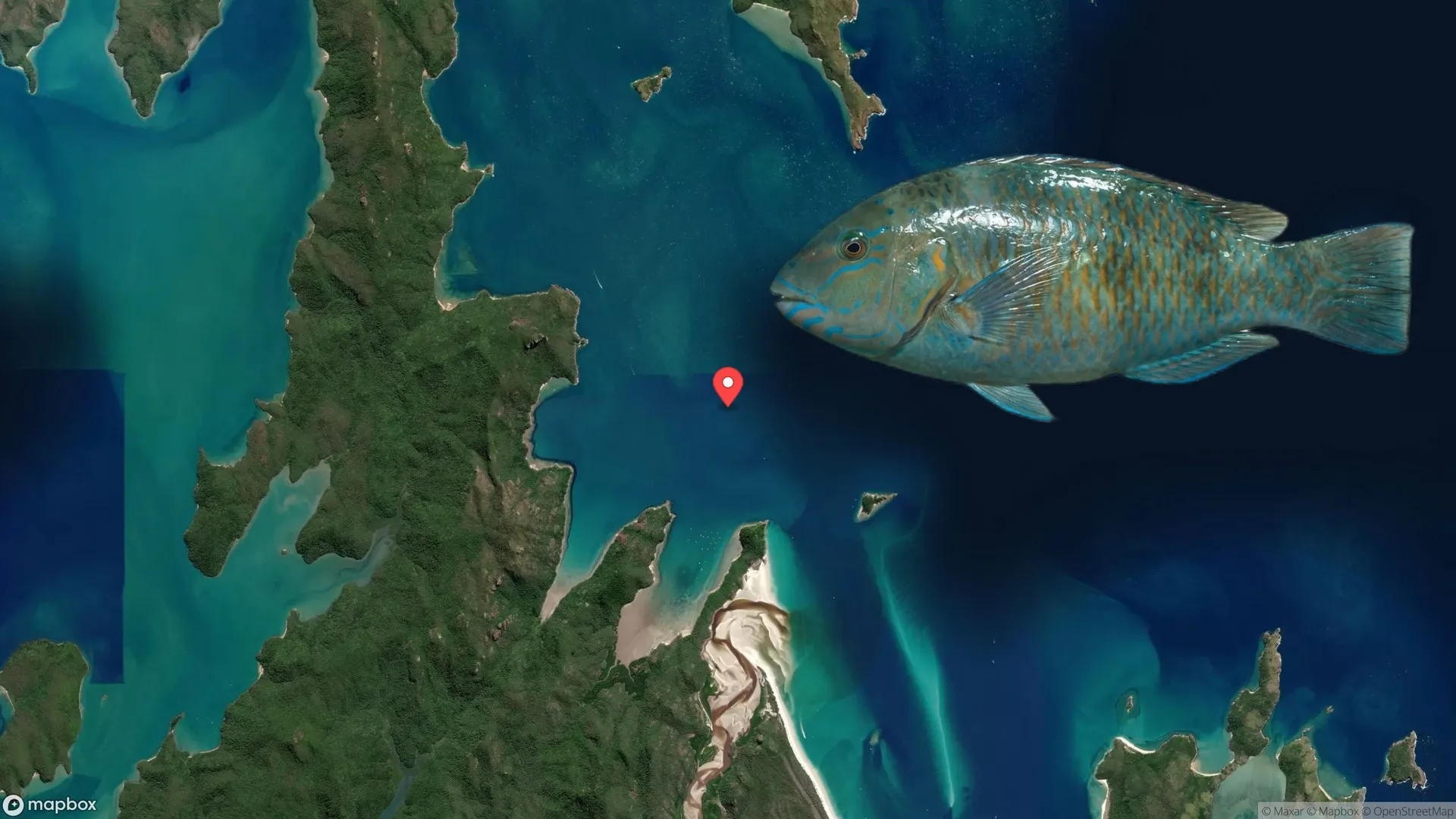
Target Species
Blue Bone
Whitsundays is one of the top spots for Blue Bone (Tuskfish) fishing in QLD, offering vast fringing reefs and shallow coral flats where these powerful fish hunt for crabs. The region gives solid year-round action, though the warmer months often bring the hardest bites on heavy tackle.
There aren’t many fish in the Whitsundays that earn as much respect—or snap as much gear—as the Blue Bone. Known scientifically as the Venus Tuskfish or Blackspot Tuskfish, these reef dwellers are the tough guys of the coral flats. They don’t burn off like a mackerel; they charge straight for the nearest hole, using their raw strength to bust leaders and straighten hooks in seconds. For anglers visiting this beautiful part of Queensland, landing a legal Blue Bone is often seen as a bigger win than catching a regular pelagic, simply because the room for error is so tight.
The Whitsundays, with its 74 islands and endless fringing reefs, is probably the best place to chase these blue-hued bruisers. The clear water allows for awesome sight fishing in the shallows, while the deeper bommies hold fish that can reach 10kg. But catching them isn’t just about tossing out a line; it takes solid knowledge of their habits, what they eat, and the structure they live around. Show up with light estuary gear, and you’ll lose every time.
In this guide, we’re diving deep into the exact tactics needed to pull Blue Bone from the Whitsunday reefs. We’ll cover why live crabs are the best bait, exactly how to rig up to handle their first run, and the key spots around the islands where they hang. Whether you’re a local looking to sharpen your skills or a visitor hoping to tick this bucket-list fish off your list, knowing the unique challenges of this fishery is the first step to getting onto one.
Getting There
Blue Bone
Choerodon cyanodus
Always check current NSW DPI regulations before fishing. Bag and size limits may change.
Understanding Whitsundays: Location Intelligence
Blue Bone in the Whitsundays are structure-loving fish found around fringing coral reefs, rocky headlands, and isolated “bommies” in depths from 2 to 20 metres. Focus on areas with broken coral rubble or sandy patches next to hard reef, as this is where they hunt for crustaceans.
To catch Blue Bone, you need to think like a crab. These fish aren’t open-water roamers; they’re homebodies who stick close to their chosen patch of reef. In the Whitsundays, that structure comes in a few forms, and spotting it on your sounder or through polarised sunglasses is key.
The Terrain
The Whitsundays archipelago stands out because of its mix of inshore silty zones and offshore clear reefs. Blue Bone do well in both, as long as there’s hard bottom. The best areas are usually the fringing reefs around islands like Hook, Whitsunday, and South Molle. Unlike the outer Great Barrier Reef, these reefs often start right at the shore, dropping quickly into 10-20 metres of water.
The Rubble Zone: The absolute hotspot for Blue Bone is the “rubble zone”—where the live coral ends and breaks into loose coral chunks and sand. This is their feeding ground. Crabs, shrimp, and shellfish hide in the rubble, and Blue Bone cruise these edges waiting for a meal to move. If you’re anchoring, set up so your bait drifts back onto this edge, not into the live coral where you’ll snag fast.
Isolated Bommies: In deeper water (10m+), watch for lone coral outcrops, known locally as “bommies.” A big bommie rising 2-3 metres off the bottom in the middle of a sandy stretch pulls in bigger Tuskfish. These fish sit tight at the base. When you hook one here, the fight is straight up and down; you’ve got to turn its head before it dives back under the coral ledge.
Depth and Tides
You can catch them in as little as a metre of water when the tide’s high over the flats, but most reliable action in the Whitsundays happens between 5 and 15 metres. This depth lets you release bycatch safely (avoiding the squeeze issues common in deeper fish) while still finding quality fish.
Tidal flow in the Whitsundays can be strong, with big water movement between islands. Neap tides usually give better Blue Bone fishing in deeper channels because the water moves slower, letting you keep your bait on the bottom where the fish feed. During spring tides, the current can be too heavy to fish the bottom without huge sinkers, which look off. But spring tides are great for shallow flats at high water, as the fish move right into mangroves and rock edges to feed on the newly covered ground.
Location Essentials
Why They Are Here
The huge number of crustaceans in the Whitsundays is the main reason Blue Bone are here. The big tides uncover wide intertidal zones packed with soldier crabs, rock crabs, and prawns. Blue Bone have special teeth—strong tusks for flipping rocks and flat plates for crushing shells. They’re here because the food never runs out.
When checking out a spot, watch for “showering” baitfish or surface signs, but remember Blue Bone feed on the bottom. Use your sounder to find “hard bottom.” If your return is thick and red (hard ground) instead of thin and green (mud/sand), you’re in the right zone. If you see a patch of hard ground with a few solid arches just off the bottom, drop your anchor.
For more on finding good grounds, check out our guide to fishing spots in Queensland.
When Is the Best Time to Fish for Blue Bone at Whitsundays?
The best time to fish for Blue Bone is during the warmer months from September to April, with dawn and dusk sessions bringing the most consistent bites. Fishing the turn of the tide, especially the hour before and after high tide, lets you target fish moving over shallow reef flats to feed.
Timing your session in the Whitsundays is less about the calendar month and more about the conditions on the day. While Blue Bone are around all year, how active they are—and how easy they are to catch—changes with the seasons and tides.
Seasonal Patterns
Summer (November - April): This is the peak time for Blue Bone. Warmer water fires up their metabolism, making them more aggressive and eager to hunt. But this also lines up with the wet season and possible cyclones. The trick in summer is to fish during the calm spells. The fish will be feeding hard in shallow water when the weather holds.
Winter (May - August): The bite slows a little as the water cools. The fish are still there, but they shift a bit deeper (10-20m) chasing stable temperatures. You might need to leave baits in longer to get a bite. The upside is winter brings the best weather for anglers—lower humidity and lighter trade winds.
Blue Bone Seasonal Calendar
Tidal Influence
The tides in the Whitsundays are huge, sometimes over 3-4 metres. That moves a massive amount of water.
- High Tide: Best for fishing the flats and shallow fringing reefs. As the water rises, Blue Bone follow the edge up to crunch crabs off the rocks.
- Low Tide: Fish fall back to deeper edges and drop-offs. This groups them up but can make them harder to reach from shore.
- The “Bite Window”: The absolute best time is the change of tide. The hour of slack water (high or low) and the first hour of the run. During full tidal flow, Blue Bone often hunker down behind coral heads to save energy. When the flow stops, they start roaming.
Tide Times
Optimal Tide
Incoming tide peaking at high
Tide movement is critical for fish activity. Most species feed actively during tide changes, especially the run-in (incoming) tide.
Detailed hourly tide charts
Official tide predictions
7-day tide calendar
Tide Guide
Best for most species. Fish move in to feed as water rises.
Good for ambush predators. Baitfish get swept out.
Slower bite. Fish less active during slack water.
New/full moon. Bigger tidal range, more fish movement.
Moon Phase & Solunar
Moon phases influence fish feeding behavior. New and full moons create spring tides with stronger currents and increased fish activity.
Best Phases
- New Moon: Peak feeding activity, spring tides, excellent fishing
- Full Moon: Strong tides, night feeding, great for nocturnal species
- 3 Days Either Side: Extended peak period for maximum results
Major/Minor Periods
- Major Periods: Moon overhead/underfoot (2-3 hours)
- Minor Periods: Moon rise/set (1-2 hours)
- Best Times: Major period + dawn/dusk = explosive action
Weather Conditions
Check current conditions before heading out. Wind, swell, and barometric pressure significantly affect fish behavior.
Official forecasts, warnings & radar
Hourly wind speed & direction
Swell height, period & direction
The Dawn Patrol Advantage
Blue Bone are visual hunters but they’re cautious. The first light of day (Dawn) gives you a real edge: the fish are hungry after a night off the feed, and the low light hides your leader and boat shadow. If you’re anchored and baited up as the sun breaks the horizon, your shot at a trophy fish doubles.
What Tackle Do You Need for Blue Bone at Whitsundays?
You need heavy tackle to stop Blue Bone from reefing you; a 20-25kg spin rod paired with a 4000-6000 size reel and 50-80lb braided line is standard. A heavy fluorocarbon leader of at least 60lb is essential to handle abrasion against coral and the fish’s powerful teeth.
If you bring a knife to a gunfight, you lose. If you bring light estuary gear to a Blue Bone fight, you lose tackle. These fish are built like tanks and fight dirty. The second they feel the hook, they make a run for the reef. Your gear must be able to stop a 5kg fish dead in its tracks within two seconds.
Rod and Reel
Leave the light bream gear at home. You need a rod with serious backbone. A short, stiff boat rod (around 6-7 feet) rated for 10-15kg or even 24kg is ideal. The shorter length gives you better control to lift the fish. For land-based fishing, a longer 9-10ft rod with the same power helps steer fish away from the rocks.
A quality spinning reel in the 4000 to 6000 size is best. It needs a smooth, strong drag. Lock that drag down tight—you’re not giving these fish any line.
Line and Leader
Main Line: 30lb braid is the bare minimum, but 50lb to 80lb braid is the go. Braid has no stretch, which is key for setting the hook fast and feeling the “crunch” before the bite.
Leader: This is your lifeline. Blue Bone live in sharp country. Use 60lb to 80lb fluorocarbon leader. Fluorocarbon stands up better to abrasion than mono and is harder for the fish to see. Run a long leader (1.5 - 2 metres) to guard against the reef when the fish dives.
For more on picking the right gear, check out our tackle basics guide.
Complete Tackle Specifications
| Component | Specification |
|---|---|
| Rod | 6-7ft heavy boat rod, 15-24kg rating |
| Reel | 5000-6000 spin reel, locked drag |
| Main Line | 50-80lb PE braid |
| Leader | 60-80lb high-grade fluorocarbon |
| Hooks | 5/0-7/0 heavy gauge circle hooks |
| Sinker | 4-8oz snapper lead (current dependent) |
| Swivels | Size 2-4 heavy duty crane swivels |
| Rig Type | Single dropper Paternoster |
How Do You Rig for Blue Bone?
The most effective rig for Blue Bone is a heavy-duty Paternoster rig with a single dropper loop, keeping the bait just off the bottom to reduce snagging while staying visible. Use a heavy gauge circle hook (5/0-7/0) to ensure a corner-of-the-mouth hookset, which suits the powerful jaw of a Tuskfish.
Keep it simple. Rigs with beads, lumo tubes, and multiple hooks only increase your chances of snagging on coral. The aim is to present a crab or prawn naturally near the seabed while keeping solid contact so you can feel the bite.
The Single Paternoster
This is the go-to rig for Whitsundays reef fishing.
- Why: It keeps the sinker on the bottom and the bait suspended about 30-50cm above it. This stops crabs (your bait) from crawling under rocks and hiding.
- Construction: Tie a heavy swivel to your main line. Attach 1.5m of 60lb leader. Tie a dropper loop about 40cm from the bottom end. Attach your sinker to the very bottom.
- The Hook: Loop your hook onto the dropper. A Circle Hook is highly recommended. Blue Bone crush their prey. A circle hook tends to slide into the corner of the jaw as they turn, giving a secure hold without needing you to strike at the perfect moment.
Building the Heavy Paternoster
- 1
Leader Prep
Cut 1.5 metres of 60-80lb fluorocarbon leader.
- 2
Dropper Loop
Tie a solid dropper loop about 40-50cm from one end. Ensure the loop is short (10cm) to prevent tangling.
- 3
Hook Attachment
Feed the loop through the eye of a 6/0 Circle Hook and pass the hook back through the loop to secure it.
- 4
Sinker Loop
Tie a loop or attach a snap swivel to the bottom end for your sinker.
- 5
Main Connection
Tie the top end of the leader to your main braid line using a quality FG knot or heavy swivel.
- 6
Bait Up
Hook your crab through the side or back leg socket, ensuring the hook point is well exposed.
- 7
Check Drag
Before casting, check your drag is nearly locked. You cannot give line on the strike.
For detailed knot instructions, check our fishing knots guide.
What Bait Works Best for Blue Bone?
Live crustaceans are the top choice for Blue Bone, with live crabs (specifically rock crabs or small mud crabs) being the most effective option. Large banana prawns, squid heads, and octopus legs are solid alternatives if live crabs aren’t available.
Blue Bone are crustacean lovers. Their whole build is made for cracking shellfish. While they might take a pilchard meant for a trout, you’ll catch far more Blue Bone using the food they hunt naturally.
The Gold Standard: Live Crabs
Nothing beats a live crab. Small rock crabs (often found under rocks at low tide) or “red claw” crabs are irresistible.
- Presentation: Remove the big claws so they don’t nip you or grab the line. Hook through the side of the shell or a leg socket. The crab needs to stay alive and wriggling.
- Scent: Crack the shell slightly to let out juices that draw fish in from a distance.
The Alternatives
If you can’t grab crabs yourself, large banana prawns work well. Use them whole with the shell on. The crunch helps trigger the feeding bite.
Squid and Octopus: Tough baits that hold up on the hook. Use the heads or thick tentacles. These are ideal for longer soaks when small fish might otherwise strip softer baits.
Bait Performance Analysis
| Live Rock Crab | Whole Prawn | Squid/Octopus | |
|---|---|---|---|
| Effectiveness Rating | 10/10 (Elite) | 8/10 (Great) | 7/10 (Good) |
| Durability on Hook | High - Shell protects it | Medium - Soft shell | Very High |
| Scent Dispersion | Medium - Crack shell to boost | High | Medium |
| Availability | Low - Must catch yourself | High - Buy at tackle shop | High |
| Best Use Conditions | Targeting trophy fish | General reef fishing | Areas with many small pickers |
Bait Tip: The 'Crunch' Factor
Blue Bone are drawn to the sound of feeding. If you hook a fish, get another bait down fast. The noise of one fish crushing a crab can spark a feeding frenzy in others nearby.
How Do You Catch Blue Bone at Whitsundays?
To catch Blue Bone, anchor your boat securely over reef structure or rubble, lower your crab bait to the bottom, and keep the line tight to detect the initial “crunch” bite. When you feel weight, lift the rod firmly (do not strike wildly with circle hooks) and wind aggressively to pull the fish away from the coral before it can snag you.
The technique for catching Blue Bone is active and intense. This is not “set and forget” fishing.
1. Positioning
Anchoring is better than drifting. Blue Bone are territorial. You want your bait to sit in their zone and annoy them into eating. Use your electric motor or anchor to hold precisely over the rubble patch or bommie edge.
2. The Bite
Blue Bone don’t typically smash a bait like a Trevally. The bite often feels like a solid “thump” or a “crunch” as they crush the crab.
- Wait: Give them 2-3 seconds after the first tap. They are crushing the shell.
- The Weight: Wait until you feel the heavy weight of the fish moving off with the bait.
3. The Fight
This is the critical moment.
- Circle Hooks: If using circles, do not whip the rod back. Just lift firmly and start winding. The hook will roll into the corner of the jaw.
- J-Hooks: If using J-hooks, strike hard to penetrate the bony jaw.
- The First 10 Seconds: This determines the outcome. You must turn the fish’s head immediately. Pump and wind. Do not let them take drag. If they get their head down, they will find a hole, flare their gills, and lock themselves in. If this happens, free-spool immediately—sometimes they think they are free and swim out, allowing you to re-engage.
For more on fighting heavy fish, check our fishing techniques page.
What Are the Rules for Fishing at Whitsundays?
Whitsundays fishing is governed by QLD Department of Agriculture and Fisheries rules; for Blue Bone (Tuskfish), there is a minimum size limit (usually 30cm) and a possession limit (usually 6). Additionally, the region is part of the Great Barrier Reef Marine Park, so anglers must check zoning maps to avoid fishing in Green Zones (no-take areas).
The Whitsundays is a highly regulated marine park. Ignorance is not a defense, and fines are significant.
Marine Park Zoning
The Great Barrier Reef Marine Park Authority (GBRMPA) divides the area into zones:
- Blue Zones (Habitat Protection): Fishing allowed (generally).
- Yellow Zones (Conservation Park): Limited fishing (usually one line, one hook).
- Green Zones (Marine National Park): NO FISHING. Look, but don’t touch.
- Pink Zones (Preservation): No entry.
Always check the “Eye on the Reef” app or GBRMPA zoning maps before dropping a line.
Species Regulations (QLD)
- Species: Venus Tuskfish / Blackspot Tuskfish.
- Size Limit: Generally 30cm minimum.
- Bag Limit: Combined limit of 6 per person (check current “Coral Reef Fin Fish” rules).
- Closed Seasons: There are two annual coral reef fin fish closures (usually around the new moon in October and November) to protect spawning stocks. During these dates, you cannot target or possess Blue Bone.
For the latest rules, verify with our regulations guide or the QLD Fisheries website.
Critical Safety Considerations
- Stingers: Box Jellyfish and Irukandji are present, especially Nov-May. Wear a stinger suit if wading or handling
When Is the Best Time to Fish for Blue Bone at Whitsundays?
The best time to fish for Blue Bone is during the warmer months from September to April, with dawn and dusk sessions producing the most consistent bites. Fishing the turn of the tide, particularly the hour before and after the high tide, gives you the best chance of hooking up as fish move over shallow reef flats to feed.
Timing your session in the Whitsundays is less about the calendar month and more about the conditions on the day. While Blue Bone are around all year, your odds of getting a bite change a lot with the seasons and tides. Knowing these patterns is what turns a quiet day on the water into a session where your arms ache from pulling in fish.
Seasonal Patterns: The Heat is On
Blue Bone are tropical fish that love warm water.
Summer (November - April): This is prime time. Warm water fires up their metabolism, making them more aggressive and eager to chase food. During these months, they’ll push right into the shallows (1-3 metres) to hunt crabs. But this season also brings the wet season and the chance of cyclones. The trick is to fish during the calm spells between storms.
Winter (May - August): The bite slows as the water cools. The fish are still there, but they shift a bit deeper (10-20m) to find warmer spots. You might need to leave your bait in longer, and they won’t hit as hard. The upside? Winter brings the best weather for fishing—lower humidity and lighter trade winds mean you can stay out longer and stay comfortable.
Blue Bone Seasonal Calendar
Tidal Influence: The Moving Feast
The tides in the Whitsundays are huge, sometimes over 3-4 metres. That’s a massive rush of water, and Blue Bone use it to feed.
- High Tide: Best for fishing the flats and shallow reefs. As the water rises, Blue Bone follow it in to crush crabs off the rocks and mangroves. This is visual fishing at its best—watch them roll in the shallows.
- Low Tide: Fish fall back to deeper edges and drop-offs. They’re packed in tighter, but harder to reach from shore. Focus on the “drop-off” where the reef drops into the channel.
- The “Bite Window”: The sweet spot is the change of tide. The hour around slack water (high or low) and the first hour of the run. When the tide’s running hard, the current can be too strong, so Blue Bone tuck behind coral heads to save energy. When it slows, they come out to roam and feed.
Tide Times
Optimal Tide
Incoming tide peaking at high
Tide movement is critical for fish activity. Most species feed actively during tide changes, especially the run-in (incoming) tide.
Detailed hourly tide charts
Official tide predictions
7-day tide calendar
Tide Guide
Best for most species. Fish move in to feed as water rises.
Good for ambush predators. Baitfish get swept out.
Slower bite. Fish less active during slack water.
New/full moon. Bigger tidal range, more fish movement.
Moon Phase & Solunar
Moon phases influence fish feeding behavior. New and full moons create spring tides with stronger currents and increased fish activity.
Best Phases
- New Moon: Peak feeding activity, spring tides, excellent fishing
- Full Moon: Strong tides, night feeding, great for nocturnal species
- 3 Days Either Side: Extended peak period for maximum results
Major/Minor Periods
- Major Periods: Moon overhead/underfoot (2-3 hours)
- Minor Periods: Moon rise/set (1-2 hours)
- Best Times: Major period + dawn/dusk = explosive action
Weather Conditions
Check current conditions before heading out. Wind, swell, and barometric pressure significantly affect fish behavior.
Official forecasts, warnings & radar
Hourly wind speed & direction
Swell height, period & direction
The Dawn Patrol Advantage
Blue Bone are visual hunters but they’re cautious. First light (Dawn) gives you an edge—the fish are hungry after dark, and the low light hides your leader and boat shadow. If you’re anchored and baited up as the sun breaks the horizon, your shot at a big one doubles.
What Tackle Do You Need for Blue Bone at Whitsundays?
You need heavy tackle to stop Blue Bone from reefing you; a 20-25kg spin rod paired with a 4000-6000 size reel and 50-80lb braided line is standard. A heavy fluorocarbon leader of at least 60lb is essential to handle the coral and the fish’s sharp teeth.
Bring a knife to a gunfight, you lose. Bring light estuary gear to a Blue Bone fight, you lose tackle. These fish are built like tanks and fight dirty. The second they feel the hook, they dive hard. Your gear must stop a 5kg fish dead in two seconds. There’s no playing them in shallow water—it’s a straight pull to get them off the reef.
Rod and Reel: The Winch
Forget your light bream rods. You need serious backbone. A short, stiff boat rod (around 6-7 feet) rated for 10-15kg or even 24kg works best. The shorter length gives you more control to lift the fish straight up. For fishing off the rocks at Shute Harbour or Airlie’s seawalls, a longer 9-10ft rod with the same power helps steer fish away from sharp edges.
A quality spinning reel in the 4000 to 6000 size is your go-to. It needs a smooth, strong drag. Q: What type of reel is best for Blue Bone – spin or overhead? Spinning reels are easier for casting baits near bommies, but a small, powerful overhead reel is great for vertical drops under the boat. The key is the drag—crank it down tight. You’re not letting these fish run.
Line and Leader: The Weakest Link
Main Line: 30lb braid is the bare minimum, but 50lb to 80lb braid is smarter. Braid has no stretch, which helps you set the hook fast and feel the “crunch” before the bite.
Leader: This is your lifeline. Blue Bone live in sharp country. Q: What is the best leader material for Blue Bone – fluorocarbon or mono? Use 60lb to 80lb fluorocarbon leader. It’s tougher on the reef and harder for fish to see in the clear Whitsunday water. Run a long leader (1.5 - 2 metres) to keep your line off the coral when the fish dives. If you go with mono, bump it to 80-100lb to make up for less abrasion resistance.
For more on picking the right gear, check our tackle basics guide.
Complete Tackle Specifications
| Component | Specification |
|---|---|
| Rod | 6-7ft heavy boat rod, 15-24kg rating |
| Reel | 5000-6000 spin reel, locked drag |
| Main Line | 50-80lb PE braid |
| Leader | 60-80lb high-grade fluorocarbon |
| Hooks | 5/0-7/0 heavy gauge circle hooks |
| Sinker | 4-8oz snapper lead (current dependent) |
| Swivels | Size 2-4 heavy duty crane swivels |
| Rig Type | Single dropper Paternoster |
How Do You Rig for Blue Bone?
The most effective rig for Blue Bone is a heavy-duty Paternoster rig with a single dropper loop, keeping the bait just off the bottom to reduce snagging while staying visible. Use a heavy gauge circle hook (5/0-7/0) to ensure a corner-of-the-mouth hookset, which is crucial for the powerful jaw of a Tuskfish.
Simplicity is key when rigging for reef brawlers. Complex rigs with beads, lumo tubes, and multiple hooks just create more chances to snag on the coral. The goal is to present a crab or prawn naturally near the bottom while keeping a direct line of contact so you can feel the bite.
The Single Paternoster: The Reef King
This is the go-to rig for Whitsundays reef fishing.
- Why: It keeps the sinker on the bottom and the bait suspended about 30-50cm above it. This stops crabs (your bait) from crawling under rocks and hiding, which they’ll do straight away if given the chance.
- Construction: Tie a heavy swivel to your main line. Attach 1.5m of 60lb leader. Tie a dropper loop about 40cm from the bottom end. Attach your sinker to the very bottom.
- The Hook: Loop your hook onto the dropper. Q: Are circle hooks effective for Blue Bone? Yes, a Circle Hook is highly recommended. Blue Bone crush their prey. A circle hook tends to slide into the corner of the jaw as they turn away, giving a secure hold that doesn’t rely on you striking at the exact moment. It also makes releasing undersized fish much easier as they’re rarely gut-hooked.
The Running Sinker: For Wary Fish
In shallower water or when the current is light, a running sinker rig can work well.
- Why: It lets the fish pick up the bait and move off without feeling the weight of the sinker straight away.
- Construction: Thread a ball sinker onto your main leader, letting it run down to the hook.
- Risk: The downside is your bait sits right on the bottom, increasing the chance of snagging on coral. This rig works best on sandy patches next to the reef, not in heavy structure.
Building the Heavy Paternoster
- 1
Leader Prep
Cut 1.5 metres of 60-80lb fluorocarbon leader. Ensure the cut ends are clean to avoid weakening knots.
- 2
Create Dropper Loop
Tie a solid dropper loop about 40-50cm from one end. Ensure the loop is short (10cm) to prevent tangling around the main line.
- 3
Attach Hook
Feed the loop through the eye of a 6/0 Circle Hook and pass the hook back through the loop to secure it (loop-to-loop connection).
- 4
Sinker Attachment
Tie a loop or attach a snap swivel to the bottom end for your sinker. A snap swivel lets you change weights quickly as the tide changes.
- 5
Main Connection
Tie the top end of the leader to your main braid line using a quality FG knot or a heavy-duty swivel.
- 6
Bait Up
Hook your crab through the side or back leg socket, making sure the hook point is well exposed. If using a prawn, thread it tail-first.
- 7
Check Drag
Before casting, check your drag is nearly locked. You can’t give line on the strike.
For detailed knot instructions, check our fishing knots guide.
What Bait Works Best for Blue Bone?
Live crustaceans are the top bait for Blue Bone, with live crabs (specifically rock crabs or small mud crabs) being the most effective choice. Large banana prawns, squid heads, and octopus legs are solid backup options if live crabs aren’t available.
Blue Bone are crustacean lovers. Their whole build—from their protruding tusks to their pharyngeal crushing plates—is made for eating shellfish. While they might grab a pilchard meant for a trout, you’ll catch far more Blue Bone using the food they naturally hunt.
The Gold Standard: Live Crabs
Nothing beats a live crab. Small rock crabs (often found under rocks at low tide) or “red claw” crabs are impossible to resist.
- Presentation: Take off the big claws so they don’t nip you or grab the line. Hook through the side of the carapace or a leg socket. The crab needs to stay alive and wriggling.
- Scent: Crack the shell slightly to let out juices that draw fish in from a distance.
- Sourcing: You can often collect these yourself at low tide around the rock walls at Airlie Beach or Shute Harbour (check zoning first).
The Alternatives
If you can’t find crabs, large banana prawns work great. Use them whole with the shell on. The shell gives that “crunch” that sets off their feeding instinct.
Squid and Octopus: Tough baits that stay on the hook. Use the heads or thick tentacles. These are ideal for longer soaks where small fish might strip softer baits.
Can You Use Lures?
Q: Do Blue Bone take lures as readily as bait? While bait usually catches more fish, lures can work.
- Soft Plastics: Q: Can you catch Blue Bone using soft plastics? Yes, especially crab imitations (like the Cranka Crab or Gulp Crabs). Work them slow and let them sit on the bottom.
- Jigs: In deeper water (15m+), slow-pitch jigs can trigger a reaction bite, but you risk snagging the reef.
- Flies: For the keen fly angler, chasing Blue Bone on the flats with heavy crab flies is the ultimate test.
Bait Performance Analysis
| Live Rock Crab | Whole Prawn | Squid/Octopus | |
|---|---|---|---|
| Effectiveness Rating | 10/10 (Elite) | 8/10 (Great) | 7/10 (Good) |
| Durability on Hook | High - Shell protects it | Medium - Soft shell | Very High |
| Scent Dispersion | Medium - Crack shell to boost | High | Medium |
| Availability | Low - Must catch yourself | High - Buy at tackle shop | High |
| Best Use Conditions | Targeting trophy fish | General reef fishing | Areas with many small pickers |
Bait Tip: The 'Crunch' Factor
Blue Bone are drawn to the sound of feeding. If you hook a fish, get another bait down fast. The noise of one fish crushing a crab can spark a feeding frenzy, opening a short window where multiple hookups are possible.
How Do You Catch Blue Bone at Whitsundays?
To catch Blue Bone, anchor your boat securely over reef structure or rubble, lower your crab bait to the bottom, and keep the line tight to feel the first “crunch” bite. When you sense weight, lift the rod firmly (no wild strikes with circle hooks) and wind hard to pull the fish away from the coral before it dives in.
Catching a Blue Bone is a raw, close-range fight. Forget finesse fishing for bream or the long run of a mackerel – a Tuskfish battle is a sudden, intense clash that’s usually decided in the first ten seconds. The method is hands-on, full focus, and leaves no room for distraction. You can’t leave the rod in the holder; you’ve got to be holding it, ready to react the instant the fish bites.
1. Precision Positioning
Your success hinges on where your bait lands. Blue Bone don’t roam far; they won’t cross a sand flat to chase a meal. You’ve got to drop the bait right at their front door.
- Anchor, Don’t Drift: Drifting rarely works for Blue Bone because your bait moves too fast and snags on coral. Anchor up so your boat sits just above the “rubble zone” or bommie, staying up-current.
- The Zone: Cast toward the structure but aim to land on the sandy or rubble edge. If you pitch straight into heavy coral, you’ll snag before any fish sees it.
- Current Management: In strong flow, cast up-current and let the bait sink as it drifts back toward the reef. Stay in touch with the bottom at all times.
2. The Bite and The Strike
Blue Bone have a unique bite. They don’t suck in bait like cod – they smash it.
- The “Crunch”: You’ll often feel a sharp tap-tap or solid thump. That’s the fish cracking the crab shell or prawn head. Don’t strike yet. If you do, you’ll yank the bait from their mouth.
- The Pause: Wait 2–3 seconds. Let them crush it and start swallowing the soft meat.
- The Weight: Wait until the rod tip bends under heavy load or the line starts moving off.
- The Set:
- If using Circle Hooks: Don’t jerk the rod. Just lift it firmly to 45 degrees and start winding fast. The hook will roll into the jaw corner.
- If using J-Hooks: Drive the hook home with a quick, hard strike to pierce the bony jaw.
3. The Fight: Turn the Head
This is where it counts. The moment the fish feels the hook, it will bolt for the nearest hole or overhang.
- Lock and Load: Set your drag tight. You can’t give them any line.
- Pump and Wind: Use the rod’s power. Lift, wind down, lift, wind down. You’ve got to force the fish’s head up and away from the reef.
- The “Reefed” Scenario: If the fish hits the rocks and you feel that dead-stick stop, don’t pull. You’ll snap off. Instead, open the bail arm and give it free spool. Often, the fish thinks it’s free, eases up, and swims out. After a minute, close the bail, wind tight, and try lifting again.
For more advanced tips on handling heavy reef fish, check out our guide to fishing techniques.
What Are the Rules for Fishing at Whitsundays?
Whitsundays fishing follows QLD Department of Agriculture and Fisheries rules; for Blue Bone (Tuskfish), there’s a minimum size (usually 30cm) and a possession limit (usually 6). The area is also part of the Great Barrier Reef Marine Park, so anglers must check zoning maps to avoid fishing in Green Zones (no-take areas).
The Whitsundays is a world-heritage listed region, and fishing here comes with real responsibilities. The Great Barrier Reef Marine Park Authority (GBRMPA) and Queensland Fisheries enforce the rules strictly. Not knowing the zones isn’t an excuse, and GPS-equipped patrol boats are common.
Marine Park Zoning
The biggest rule in the Whitsundays is knowing your location. The water’s split into colour-coded zones:
- Green Zones (Marine National Park): These are “no-take” areas. You can’t fish, collect, or have rigged gear (hooks must be unbaited and stowed). Well-known Green Zones include parts of Hook Island and the waters near Whitehaven Beach.
- Yellow Zones (Conservation Park): Light fishing allowed, usually one line with one hook per person.
- Blue Zones (Habitat Protection): General recreational fishing is okay, but trawling is banned.
- Pink Zones (Preservation): No entry at all.
Q: Are there marine park zones where Blue Bone fishing is restricted? Yes. Always check the zoning map. The free “Eye on the Reef” app is vital for real-time zone tracking.
Species Regulations (QLD)
- Species: Venus Tuskfish / Blackspot Tuskfish.
- Size Limit: 30cm minimum length.
- Bag Limit: Combined limit of 6 per person for all Tuskfish species (part of the Coral Reef Fin Fish allowance).
- Spawning Closures: There are two annual closures for Coral Reef Fin Fish, typically 5-day windows around the new moons in October and November. During these times, you can’t target or keep Blue Bone.
For the latest official rules, check our regulations guide or the QLD Fisheries website.
Critical Safety Considerations
- Stingers: The Whitsundays has Box Jellyfish and Irukandji, especially from November to May. If you’re wading or landing fish, wear a stinger suit or long sleeves and pants. Keep vinegar on board.
- Coral Cuts: Reef is razor sharp. Cuts from coral can get infected fast in the tropics. Wear reef booties when wading and clean any scrapes straight away with antiseptic.
- Tides: The 3–4 metre tides can flood channels quickly. If you’re fishing a rock bar or island at low tide, make sure you’re not cut off by rising water.
- Sharks: The Whitsundays has plenty of sharks. Don’t clean fish at the ramp or where you swim. If you hook up, get the fish to the boat fast to avoid the “taxman.”
Your Questions About Blue Bone Fishing at Whitsundays
What is the best time to fish at Whitsundays?
The best time to fish is generally from dawn until mid-morning, or late afternoon into dusk, especially when these times coincide with a tide change. While you can catch fish all day, the peak fishing hours for Blue Bone are definitely early morning. The low light gets them hunting further from their caves, and the water surface is often calmer, making it easier to spot the productive rubble patches. Summer months (November to April) bring the most aggressive action, though you must watch for weather warnings during cyclone season.
Is Whitsundays suitable for beginners?
Yes, the Whitsundays is suitable for beginners, provided they use the correct tackle and focus on the fringing reefs rather than deep offshore waters. For beginner friendly fishing, try the rock walls at Shute Harbour or the rock groynes at Airlie Beach. While landing a large Blue Bone takes skill, the abundance of smaller reef species makes it an action-packed spot for novices. Hiring a guide for a day is the fastest way to learn the ropes and find the specific easy fishing spots that are safe and productive.
Do I need a boat to fish at Whitsundays?
While a boat opens up 90% of the fishing grounds, you do not strictly need one as there are productive land-based options available. Shore fishing or land-based fishing works well at spots like the Shute Harbour public fishing pontoon, the rock walls at Port of Airlie, and the rocky headlands around Cannonvale. However, to reach the prime Blue Bone grounds on the islands (like Hook or Whitsunday Island), a boat is essential. Kayak fishing is also popular here, but watch out for currents and sharks.
Where are the best specific spots at Whitsundays?
The best spots are the fringing reefs around Hook Island, the Pinnacles near Hamilton Island, and the rubble grounds off South Molle Island. Locals guard their specific hot spots and fishing marks closely, but general areas that consistently produce include the western side of Hook Island (look for bays with coral drop-offs), the deep channel between South Molle and Daydream Island, and the shallow reefs around the Whitsunday Island group. Watch for where coral meets sand.
What size Blue Bone can I expect?
The average catch size for Blue Bone in the Whitsundays is between 35cm and 50cm, weighing 1–3kg. While the average catch size is modest, trophy fish over 65cm and 6kg are landed every year, usually by anglers using live crabs in slightly deeper water (15–20m). A fish over 60cm is the catch of a lifetime for many reef anglers, thanks to the battle it puts up.
Is there parking available at Whitsundays?
Yes, there is ample parking for trailers and cars at the major boat ramps, specifically Port of Airlie and Shute Harbour. Access is generally excellent. The Port of Airlie ramp has a large paid car park built for trailers. Shute Harbour had a major upgrade and now offers top-notch facilities. For how to get there, just follow the signs to Airlie Beach from the Bruce Highway; both ramps are clearly marked from town.
Can I fish at night at Whitsundays?
Yes, you can fish at night, but Blue Bone are primarily diurnal (daytime) feeders, so night sessions are better suited for species like Red Emperor or Spangled Emperor. If you're after night fishing tips, target the deeper channels with squid or cut baits. While you might hook the odd Blue Bone after dark, they usually retreat to their caves to rest. Night fishing is better for pelagics drawn to boat lights or scavenging bottom feeders.
Where can I buy bait near Whitsundays?
You can buy high-quality bait at several tackle shops in Airlie Beach and Cannonvale, as well as at the fuel pontoon at the marina. Bait shops like Whitsunday Fishing World and the local BCF carry frozen prawns, squid, and pilchards. For the best tackle stores nearby advice, ask the staff what's biting; they often have locally caught squid or garfish, which outfish the imported servo bait every time.
What are the current bag and size limits?
The minimum legal size is 30cm, and the possession limit is typically 6 fish per person, but this is part of a combined limit for coral reef fin fish. Regulations change, so always check the QLD Fisheries app. Remember that legal limits apply to the fish you’ve got on ice, so if you're on a multi-day trip, you can’t stack over the possession limit (you can’t keep 6 fish per day for 3 days; only 6 total in your cooler).
Is Whitsundays family-friendly for fishing?
Yes, the Whitsundays is incredibly family-friendly, with calm waters in the passages and plenty of safe shore-based options. For kids fishing, the Shute Harbour fishing pontoon is perfect—it’s got rails, stays steady, and holds plenty of small fish to keep kids hooked. Safe fishing spots also include the sandy beaches at low tide, where kids can learn to cast for whiting without the risk of slipping off rocks.
What should I bring for a fishing session?
Bring heavy tackle (20kg+), plenty of spare hooks and leader (you will get busted off), sun protection, and lots of water. Your fishing checklist must include polarized sunglasses (crucial for spotting reef edges), a landing net (never lift heavy fish by the line), and a solid pair of pliers for unhooking. Essential gear also includes a reef pick anchor setup, as standard sand anchors often snag in the coral.
How crowded does Whitsundays get?
The popular spots can get busy during school holidays and calm weekends, but the area is vast enough to find your own patch. To find quiet fishing times, skip the Easter and September school holidays. Mid-week sessions are usually peaceful. The best times to avoid crowds are early mornings on weekdays; you’ll often have the whole bay to yourself before the tour boats and weekend fleet roll in.
Latest Fishing Reports
Stay updated with the latest catches, conditions, and hot tips from Whitsundays. Check these sources for recent reports filtered by location and species.
Fishraider
Community fishing reports and catch logs
Fishing World
Professional fishing reports and news
Tackle World
Local tackle shop reports and tips
NSW DPI
Official recreational fishing reports
Fishingmonthly
Monthly fishing magazine and reports
Hooked Up
Video fishing reports and tips
Pro Tip: Filter Reports
When browsing reports, search for "Whitsundays" or nearby landmarks. Look for reports from the last 7-14 days for the most relevant information. Pay attention to tide times, weather conditions, and successful techniques mentioned.
Share Your Catch
Caught something at Whitsundays? Share your success with the community! Upload your catch photos and reports to help other anglers.
Disclaimer: Fishing regulations can change rapidly. While we strive to keep this guide updated, always verify the latest zoning maps and catch limits with the Queensland Department of Agriculture and Fisheries before your trip.
The Whitsundays offers some of the finest Blue Bone fishing in Australia, but it demands respect—for the reef, the rules, and the raw power of the fish. Whether you’re soaking a crab off the rocks at Shute Harbour or anchoring over a remote bommie off Hook Island, the “crunch” of a Blue Bone is a sound you’ll never forget.
Explore more fishing spots in the area, learn about other species that inhabit these reefs, or brush up on your skills with our fishing basics guide. Good luck, and hold on tight!
Quick Info
- Location
- Whitsundays
- Coordinates
- -20.2200, 149.0200
- Difficulty
- intermediate
- Target Species
- Blue Bone
Conditions
Check local weather and tide conditions before heading out.