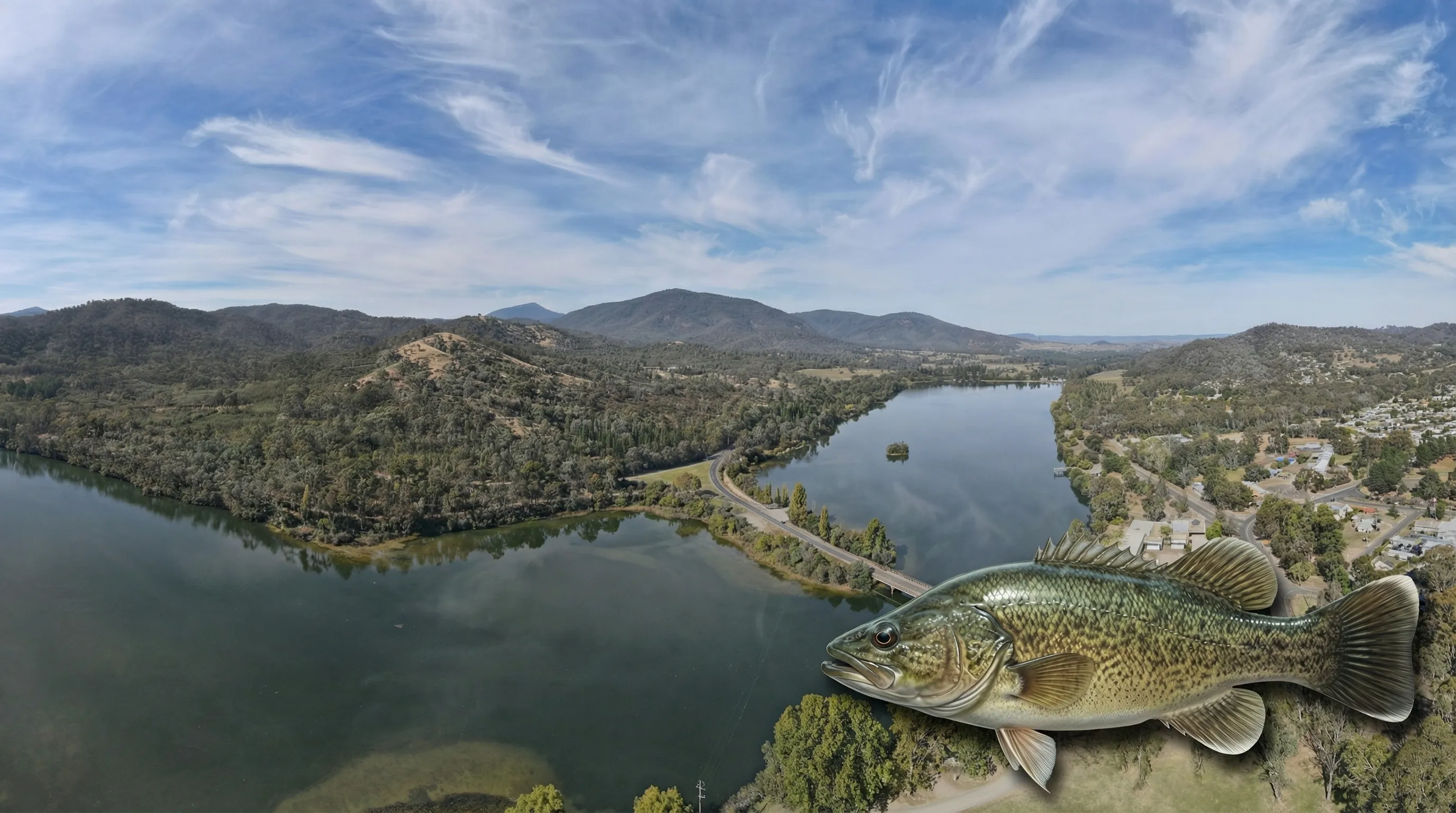
Target Species
Murray Cod
Unlocking the Secrets of Cod Concentration at Eildon
Eildon is one of the best spots for Cod concentration fishing in VIC, offering massive schools of stocked Murray Cod and year-round access to trophy fish in deep timber structure. Anglers targeting this location can expect metre-plus specimens by focusing on the distinct thermoclines and submerged river beds where these predators gather.
Lake Eildon is nothing short of a Victorian fishing mecca. Holding around six times the water volume of Sydney Harbour when full, this inland ocean has become the heart of the state’s “Million Murray Cod” stocking program. For anglers, the challenge isn’t just knowing fish are there; it’s about finding the right Cod concentration across thousands of hectares. Unlike smaller rivers where fish stack up in obvious holes, Eildon’s size means they can be anywhere, yet they reliably group in certain spots based on season, water level, and structure.
The draw of Eildon is the chance at a fish of a lifetime. It’s one of the few places in Australia where landing a metre-long Murray Cod is a real possibility for keen anglers. The lake’s varied landscape—steep rocky bluffs, deep river channels, grassy edges, and sunken timber—creates endless options. But that variety can be overwhelming. Success comes from knowing how to track down the best Cod concentration, which often shifts with the seasons and changing dam levels.
Whether you’re throwing big swimbaits into the timber at first light or trolling deep divers along the rocky points of the Big River arm, Eildon calls for respect and smart tactics. It’s a fishery that rewards patience and local know-how. By learning how to find active Cod concentration, you go from just “washing lures” to targeting hungry, aggressive fish. This guide breaks down the key zones, techniques, and seasonal patterns to turn Lake Eildon’s vast blue waters into your own reliable hunting ground.
Getting There
Cod concentration
Maccullochella peelii
Always check current NSW DPI regulations before fishing. Bag and size limits may change.
Understanding Eildon: Location Intelligence
The highest Cod concentration at Eildon is usually found around submerged standing timber in the Big River and Goulburn arms, as well as along the rocky drop-offs of the main basin where thermoclines hold baitfish.
To successfully target the densest Cod concentration at Lake Eildon, you need to understand just how complex this place really is. It’s not a simple basin of water; it’s a drowned mountain range with a maze of old river beds, creek channels, ridges, and valleys hidden below. The lake draws water from several major rivers—the Goulburn, Delatite, Big, and Jamieson—and each “arm” has its own vibe and fish behaviour.
The Structure of the Lake
The real key to finding solid Cod concentration is structure. Eildon is legendary for its standing timber. When the dam was built and later raised, thousands of trees were left underwater. These ghostly trunks now act as vertical highways for Murray Cod. The fish use them to ambush meals and move up or down with little effort. In the Big River Arm and the Jerusalem Creek area, you’ll find thick patches of timber. Throwing big spinnerbaits or surface lures near these trees at first light is a time-tested move.
But not every tree holds fish. The sweet spots are where timber meets a depth change or contour line. A single tree on the edge of a drop-off into an old river channel is far more likely to hide a trophy than a group of trees on a flat mud flat. This is where modern sonar really helps. Look for the “Christmas trees” on your screen—strong arches hugging the vertical wood.
The Arms vs. The Main Basin
The Delatite Arm is more open, with grassy edges and fewer trees compared to the Big River Arm. It often fishes well for Golden Perch (Yellowbelly), but Cod here are more tied to rocky points and submerged laydowns (fallen logs) rather than upright timber. Trolling deep-diving hardbodies along the steep rocky banks can be very effective.
In contrast, the Main Basin near the dam wall is deep—really deep. Here, the game shifts. Cod often suspend in mid-water, following schools of baitfish (Redfin and Carp) instead of sitting on bottom structure. This “pelagic” style of Murray Cod has become more common in recent years. Anglers using “LiveScope” or similar forward-facing sonar often target these suspended fish in 15 to 30 metres of water, watching their lure get chased in real time.
Water Levels and Thermoclines
Lake Eildon is an irrigation reservoir, so water levels swing a lot. A hot spot one year might be dry land the next. These shifts keep the system alive and changing. When water rises, it floods grassy edges, and Cod often move shallow to feed on worms, grubs, and land-based insects. That’s prime surface fishing time. On the flip side, when levels drop fast, fish usually fall back to the safety of deeper river channels.
Temperature layers, or the thermocline, are another big deal. In summer, the top water warms up while the deep stays cold. There’s a specific zone where they meet—the thermocline—rich in oxygen and comfort for fish. Pinpointing the thermocline depth (often seen as a fuzzy band on your sounder) is the key to summer Cod. If it’s sitting at 8 metres, fishing at 15 might be a waste, as oxygen drops too low.
Location Essentials
When Is the Best Time to Fish for Cod concentration at Eildon?
The best time to target Cod concentration at Eildon is during the low-light periods of dawn and dusk, or well into the night, especially through the warmer months from December to April. While winter gives up trophy fish, the heat of summer and early autumn brings the most action and surface feeding.
Timing your session at Lake Eildon isn’t just about the clock—it’s about reading the conditions. Murray Cod are top predators, and like many apex hunters, they use low light to strike with stealth. You can catch them in the middle of the day—especially trolling deep divers—but your chances jump when the sun goes down.
The Magic of the “Change of Light”
Dawn and dusk are classic peak times. As the sun sets, shadows stretch out from steep banks and standing trees, creating ambush zones that weren’t there an hour ago. This is when the Cod concentration starts moving from deep water into the shallows to feed. If you’re casting lures, this is the time to work the edges of weed beds in the Delatite Arm or the timber lines in the Big River. The “boof”—that sudden gulp of a Cod inhaling a surface lure—is most often heard in this twilight window.
Night Fishing: The Graveyard Shift
For serious Eildon anglers, night fishing is often the most rewarding. Once the weekend boat traffic (wake skiers and jet skis) clears off, the lake calms down, and the big fish start hunting. Large Murray Cod are confident at night. They rely on their lateral line to pick up vibrations. That’s why big, noisy surface paddlers, wakebaits, and chatterbaits work so well in total darkness. The quiet of a night session, broken only by the blast of a surface strike, is something every angler should experience.
Moon Phases and Solunar Influence
Even though Lake Eildon is freshwater and doesn’t have tides, the moon still influences fish through solunar periods. Many local anglers swear by the Full Moon for topwater action. The idea is that moonlight casts a silhouette, making your surface lure stand out. On the other hand, the New Moon (darkest nights) is often better for sub-surface lures like spinnerbaits and swimbaits, where vibration matters most.
Barometric pressure is another major player. A rising barometer, usually ahead of a high-pressure system, can spark a feeding burst. If you see the pressure climb past 1020 hPa, drop everything and get on the water. But if the barometer drops fast, expect the bite to shut down as fish go quiet on the bottom.
Cod concentration Seasonal Calendar
Tide Times
Optimal Tide
Rising Barometer & Solunar Peaks
Tide movement is critical for fish activity. Most species feed actively during tide changes, especially the run-in (incoming) tide.
Detailed hourly tide charts
Official tide predictions
7-day tide calendar
Tide Guide
Best for most species. Fish move in to feed as water rises.
Good for ambush predators. Baitfish get swept out.
Slower bite. Fish less active during slack water.
New/full moon. Bigger tidal range, more fish movement.
Moon Phase & Solunar
Moon phases influence fish feeding behavior. New and full moons create spring tides with stronger currents and increased fish activity.
Best Phases
- New Moon: Peak feeding activity, spring tides, excellent fishing
- Full Moon: Strong tides, night feeding, great for nocturnal species
- 3 Days Either Side: Extended peak period for maximum results
Major/Minor Periods
- Major Periods: Moon overhead/underfoot (2-3 hours)
- Minor Periods: Moon rise/set (1-2 hours)
- Best Times: Major period + dawn/dusk = explosive action
Weather Conditions
Check current conditions before heading out. Wind, swell, and barometric pressure significantly affect fish behavior.
Official forecasts, warnings & radar
Hourly wind speed & direction
Swell height, period & direction
Summer Boat Traffic Strategy
Eildon gets incredibly busy with water skiers in summer. To find the active Cod concentration, fish the “graveyard shift” between 8:00 PM and 2:00 AM, or head far up the Big River arm where speed limits and timber density keep the ski boats away.
What Tackle Do You Need for Cod concentration at Eildon?
You need heavy, reliable tackle for Eildon Cod concentration; specifically a 6-10kg baitcaster setup for casting accuracy in timber, or a medium-heavy spin rod for bait fishing, spooled with minimum 30lb braid and 40lb fluorocarbon leader to handle abrasive structures.
When targeting the Cod concentration at Eildon, you’re stepping into a gunfight. These fish are powerful, dirty fighters that live in “snag city.” Hook a metre-plus cod near standing timber on light gear, and the fight’s over before it starts. The fish will wrap you around a tree in seconds. So your tackle must focus on power and abrasion resistance, not finesse.
Rod Selection: The Baitcaster Advantage
For casting lures, a baitcaster is the go-to tool. A rod in the 6’0” to 7’6” range with a rating of 6-10kg (medium-heavy) or even 10-15kg (heavy) for big swimbaits works best. The baitcaster gives you pinpoint accuracy, letting you drop a spinnerbait millimetres from a tree trunk where cod are holding. For swimbaiting, longer rods (7’6” to 8’0”) help launch heavy lures further, covering more water.
For bait fishing from the bank or boat, a shorter, sturdy spin rod or overhead rod does the job. You want a sensitive tip to feel the first tap, but serious backbone in the butt to turn the fish’s head away from cover.
Reels and Line: The Winch
Your reel needs a strong drag that can apply 6kg+ of pressure. For baitcasters, 300 or 400 size reels (like a Shimano Tranx or Daiwa Tatula) are ideal. If you run spin gear, go for a 4000 or 5000 size to manage the heavy line.
Main Line: Don’t go light. 30lb braid is the bare minimum, but most swimbait anglers run 50lb to 80lb braid. Heavier braid isn’t just about strength — the thicker diameter helps control backlashes on baitcasters and gives you a better chance when rubbing through timber.
Leader: This is your lifeline. Use 40lb to 60lb Fluorocarbon. It’s nearly invisible underwater and, more importantly, tough against scrapes. When a cod bites, it’ll often bolt straight into the nearest snag. Your leader has to survive being dragged over sunken eucalypt branches and granite rock. For giant swimbaits, some anglers step up to 80lb leader.
Terminal Tackle
Don’t skimp on the small stuff. Cheap split rings and hooks won’t last against a big Eildon cod. Swap out factory trebles on hardbody lures for 4x strong hardware. If bait fishing, use chemically sharpened circle hooks or “suicide” patterns in sizes 5/0 to 8/0.
For more tackle basics, see our tackle essentials guide.
Complete Tackle Specifications
| Component | Specification |
|---|---|
| Casting Rod | 7ft Medium-Heavy Baitcaster, 6-10kg |
| Swimbait Rod | 7'6"-8ft Heavy Baitcaster, 10-25kg |
| Reel | 300-400 size Baitcaster or 4000-5000 Spin |
| Main Line | 30-50lb PE Braid (High Vis for sighting) |
| Leader | 40-60lb Fluorocarbon (1.5m length) |
| Hooks (Bait) | 5/0 - 8/0 Suicide or Circle Hooks |
| Lure Clips | Size 4-5 Heavy Duty Snaps (No swivels on clips) |
| Sinker | Running sinker or Paternoster (size varies by depth) |
How Do You Rig for Cod concentration?
The most effective rig for bait fishing Cod concentration is a Paternoster rig to keep baits visible above the silt and mud, while lure anglers should use a “Lefty’s Loop” knot or a high-quality snap to ensure maximum action from swimbaits and hardbodies.
Rigging for Eildon cod depends mostly on whether you’re using bait or casting lures. The lake bed at Eildon is often silty or covered in rotting weed. With a standard running sinker rig, your bait can sink into the gunk and vanish from sight.
For bait fishing, the Paternoster Rig is the better choice. With the sinker on the bottom and the hook coming off the main line 30-50cm above, your bait (yabby or grub) stays up in the strike zone, waving in the current to grab attention.
For lure anglers, your knot matters. Never tie a tight “granny knot” to a lure — it kills the action. Use a Lefty’s Loop (Loop Knot) so the lure moves freely. Or, use a strong, high-quality snap (no swivel) to make changing lures quick and easy.
Building the Perfect Eildon Paternoster
- 1
Prepare Leader Material
Cut a 1.5-metre length of 40-50lb fluorocarbon leader. This material is stiff and resists tangling.
- 2
Create the Sinker Loop
Tie a double overhand loop at the very bottom of the leader. This is where your sinker will attach.
- 3
Form the Dropper Loop
About 40-50cm up from the sinker, create a dropper loop. This loop should be about 10-15cm long when finished.
- 4
Attach the Hook
Feed the dropper loop through the eye of a 6/0 Circle Hook, then loop it over the hook point and pull tight. This avoids knots that can weaken the line.
- 5
Connect to Main Line
Tie a high-strength swivel to the top of the leader using a Uni Knot. This connects to your braided main line.
- 6
Add Weight
Attach a bomb sinker (1-3oz depending on depth) to the bottom loop. If you get snagged, the sinker loop is often the weakest point, saving your rig.
- 7
Bait Up
Hook your yabby through the tail or scrub worms in a bunch. You are now ready to drop.
What Bait Works Best for Cod concentration?
The best baits for Cod concentration at Eildon are Bardi Grubs and large Yabbies, which are natural food sources that withstand the attention of smaller nuisance fish; scrub worms and cheese are effective alternatives, particularly after rain.
While lures get the glory, bait often gets the fish, especially when the bite is tough. The Cod concentration at Eildon is well-educated, but they rarely refuse a well-presented natural offering. The key is matching the hatch and making sure your bait is big enough to draw in a large predator while surviving the pecking of small carp and roach.
Bardi Grubs are the gold standard. These large, white moth larvae are like candy to Murray Cod. They release a strong scent and have a texture fish hold onto. They’re expensive and hard to find, but for a trophy fish, they’re worth the effort.
Yabbies are the most versatile bait. A live yabby waving its claws is a trigger for aggressive strikes. Use medium-to-large yabbies (10–15cm). To make them even more effective, some locals remove one claw, making the yabby look injured and easier to eat.
Cheese is an old-school favourite that still works, particularly “Mozzarella” or specialised cod cheese blocks. It stays on the hook well and releases a scent trail. It’s often used with a Bardi Grub (the “Cocktail”) to protect the pricey grub.
Bait Performance Analysis
| Bardi Grubs | Live Yabbies | Scrub Worms | |
|---|---|---|---|
| Effectiveness Rating | 10/10 (Excellent) | 9/10 (Excellent) | 7/10 (Good) |
| Durability on Hook | Low (Soft) | High (Hard Shell) | Low |
| Scent Dispersion | High | Medium | High |
| Availability | Low (Seasonal) | High | High |
| Best Use Conditions | Targeting Trophy Fish | Active Feeding Periods | Rising Water Levels |
Bait Preservation Tip
Keep your yabbies cool and moist, not submerged in deep water without oxygen. A bucket with damp hessian or fresh gum leaves keeps them lively for days. A lively yabby catches fish; a dead one catches carp.
How Do You Catch Cod concentration at Eildon?
To catch Cod concentration at Eildon, cast spinnerbaits or swimbaits tight against standing timber and rocky points, allowing the lure to sink into the strike zone before a slow roll retrieve; alternatively, troll large hardbody lures at 5–10 metres depth along the river channel edges.
Catching fish at Eildon takes a mix of precision, patience, and aggression. The “chuck and chance it” method rarely works here. You need to picture what your lure is doing below the surface and how it moves around the Cod concentration holding in the structure.
Casting Strategy: “In the Kitchen”
Murray Cod are ambush predators. They sit deep inside the structure—under the log, in the root ball, or right against the rock face. To get a bite, you need to put your lure “in the kitchen.” That means casting accuracy is everything.
- The Approach: Use your electric motor to position the boat 15–20 metres from the bank or timber.
- The Cast: Aim past the target if possible, or drop your lure straight down the face of a tree.
- The Sink: This is the most important part. Let your spinnerbait or swimbait free-fall to the bottom or target depth. Watch your line closely. Many hits happen on the drop. If the line stops or twitches, strike right away!
- The Retrieve: Slow is usually better. A “slow roll”—just fast enough to spin the blades or swim the lure—keeps it in the strike zone longer. Bump the timber. If you aren’t getting snagged now and then, you aren’t close enough.
Trolling: Covering Water
Trolling is the best way to find scattered fish or explore new ground.
- Follow the Contour: Don’t just run straight. Track the 6-metre, 8-metre, or 10-metre contour line. This keeps your lure in the sweet spot.
- Lure Selection: Use large, deep-diving hardbodies (like AC Invaders or StumpJumpers) that dive deeper than the water you’re fishing. You want the lure to “plough” the bottom now and then, kicking up mud and bouncing off rocks. That erratic action fires up strikes.
- Use a Lure Retriever: You will get snagged. A heavy lure retriever on a cord is essential to save your expensive lures.
The Strike and Fight
The bite of a Murray Cod is unmistakable. It’s a sudden, powerful “thump.”
- Sub-Surface: When you feel the weight, strike hard! You need to drive thick hooks into a tough, bony mouth.
- Surface: If fishing topwater, wait. When you hear the “boof,” don’t strike. Wait until you feel the fish on the rod, then strike. Striking at the sound often pulls the lure free.
- The Battle: Once hooked, the fish will make for cover (the snag). You can’t give any line. Press your thumb on the spool if needed and pull hard. Turn the fish’s head fast. If it gets a run towards the timber, you’ll likely lose it.
For more on fighting techniques, read our fishing techniques guide.
What Are the Rules for Fishing at Eildon?
Fishing at Eildon is governed by Victorian Fisheries regulations, which currently enforce a slot limit for Murray Cod (usually 55cm to 75cm) and a closed season from September to November, though Lake Eildon specifically has been open year-round in recent years—always verify the latest “Victorian Recreational Fishing Guide” before casting.
Lake Eildon is a high-profile fishery, and Fisheries Officers patrol it regularly. Ignorance of the rules is not a valid defence. Regulations are in place to ensure the sustainability of the “Million Murray Cod” program and to protect the trophy breeders.
Key Regulations (Verify with VFA)
- Recreational Fishing Licence (RFL): You must hold a valid Victorian RFL unless exempt (e.g., under 18, over 70, or holding certain concession cards).
- Bag and Size Limits:
- Murray Cod: Typically, there is a “slot limit.” This means you can only keep fish within a specific size range (e.g., 55cm to 75cm). Fish smaller than the minimum or larger than the maximum must be released immediately. The bag limit is usually very low (1 or 2 fish).
- Golden Perch: Have their own bag and size limits.
- Carp: Are a noxious pest. If caught, they must not be returned to the water. They must be killed humanely and disposed of continuously.
- Closed Season: Historically, Murray Cod have a closed season (Sept-Nov) to protect spawning fish. However, Lake Eildon has often been exempt from this closure in recent years due to its status as a stocked impoundment where natural recruitment is low. Crucial: Check the current year’s guide to confirm if the closed season applies to Eildon.
Conservation and Handling
If you catch a trophy cod (over the slot limit), it is a breeder. Treat it with respect.
- Keep it Wet: Minimise time out of the water.
- Support the Body: Never lift a large cod by the jaw (lip grips) vertically. This can damage their spine and internal organs. Support the belly horizontally.
- Proper Release: Hold the fish in the water facing the current (or move it gently forward) until it kicks away strongly.
For more on legal requirements, check our regulations guide.
Critical Safety Considerations
Submerged Timber: Eildon is full of standing trees just below the surface. At high speed, these are deadly. Always navigate with caution, especially outside marked channels. Night Navigation: Fishing at night is productive but dangerous. Use spotlights and navigate slowly. Cold Water: In winter, water temperatures drop significantly. Always wear a life jacket, especially when fishing alone. Snakes: In summer, Tiger Snakes and Brown Snakes are common on the banks and can swim to boats. Watch your step.
Your Questions About Cod concentration Fishing at Eildon
What is the best time to fish at Eildon?
The best time to fish at Eildon is generally early morning (dawn) and late evening (dusk) throughout the year, with the warmer months of December through April offering the most consistent action for active fish. While "peak fishing hours" are traditionally low-light periods, winter fishing (June-August) can produce the biggest fish during the middle of the day. In summer, the heat often shuts fish down between 10 AM and 4 PM, making night fishing the superior option.
Is Eildon suitable for beginners?
Eildon is considered an intermediate-to-advanced fishery because locating fish in such a vast waterway can be difficult for novices without local knowledge or electronics. However, it can be "beginner friendly" if you target Golden Perch (Yellowbelly) or Redfin using bait (worms/yabbies) around the trees. Targeting trophy Murray Cod requires patience and specific casting skills that might frustrate a complete novice. Hiring a local guide for a day is the best way to fast-track the learning curve.
Do I need a boat to fish at Eildon?
While a boat significantly improves your access to prime structure and remote arms, land-based fishing is very viable at Eildon, particularly around the camping grounds at Fraser National Park and Jerusalem Creek. Shore fishing can be productive if you focus on steep banks where deep water is close to the shore. Long casts with bait or walking the banks casting spinnerbaits work well. Kayak fishing is also hugely popular here and offers a stealthy approach to the timber.
Where are the best specific spots at Eildon?
The best specific spots for Cod concentration include the Big River Arm for heavy timber, the Goulburn Arm for river channel drop-offs, and the rocky points around the Dam Wall for deep-dwelling fish. "Hot spots" change with water levels.
Quick Info
- Location
- Lake Eildon
- Region
- Goulburn Valley, VIC
- Coordinates
- -37.2167, 145.9167
- Difficulty
- intermediate
- Target Species
- Murray Cod
Conditions
Check local weather and tide conditions before heading out.