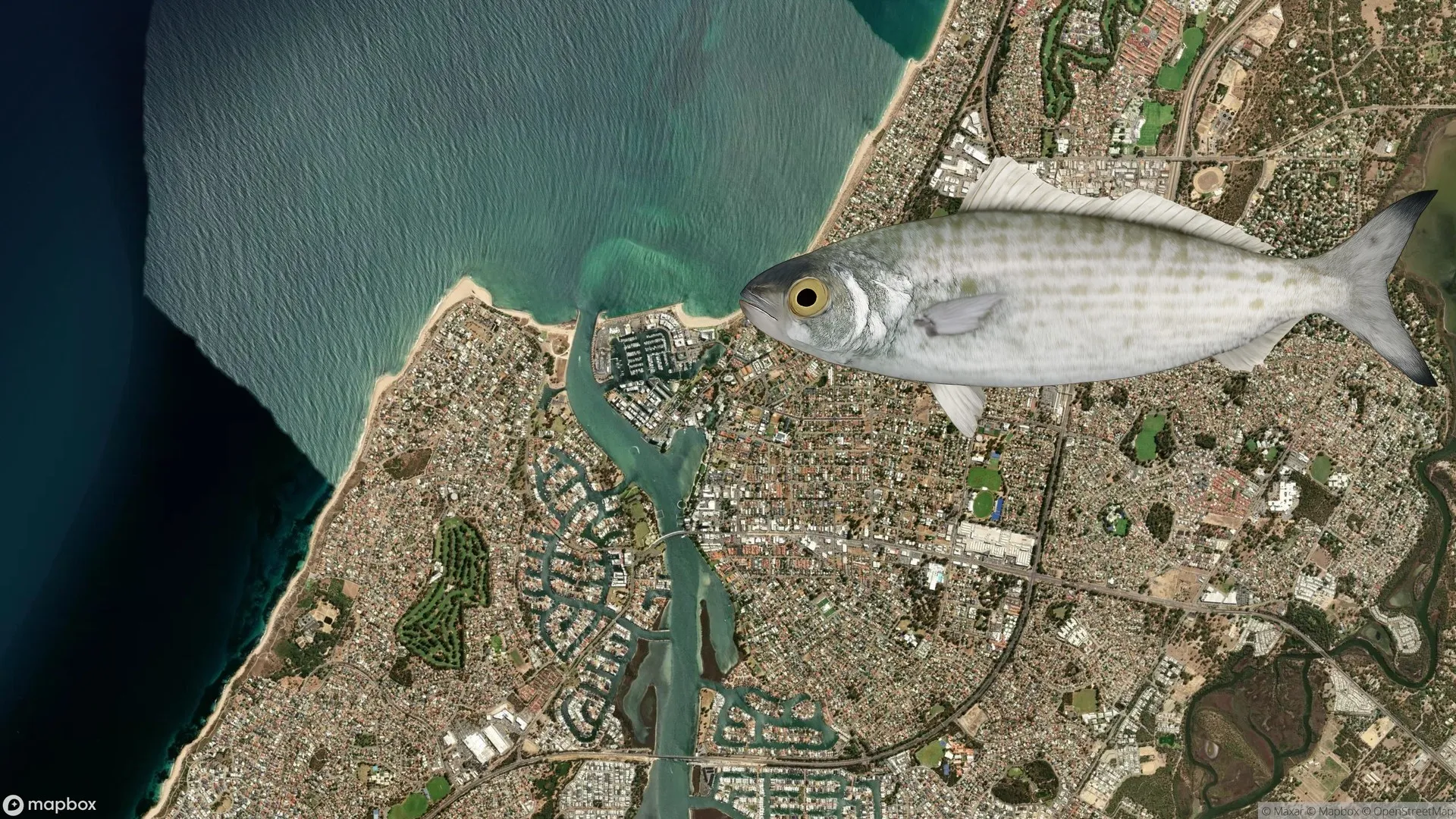
Target Species
Australian Herring
If there is one fish that defines the West Australian childhood and the weekend angler’s esky, it is the humble Herring (Tommy Ruff). And if there is one place that serves as the spiritual home for chasing these feisty silvers, it is the Mandurah Estuary. Specifically, the main channel sections that wind through the heart of Mandurah offer some of the most accessible, consistent, and enjoyable light tackle sport available in the state.
Mandurah Estuary Main is one of the best spots for Herring fishing in WA, offering sheltered waters with strong tidal flows that concentrate schools of fish near accessible boardwalks and bridges. The combination of deep channels and shallow sand flats creates an ideal feeding ground where anglers can consistently catch bag limits using light tackle and berley.
For many locals and visitors alike, the “Mandurah Herring run” is a calendar event. Unlike the often unpredictable nature of offshore fishing, the estuary provides a relatively safe and comfortable environment where you can refine your skills. Whether you are dangling a line off the boardwalks near the Mandurah Performing Arts Centre, casting near the old bridge pylons, or drifting the channels in a tinny, the action can be frantic when the school moves in.
This guide isn’t just about telling you where the water is; it is about breaking down the specific mechanics of the Mandurah system. We will look at how the massive tidal exchange between the Indian Ocean and the Peel-Harvey inlet drives Herring behaviour, why berley is your absolute best friend in this location, and how to rig up to ensure you aren’t just feeding the blowies. From the specific “blob” floats used by locals to the exact leader lengths that prevent tangles in the current, we are covering it all.
Getting There
Herring
Arripis georgianus
Always check current NSW DPI regulations before fishing. Bag and size limits may change.
Understanding Mandurah Estuary Main: Location Intelligence
Mandurah Estuary Main acts as a massive funnel connecting the Indian Ocean to the Peel-Harvey system, creating a nutrient-rich highway that Herring use to feed on baitfish moving with the tides. The structure provided by bridge pylons, rock walls, and undulating sandbanks offers ambush points for Herring, making them predictable targets for anglers who understand the water movement.
To catch Herring consistently here, you need to understand what makes the Mandurah Estuary “Main” section unique. This isn’t just a static body of water; it is a high-volume tidal highway. The system connects the massive Peel-Harvey Estuary to the Indian Ocean. This means millions of litres of water push in and out with every tide cycle, carrying crab larvae, prawns, whitebait, and nutrients. Herring are opportunistic predators, and they sit in this current like trout in a stream, waiting for food to come to them.
Location Essentials
The Topography of the Bite
The “Main” area generally refers to the stretch of water from the ocean entrance (near the breakwalls), running past the Mandurah Foreshore, under the Old Mandurah Bridge (now a dedicated fishing platform) and the new Estuary Bridge, and into the opening of the Peel Inlet.
The Channels: The centre of the estuary is dredged and deep, allowing for boat traffic. Herring will often school right on the drop-offs—the edges where the shallow sandbanks roll into the deeper channel. If you are boat fishing, sounding out these edges is critical. You aren’t looking for the deepest hole; you are looking for the slope where the current accelerates.
The Bridges: The pylons of the old and new bridges are magnets for fish. They create pressure waves and eddies in the current. Herring love to sit in the “slack” water just behind a pylon, darting out into the current to grab a morsel before retreating. This is why the fishing platforms on the old bridge are so productive; you are dropping your bait vertically into their living room.
The Weed Beds: Interspersed with the sand are patches of ribbon weed and seagrass. These hold the shrimp and small invertebrates Herring graze on. When the tide is high and the current is slower, Herring will often disperse over these weed beds. Casting a small lure or a drifting bait over the top of the weed (without snagging it) is a deadly technique here.
Seasonal Movements
While Herring can be caught year-round in Mandurah, their behaviour shifts. In Autumn, the famous “run” occurs. This is when larger schools of mature fish enter the estuary to spawn or feed aggressively before winter. During this time, the fish are often larger and more competitive, meaning you can get away with slightly heavier leaders or larger baits.
In Spring, you often see an influx of juvenile fish mixed with the adults. This is when size selection becomes important. You might catch twenty undersize fish for every “keeper.” Using slightly larger hooks (like a #6 or #4 long shank) can help filter out the tiny ones that tend to swallow smaller hooks deep.
The “Burley” Factor
You cannot discuss location intelligence in Mandurah without mentioning berley (chum). Because the estuary is a large expanse of water, the fish can be spread out. Berley is the tool that concentrates them. In the
Mandurah Estuary, berley is the dinner bell. When the tide is running, a consistent trail of pollard and fish oil creates a scent corridor that draws fish from downstream up to your position. Without it, you are relying on a fish randomly bumping into your bait. With it, you are creating a feeding frenzy. The “Main” estuary channel is particularly suited to this because the flow distributes the scent quickly. Just remember: a little and often is better than a bucket all at once.
When Is the Best Time to Fish for Herring at Mandurah Estuary Main?
The best time to fish for Herring at Mandurah Estuary Main is during dawn and dusk when low light conditions encourage fish to feed aggressively near the surface. Specifically, the rising tide (incoming) pushing clean ocean water into the estuary triggers the most consistent bite, particularly during the Autumn annual run (March to May).
Timing your run to Mandurah isn’t just about showing up; it’s about syncing with the rhythm of the estuary. While Herring are famously cooperative, they can be frustratingly finicky if the conditions are wrong. The interplay between light, tide, and season dictates whether you fill your bucket or go home with donuts.
The Tidal Influence
In the Mandurah system, the tide is everything. The estuary is essentially a giant lung, breathing in from the ocean and exhaling from the Peel Inlet.
- The Incoming (Rising) Tide: This is generally the premium time for Herring. Cool, oxygenated, nutrient-rich saltwater pushes in from the ocean, bringing schools of fish with it. The water clarity usually improves, and the fish feel safer pushing up onto the sand flats and around the bridge pylons.
- The Turn: The absolute peak bite often occurs 30 minutes either side of the high tide change. As the raging current slows down, the water becomes “slack.” This is when berley is most effective because it hangs in the zone rather than washing away at 5 knots. Herring often go into a frenzy during this brief window.
- The Outgoing (Falling) Tide: Still productive, but often brings dirtier water from the inlet. You can still catch them, but you may find more “blowies” (blowfish) becoming a nuisance as the water dirties up.
Dawn, Dusk, and the “Change of Light”
Herring are visual hunters with large eyes. They love low-light conditions.
- Dawn: Arriving 30 minutes before sunrise is the strategy of the serious local. The water is usually calmest, the boat traffic hasn’t started, and the Herring are often feeding right on the surface. You will frequently see “boils” or ripples where schools are harassing baitfish.
- Dusk: The afternoon sea breeze (the “Fremantle Doctor”) can make the estuary choppy, but as the sun dips, the wind often drops. This evening changeover is fantastic, especially around the illuminated sections of the bridges.
- Night Fishing: Unlike some species that shut down, Herring in Mandurah will feed at night, especially around artificial light. The lights from the traffic bridge and the boardwalks attract moths, prawns, and baitfish. Herring patrol the shadow lines—the border between the light and the dark—ambushing prey.
Herring Seasonal Calendar
Tide Times
Optimal Tide
Incoming tide, ideally peaking around sunrise or sunset
Tide movement is critical for fish activity. Most species feed actively during tide changes, especially the run-in (incoming) tide.
Detailed hourly tide charts
Official tide predictions
7-day tide calendar
Tide Guide
Best for most species. Fish move in to feed as water rises.
Good for ambush predators. Baitfish get swept out.
Slower bite. Fish less active during slack water.
New/full moon. Bigger tidal range, more fish movement.
Moon Phase & Solunar
Moon phases influence fish feeding behavior. New and full moons create spring tides with stronger currents and increased fish activity.
Best Phases
- New Moon: Peak feeding activity, spring tides, excellent fishing
- Full Moon: Strong tides, night feeding, great for nocturnal species
- 3 Days Either Side: Extended peak period for maximum results
Major/Minor Periods
- Major Periods: Moon overhead/underfoot (2-3 hours)
- Minor Periods: Moon rise/set (1-2 hours)
- Best Times: Major period + dawn/dusk = explosive action
Weather Conditions
Check current conditions before heading out. Wind, swell, and barometric pressure significantly affect fish behavior.
Official forecasts, warnings & radar
Hourly wind speed & direction
Swell height, period & direction
The 'Wind Lane' Advantage
In Mandurah, don’t hate the wind—use it. When a light breeze creates a “ripple” on the water surface, it refracts light and makes the Herring feel safer from overhead predators (birds). A glassy calm day can actually be too clear, making the fish flighty. Look for areas where the wind pushes water against a structure or current line; food gathers there, and so do the Herring.
What Tackle Do You Need for Herring at Mandurah Estuary Main?
The ideal tackle for Herring at Mandurah is a light spinning outfit: a 7-9ft rod rated for 2-5kg line, paired with a 2500-size reel. Spool up with 6-10lb braid for casting distance and sensitivity, and use a 1.5m leader of 10-15lb fluorocarbon to withstand the Herring’s abrasive teeth while remaining invisible in the clear estuary water.
Herring are a sportfish in miniature. They jump, they shake their heads, and they run hard for their size. To truly enjoy the experience—and to catch more fish—you need to scale your gear down. Using a heavy surf rod here is like using a sledgehammer to crack a walnut; you’ll miss bites and lose the fun.
The Rod: Length Matters
For shore-based angling at Mandurah (jetties, rock walls, boardwalks), a slightly longer rod is advantageous. A 7ft to 9ft light spin rod is perfect.
- Why the length? It helps you steer fish around pylons and, crucially, allows you to lift the fish out of the water if you are on a high boardwalk (like the new bridge fishing platforms).
- Action: You want a rod with a soft, sensitive tip (“fast action”). Herring have soft mouths. A stiff rod will rip the hook out when they thrash. A soft tip absorbs the shock of their frantic head shakes.
The Reel and Line
A 2500 to 3000 size spinning reel is the sweet spot. You don’t need a massive drag system, but it should be smooth.
- Main Line: Braid is superior to monofilament here. 6lb to 10lb braid cuts through the strong Mandurah current better than thick mono, allowing your bait to sink naturally. It also offers zero stretch, meaning you feel the subtle “tap-tap” of a Herring inhaling the bait instantly.
- Leader: This is non-negotiable. You must run a leader. 10lb to 15lb Fluorocarbon is ideal. Herring have small, sandpaper-like teeth that can wear through super-light line, and the estuary water can be crystal clear. Fluorocarbon is invisible underwater and abrasion-resistant.
For more detailed information on setting up your gear, check out our tackle basics guide.
Complete Tackle Specifications
| Component | Specification |
|---|---|
| Rod | 7-9ft Light Spin, 2-5kg rating |
| Reel | 2500-3000 size spin reel |
| Main Line | 6-10lb PE Braid (high vis helps track drift) |
| Leader | 10-15lb Fluorocarbon (1.5m length) |
| Hooks | #6 or #8 Long Shank (chemically sharpened) |
| Sinker | Usually none (weighted float provides casting weight) |
| Swivels | Size 10-12 barrel swivels (black) |
| Float | Weighted 'Blob' float or clear bubble float |
How Do You Rig for Herring?
The most effective rig for Herring in Mandurah is the Weighted Float Rig (Blob Rig). This setup uses a weighted float to provide casting distance, followed by a 1.5-metre leader to a small unweighted hook. This allows the bait to drift naturally in the upper water column where Herring feed, while keeping it above the weed and the nuisance blowfish on the bottom.
While you can catch Herring on a standard paternoster rig (sinker on bottom, hooks above), the Float Rig is the king of the estuary. Why? Because Herring are top-to-mid-water feeders. If your bait is on the bottom, you are in “Blowie Country.” The float keeps your bait suspended in the strike zone and gives you a visual indicator of the bite.
The Mechanics of the “Blob”
The “Blob” is a specific type of weighted float popular in WA. It looks like a small, white or red plastic egg. It has enough weight built-in to cast 30-40 metres, but it floats.
- The Drift: The key is that the bait (trailing behind the float) sinks slowly. It looks like a natural piece of food washing down the current.
- The Strike: When a Herring grabs the bait, the float might dip, or more commonly, it will skate sideways across the surface.
Building the Perfect Weighted Float Rig
- 1
Attach the Float
Thread your main line (braid) through the top of the weighted float. Some blobs slide on the line, others tie directly. If it's a slider, add a small bead below it to protect the knot.
- 2
Tie the Swivel
Tie a small Size 10 or 12 barrel swivel to the end of your main line using a Uni Knot or Improved Clinch Knot. This acts as a 'stopper' for the float.
- 3
Measure the Leader
Cut a piece of 10-15lb fluorocarbon leader. Length is critical: it needs to be roughly 1.5 metres. Too short, and the fish see the float. Too long, and it's hard to cast.
- 4
Tie Hook to Leader
Attach your #6 or #8 Long Shank hook to one end of the leader using a Clinch Knot. Ensure the knot is tight and the tag end is trimmed.
- 5
Connect Leader to Swivel
Tie the other end of the leader to the free end of the barrel swivel. You now have: Main Line > Float > Swivel > 1.5m Leader > Hook.
- 6
Bait Up
Thread your bait (maggot, piece of prawn, or blue bait) onto the hook. Ensure the hook point is exposed—Herring strike fast, and you need immediate penetration.
- 7
The 'Split Shot' Tweak
If the current is ripping very hard, crimp a tiny split-shot sinker halfway down the leader. This helps the bait get down if the water is moving too fast for a natural sink.
What Bait Works Best for Herring?
The most effective baits for Herring at Mandurah are maggots (wogs), blue sardines (blue bait), and prawn pieces. Maggots are particularly effective because they are tough, stay on the hook during casting, and mimic the small larvae found naturally in the estuary system.
In Mandurah, bait selection is a trade-off between “attraction” and “durability.” Herring are pickers. They will strip a soft bait in seconds without hooking up. This is why local knowledge points towards tougher baits or specific cuts.
The “Wog” (Maggot) Advantage
It might sound unappealing to the uninitiated, but live maggots (often sold as “wogs” in WA tackle shops) are the gold standard for estuary Herring.
- Durability: You can catch 3, 4, or even 5 fish on a single maggot. They are incredibly tough.
- Presentation: They wiggle. That subtle movement on a drifting hook is irresistible.
- Size: They match the hatch perfectly.
Other Top Contenders
If you can’t stomach the maggots, Blue Bait (Blue Sardines) are excellent but soft. The trick is to use them while they are still semi-frozen or salt them down the night before to toughen the flesh. Prawns (river prawns or coral prawns) are fantastic but expensive and soft; peel them and use small chunks about the size of a fingernail.
Bait Performance Analysis
| Maggots (Wogs) | Blue Bait | Prawn Pieces | Squid Strips | |
|---|---|---|---|---|
| Effectiveness Rating | 5/5 - Excellent | 4/5 - Very Good | 4/5 - Very Good | 3/5 - Good |
| Durability on Hook | High - Multiple fish per bait | Low - Strips easily | Low - One hit wonder | High - Very tough |
| Scent Dispersion | Low - Visual/Movement based | High - Very oily | Medium - Sweet scent | Low - Needs movement |
| Availability | Tackle shops only | Most tackle/servo shops | Grocery/Tackle stores | Widely available |
| Best Use Conditions | Fast currents & competitive schools | Slower water where scent helps | Fussy fish that need enticing | When blowfish are stealing soft baits |
The Secret Sauce: Berley Cages
If you want to double your catch rate, swap your standard “blob” float for a Berley Cage Float. These are weighted floats with a small cage built into them. You pack the cage with a pollard and fish oil mix. Every time you cast, you are delivering a fresh burst of scent right next to your hook. In the Mandurah channels, this is absolute dynamite.
How Do You Catch Herring at Mandurah Estuary Main?
To catch Herring at Mandurah, cast your float rig 45 degrees uptide (into the current) and allow it to drift naturally past you while maintaining a semi-tight line. Use a slow, erratic retrieve with small rod twitches to mimic injured prey, and strike immediately upon feeling a sharp tap or seeing the float skate sideways.
Success in the Mandurah Estuary comes down to technique. You can have the best gear and bait, but if you present it unnaturally, the Herring will ignore it. The water here is often clear, and the fish are smart.
The “Drift and Twitch” Technique
The biggest mistake beginners make is casting out and leaving the rod in a holder, or winding in too fast like they are chasing tailor. Herring require finesse.
- Cast Upttide: Look at which way the water is moving. Cast your float about 45 degrees into the current.
- Manage the Slack: As the float drifts towards you, wind in just enough line to keep in contact with the float. You don’t want to drag it against the current; you want it to flow naturally.
- The Twitch: Every 3 to 5 seconds, give the rod tip a sharp, short flick (a twitch). This causes the bait to jump and then flutter down. This triggers the predatory instinct of the Herring. They usually hit on the “flutter” (the pause).
- The Strike: Herring bites are fast. You will feel a “rat-a-tat-tat” vibration. Don’t wait. Lift the rod tip firmly (but not violently) to set the hook. If you are using circle hooks, just wind fast; if using J-hooks or Long Shanks, a strike is necessary.
Dealing with the “Blowie” Plague
The Mandurah Estuary is famous for its Blowfish (Torquigener pleurogramma). They are bait thieves and line cutters.
- Keep it Moving: Blowies are lazy. Herring are fast. If you keep your bait moving with a slow retrieve, the Herring will beat the blowies to it.
- Fish Higher: If you are getting plagued by blowies, your bait is likely too deep. Shorten your leader to 1 metre or even 80cm to keep the bait closer to the surface where the Herring school.
- Check Your Hook: Blowies can bite through hooks or crush barbs. Check your hook point regularly to ensure it’s still sharp.
Landing the Fish
If you are fishing from the Old Bridge platforms or the boardwalks, you are elevated above the water.
- Don’t “High Stick”: When lifting a fish, don’t point the rod straight up at the sky. This puts maximum pressure on the fragile tip section. Keep the rod at a 45-degree angle and lift smoothly.
- The Swing: Swing the fish over the rail in one smooth motion. If you hook a monster (30cm+), you might need a long-handled landing net, but for most Herring, a confident lift is fine.
- Handling: Herring lose scales easily. If you are releasing them, handle them with wet hands or a wet cloth. If you are keeping them, dispatch them immediately (iki jime or cervical dislocation) and get them on ice. Herring flesh goes mushy very quickly if left in the sun.
What Are the Rules for Fishing at Mandurah Estuary Main?
Mandurah Estuary is part of the West Coast Bioregion. As of current regulations, the daily bag limit for Herring is 12 per angler. While there is no statutory minimum size limit, ethical anglers typically release fish under 20cm. Always check the official Department of Primary Industries and Regional Development (DPIRD) rules before fishing.
Fishing in Mandurah is heavily regulated to ensure sustainability, and Fisheries officers patrol the boardwalks and bridges frequently. Ignorance is not a valid defence.
Key Regulations (West Coast Bioregion)
- Bag Limit: The daily bag limit for Australian Herring is currently 12. This is a mixed species bag limit reduction that was introduced to help stocks recover.
- Size Limit: There is currently no legal minimum size for Herring, but the “unwritten rule” among locals is 20-22cm. Fish smaller than this are mostly head and bone and are best returned to grow.
- Licence: You do not need a recreational fishing licence for shore-based fishing in the estuary. However, if you are fishing from a boat (powered), you must hold a Recreational Fishing from Boat Licence (RFBL).
- Crabbing: If you decide to scoop for Blue Swimmer Crabs while fishing (common in Mandurah), strict size limits (127mm) and bag limits apply.
For the most up-to-date rules, always verify with our fishing regulations guide or the official WA Fisheries website.
Critical Safety Considerations
- Slippery Surfaces: The lower boardwalks and rock walls near the bridge can be incredibly slippery with algae and slime. Wear shoes with non-slip grip (cleats are recommended for rocks).
- Strong Currents: The tidal flow under the bridges is powerful. Do not attempt to swim or wade in the deep channels. If you drop gear in, let it go.
- Stingers: Cobbler (catfish) inhabit the bottom of the estuary. They have venomous spines. If you hook a fish with whiskers, handle with extreme caution or cut the line.
- Pedestrians: The boardwalks are shared zones. Always check behind you before casting to avoid hooking a cyclist or jogger.
Your Questions About Herring Fishing at Mandurah Estuary Main
When is the absolute best time to fish at Mandurah Estuary Main?
The peak fishing window is during the incoming tide, specifically the two hours leading up to high tide, combined with dawn or dusk. While you can catch fish all day, the "change of light" triggers feeding frenzies. If you can align a sunrise with a high tide, you are in for a red-letter session. Mid-day fishing can be slower and is often plagued by blowfish.
Is Mandurah Estuary Main suitable for beginners?
Yes, it is one of the most beginner-friendly fishing spots in Western Australia due to its easy access, safe platforms, and abundance of aggressive fish. The infrastructure—flat boardwalks, railings, and parking—makes it perfect for learning. You don't need to rock hop or cast 100 metres. It is an ideal classroom for teaching kids the basics of casting and bite detection.
Do I need a boat to fish at Mandurah Estuary Main?
No, a boat is not required. The land-based fishing options at boardwalks, jetties, and bridge platforms provide excellent access to deep water where herring school. Many anglers prefer shore-based fishing as it allows easy access to prime spots without the hassle of launching.
Quick Info
- Location
- Mandurah Estuary
- Region
- Peel, WA
- Coordinates
- -32.5269, 115.7217
- Difficulty
- beginner
- Target Species
- Australian Herring
Conditions
Check local weather and tide conditions before heading out.