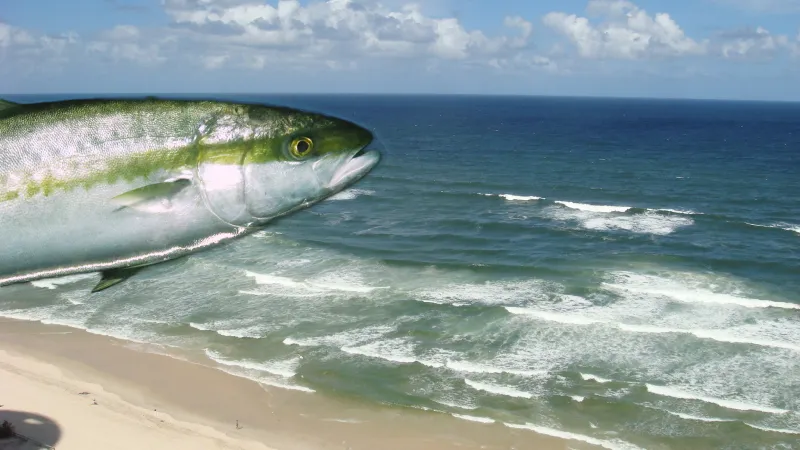
Target Species
Yellowtail Kingfish
Yellowtail Kingfish fishing at Gold Coast Offshore is a premier blue-water experience, offering anglers access to hard-fighting pelagics around deep reef structures, gravel beds, and fish aggregating devices. This offshore fishery is famous for its hard-pulling reef dwellers that test your tackle, physical endurance, and boat positioning skills.
The offshore waters of the Gold Coast represent a dynamic meeting point of warm northern currents and cooler southern flows. This unique marine intersection creates a highly productive environment where baitfish school in massive numbers, attracting apex predators like the Yellowtail Kingfish. Local anglers refer to these fish as the ultimate reef bandits because of their immediate instinct to dive straight back into the sharpest structure the moment they feel the hook. Taming these powerful fish requires a solid understanding of the local underwater topography, specialized heavy tackle, and precise boat control.
Whether you are targeting the smaller, fast-paced school fish on the closer gravel patches or hunting for a trophy-sized hoodlum on the deep-water pinnacles, the Gold Coast offshore grounds provide a thrilling playground. In this guide, you will learn the exact GPS structures to target, how the East Australian Current dictates the bite, the most effective live bait rigs, and the vertical jigging methods that local charter skippers rely on to secure quality catches.
Getting There
Yellowtail Kingfish
Seriola lalandi
Always check current NSW DPI regulations before fishing. Bag and size limits may change.
Understanding Gold Coast Offshore: Location Intelligence
To consistently catch Yellowtail Kingfish off the Gold Coast, you must first understand the complex underwater terrain that shapes this fishery. The seabed here does not drop off gradually. Instead, it is defined by a series of parallel sandstone reef lines running north to south, known locally by their depth in fathoms: the 18s, 24s, 36s, and the deep 50 fathom reefs.
These reef lines act as massive speed bumps for the south-flowing East Australian Current. As this powerful current collides with the steep edges of the reefs and high-relief pinnacles, it forces nutrient-rich water upward. This process, known as upwelling, triggers a massive food chain. Plankton blooms attract vast schools of baitfish, including slimy mackerel, yellowtail scad (yakkas), and flying fish. The Yellowtail Kingfish patrol these pressure waves, waiting on the up-current side of the structure where the bait is forced to stack up.
The shallower reefs, such as the 18-fathom and 24-fathom lines, are located closer to the coast and are characterized by low-lying ledges, gravel patches, and small broken structures. These areas are highly popular for targeting school-sized kingfish, often referred to as rats, which average between 60 and 80 centimetres. While these fish are highly active and provide fast-paced action, they are also heavily targeted by local recreational boats.
For the true giants, you must venture further east to the 36-fathom and 50-fathom reefs, or target the deep-water wrecks scattered across the sandy plains. These deeper reefs feature dramatic pinnacles rising up to 20 metres off the seafloor, creating intense pressure points where massive hoodlums over a metre in length congregate. In these deeper zones, you will also find the offshore Fish Aggregating Devices (FADs). In late summer and autumn, these floating structures hold excellent numbers of kingfish alongside mahi mahi and cobia, offering a fantastic alternative when the bottom bite on the reefs slows down.
Location Essentials
Successful kingfish hunting offshore is entirely dependent on your marine electronics. You should never simply drop your lines on a GPS mark and hope for the best. Instead, use your high-frequency sounder to locate the exact position of the bait schools. Look for dense, tightly packed bait balls that are being pushed into vertical columns or forced hard against the reef edges. The kingfish will appear as large, distinct arches or thick streaks hovering just above or directly inside these bait schools. Once you locate the active fish on the up-current side of the pinnacle, position your boat to drift directly over the strike zone, keeping your presentations completely vertical.
When Is the Best Time to Fish for Yellowtail Kingfish at Gold Coast Offshore?
The best time to fish for Yellowtail Kingfish at Gold Coast Offshore is during the low-light hours of dawn and dusk, especially when these periods coincide with a high-tide change and a moderate current run of 0.5 to 2 knots.
Yellowtail Kingfish are highly active predatory fish that rely on light transitions to ambush their prey. While they can be caught throughout the day, the hour before sunrise and the hour after sunset consistently produce the most intense feeding flurries. During these times, baitfish are often disoriented, making them easy targets around the pinnacles and reef edges of the 18-fathom and 24-fathom lines.
Tidal movement is another critical factor for offshore success. In the waters east of the Gold Coast, the East Australian Current (EAC) plays a dominant role. A moderate current pushing onto the reef structure creates a pressure edge where bait stacks up. Kingfish will hold on the up-current side of these pinnacles, waiting to intercept food. If there is no current run, the bite will often shut down completely. Conversely, a raging current of over 3 knots makes it nearly impossible to keep your baits or jigs in the strike zone, meaning you must carefully plan your trips around neap tides or the slack water periods of spring tides.
Seasonally, while kingfish are a year-round prospect off the Gold Coast, the cooler months from late winter through to early summer offer the most consistent action. During late summer and early autumn, you can also find active kingfish holding wider offshore around the local Fish Aggregating Devices (FADs) alongside other pelagic species like mahi mahi.
Tide Times
Optimal Tide
Run-in tide peaking at dawn or dusk
Tide movement is critical for fish activity. Most species feed actively during tide changes, especially the run-in (incoming) tide.
Detailed hourly tide charts
Official tide predictions
7-day tide calendar
Tide Guide
Best for most species. Fish move in to feed as water rises.
Good for ambush predators. Baitfish get swept out.
Slower bite. Fish less active during slack water.
New/full moon. Bigger tidal range, more fish movement.
Moon Phase & Solunar
Moon phases influence fish feeding behavior. New and full moons create spring tides with stronger currents and increased fish activity.
Best Phases
- New Moon: Peak feeding activity, spring tides, excellent fishing
- Full Moon: Strong tides, night feeding, great for nocturnal species
- 3 Days Either Side: Extended peak period for maximum results
Major/Minor Periods
- Major Periods: Moon overhead/underfoot (2-3 hours)
- Minor Periods: Moon rise/set (1-2 hours)
- Best Times: Major period + dawn/dusk = explosive action
Weather Conditions
Check current conditions before heading out. Wind, swell, and barometric pressure significantly affect fish behavior.
Official forecasts, warnings & radar
Hourly wind speed & direction
Swell height, period & direction
The Current Edge Advantage
Always use your marine electronics to locate the up-current side of the reef or pinnacle. Kingfish almost always hold on this pressure edge where the current first hits the structure, as this is where baitfish are forced to congregate. Position your drift to pass directly over this zone.
Yellowtail Kingfish Seasonal Calendar
What Tackle Do You Need for Yellowtail Kingfish at Gold Coast Offshore?
To successfully target Yellowtail Kingfish offshore from the Gold Coast, you need a heavy-duty spin or overhead outfit rated for PE 3 to PE 6 line, paired with a high-drag reel capable of handling 15 to 20 kilograms of stopping power.
Yellowtail Kingfish are notorious reef-fighters. The moment they are hooked, their immediate instinct is to dive straight back into the sharpest structure available. If you fish too light, you will get reefed and lose your gear almost every time. A standard 30 to 40-pound outfit is rarely enough to stop a decent Gold Coast kingfish on the 24-fathom or 36-fathom reefs.
For jigging and live-baiting, a short, powerful rod of 5 feet to 6 feet in length is ideal. This shorter length gives the angler more lifting power over the fish during a vertical fight. Pair this with a 6000 to 10000 size spin reel or a compact, high-speed overhead jigging reel. Your reel must be spooled with high-quality braid and backed by a smooth, reliable drag system.
Your leader choice is just as critical as your main line. You should use a minimum of 60-pound fluorocarbon, though 80 to 100-pound leader is highly recommended when fishing around heavy structure or deep wrecks. Fluorocarbon offers excellent abrasion resistance against the reef and is less visible in the clear offshore waters. If you are casting surface lures on the shallower reefs like Palm Beach, a longer 8-foot casting rod rated for PE 4 to PE 6 is necessary to launch heavy stickbaits and poppers.
For more information on selecting the right gear for offshore fishing, see our tackle essentials guide.
Complete Tackle Specifications
| Component | Specification |
|---|---|
| Heavy Jigging Rod | 5'0"-5'6" overhead or spin, rated PE 5-8 |
| Heavy Jigging Reel | High-speed overhead or 10000 size spin reel with 15-20kg drag |
| Casting Rod | 7'6"-8'0" heavy-action spin rod, rated PE 4-6 |
| Casting Reel | 8000-14000 size high-speed spin reel |
| Main Line | 50-80lb high-quality color-metered PE braid |
| Leader | 60-100lb fluorocarbon or tough monofilament (1.5-3m) |
| Hooks | 6/0-9/0 heavy-duty inline circle hooks or live-bait hooks |
| Jigs | 150-300g knife jigs or flutter jigs depending on depth and current |
How Do You Rig for Yellowtail Kingfish?
The most effective rig for Gold Coast Yellowtail Kingfish is a heavy-duty live bait leader consisting of a 1.5 to 3-metre length of 80-pound fluorocarbon, a strong 6/0 to 9/0 circle hook, and a heavy-duty barrel swivel to handle the immense twisting force of a fighting fish.
When rigging for kingfish, simplicity and strength are the two most important factors. Every knot must be tied perfectly, as these fish will expose any weakness in your line. The standard live bait rig can be fished either as a simple drift rig with a running ball sinker sitting directly on top of the swivel, or via a downrigger to keep the bait at a specific depth.
Using a circle hook is highly recommended for live-baiting. Kingfish tend to swallow baits quickly, but a circle hook is designed to slide out of the stomach and lock securely into the corner of the fish’s mouth. This not only ensures a solid hookup but also makes it much easier to release the fish unharmed if it is undersized or if you are practicing catch and release. To connect your heavy leader to your braided main line, use an FG knot, which is the slimmest and strongest connection knot available.
For a detailed look at other offshore setups, explore our guide on fishing rigs and master your connections with our guide on fishing knots.
Building the Ultimate Kingfish Live Bait Rig
- 1
Connect Main Line to Leader
Tie a 2-metre length of 80-pound fluorocarbon leader to your braided main line using an FG knot, ensuring the wraps are tight and locked.
- 2
Thread the Sinker
If drift fishing, slide a ball or bean sinker onto your leader. Choose a weight just heavy enough to get the bait down while keeping the line vertical.
- 3
Attach the Swivel
Tie a heavy-duty, crane-style barrel swivel (rated to at least 100 pounds) to the end of your leader using a Uni knot or a San Diego Jam knot.
- 4
Prepare the Hook Leader
Cut a 1.5-metre section of 80 to 100-pound fluorocarbon to act as your hook trace, connecting one end to the open side of the barrel swivel.
- 5
Tie on the Circle Hook
Attach a heavy-gauge 8/0 circle hook to the end of your hook trace using a snell knot or a heavy-duty Uni knot.
- 6
Check the Connections
Pull hard on all connections using gloves or rigging tools to ensure there is no slippage and that the knots have seated perfectly.
- 7
Rig the Live Bait
Gently pass the hook through the hard nose cartilage or just behind the head of your live bait, ensuring you do not damage the spine.
What Bait Works Best for Yellowtail Kingfish?
Live bait is the undisputed king for targeting Yellowtail Kingfish off the Gold Coast, with slimy mackerel, yellowtail scad (yakkas), and live squid being the most reliable and effective options.
While kingfish will occasionally strike dead baits, nothing compares to the vibration and distress signals sent out by a live bait struggling on the hook. Slimy mackerel are considered the premium choice by local Gold Coast anglers. They are highly active, fast swimmers that create a lot of flash and vibration in the water, making them irresistible to passing kingfish.
Yellowtail scad, commonly known as yakkas, are another outstanding option. They are incredibly hardy and can survive for long periods in a live well or on the hook. Live squid are deadly when fished around deep wrecks and pinnacles, especially during the cooler winter months. You can catch your own live bait using sabiki rigs around the bait reefs just outside the Gold Coast Seaway before heading further offshore.
To learn more about gathering and maintaining your bait, check out our bait guide.
Bait Performance Analysis
| Slimy Mackerel | Yellowtail Scad (Yakkas) | Live Squid | |
|---|---|---|---|
| Effectiveness Rating | Excellent | Very Good | Excellent |
| Durability on Hook | Moderate | Excellent | Moderate |
| Scent Dispersion | High | Moderate | High |
| Availability | Seasonal | Year-round | Winter Peak |
| Best Use Conditions | Early morning drift fishing over deep pinnacles | Slow-trolling or downrigging around reef edges | Deep wrecks and vertical jigging zones |
Keeping Your Bait Fresh
Kingfish are highly visual hunters and will ignore sluggish or dying bait. Keep your live well pump running constantly, avoid overcrowding the tank, and handle the bait as little as possible with wet hands when rigging to preserve their protective slime coat.
How Do You Catch Yellowtail Kingfish at Gold Coast Offshore?
Catching Yellowtail Kingfish at Gold Coast Offshore requires a combination of precise vertical jigging, slow-trolling live baits directly over reef pinnacles, and maintaining a vertical line angle in the strike zone.
Success on these hard-fighting pelagics relies heavily on your boat positioning and how you present your offering. Because kingfish hold tightly to structure and pressure waves created by currents, your casting strategy and bait placement must be highly calculated.
Casting Strategy and Bait Placement
When you arrive at an offshore reef like the 24-fathom or 36-fathom line, do not simply drop your lines over the side. Spend time idling over the area and watching your sounder. Look for the up-current side of the reef pinnacle where the moving water forces bait schools to stack up. This pressure edge is where active kingfish patrol.
If you are jigging, position your boat up-current of the structure, shut off or idle the motor, and drop your metal jigs directly down. It is vital to keep your line as vertical as possible. If the East Australian Current causes your line to scope out at a wide angle, your jig will swing away from the reef edge and out of the strike zone. Use heavier jigs, up to 300 grams, to combat fast drifts.
For live-baiting, slow-trolling or drifting is highly effective. Instead of dropping your live slimy mackerel or yakka directly to the bottom where it can easily swim into a crevice and snag, suspend it 5 to 15 metres above the reef. This keeps the bait highly visible to cruising kingfish and gives you a head start when a fish strikes and attempts to run back into the rocks.
Bite Detection and Hookset
Yellowtail Kingfish do not nibble. Whether they hit a fast-moving metal jig or a live bait, the strike is incredibly violent.
When vertical jigging, you will be working the rod in a rapid, rhythmic motion. A bite will feel like your rod has suddenly hit a concrete wall, or occasionally, your line will go completely slack if the fish grabs the jig and swims upward. In either case, wind rapidly to clear any slack and strike firmly upward multiple times to drive the heavy assist hook into the fish’s hard jaw.
When live-baiting with circle hooks, the golden rule is to never strike. When a kingfish takes the bait, the rod tip will bend down slowly before locking up completely. Allow the fish to run for two to three seconds, then simply engage the reel and wind fast. The pressure of the fish pulling against the drag will slide the circle hook to the corner of the mouth and lock it in place.
Fighting and Landing Strategies
The first thirty seconds of a kingfish fight will determine whether you land the fish or get reefed. Kingfish are notorious for diving straight back into the sharpest structure they can find to cut your line.
As soon as the hook is set, keep the rod high and apply maximum pressure. Do not give the fish an inch of line if you can help it. Keep your knees pressed against the gunwale of the boat for stability and use your body weight to lift the fish, winding down rapidly on the drop.
If you feel the line rubbing against structure, do not free-spool. Keep the pressure on and hope your heavy fluorocarbon leader holds. Once you have managed to steer the fish 15 to 20 metres off the bottom, you can settle into a steady rhythm.
When the fish near the surface, they will often make a final, desperate run under the boat. Be prepared to plunge your rod tip into the water to prevent the line from rubbing against the outboard motors or the hull. Use a large, heavy-duty landing net or a gaff to secure the fish, ensuring you lift it cleanly over the side. For more general tips on fighting strong ocean sportfish, check out our fishing techniques guide.
What Are the Rules for Fishing at Gold Coast Offshore?
Fishing for Yellowtail Kingfish offshore from the Gold Coast is subject to Queensland tidal water regulations, which include a default possession limit of up to 20 unlisted tidal species per person.
It is essential for every angler to understand and respect the local fisheries guidelines to protect this valuable sportfish for future generations. Because regulations can change, you should always check current rules at state fisheries before heading out on the water.
In Queensland waters, Yellowtail Kingfish do not have a specific individual minimum or maximum size limit. Instead, they fall under the general rule for unlisted tidal species. This means there is no legal minimum size limit, and they are subject to the default tidal possession limit of up to 20 Yellowtail Kingfish per person, in combination with any other unlisted species.
However, local ethical anglers choose to release smaller “rat” kingfish under 60 centimetres to allow them to reach breeding age.
Conservation Practices
- Barotrauma Mitigation: When pulling kingfish from depths greater than 20 metres, they often suffer from barotrauma. If you plan to release a deep-caught fish, use a venting needle or a specialized barotrauma release weight to return them safely to the depths.
- Support the Fish: When handling kingfish destined for release, support their belly horizontally with wet hands or a wet towel. Never hang a large fish vertically by its jaw, as this can cause permanent damage to its spine and internal organs.
- Limit Your Catch: Just because the default limit allows up to 20 fish does not mean you should keep them all. Kingfish have firm, delicious flesh that is excellent for sashimi or grilling, but they are best eaten fresh. Only keep what you need for an immediate meal.
- Use Circle Hooks: When bait fishing, circle hooks significantly reduce the chance of gut-hooking, allowing for a clean hook extraction and a much higher survival rate for released fish. Learn more about choosing the right hooks in our tackle basics section.
Critical Safety Considerations
The Gold Coast offshore waters can be highly unpredictable and present several serious hazards for recreational boaters.
- Bar Crossings: Crossing the Gold Coast Seaway bar or the nearby Tweed River bar can be extremely dangerous, especially on an outgoing tide with an easterly swell. Always check local bar cameras, wear lifejackets during the crossing, and log on with Volunteer Marine Rescue (VMR) on VHF channel 73 or 16.
- The East Australian Current: This powerful current can run at over three knots, creating large, standing waves when pushing against a strong southerly wind. Ensure your vessel is seaworthy and has a reliable bilge pump.
- The Shark Tax: Large bull sharks and whaler sharks are highly active around the offshore reefs. If you find yourself losing multiple fish to sharks, move to a different reef immediately to avoid unnecessary mortality.
- Required Safety Gear: Ensure your boat is equipped with a registered EPIRB, up-to-date flares, a marine VHF radio, and sufficient lifejackets for all passengers.
Your Questions About Yellowtail Kingfish Fishing at Gold Coast Offshore
What is the best time to fish at Gold Coast Offshore?
The best time to fish for Yellowtail Kingfish offshore from the Gold Coast is during the low-light hours of dawn and dusk, particularly when they align with a tide change. Determining when to fish is crucial for success. While kingfish can be caught throughout the day, the peak fishing hours occur in the early morning. During late winter and through spring, you will find the most consistent action as larger fish move onto the deeper reefs.
Is Gold Coast Offshore suitable for beginners?
Gold Coast Offshore is generally not considered a beginner-friendly destination due to the deep water, strong currents, and the sheer physical strength of the fish. For those seeking easy fishing spots, the local estuaries are a better starting point. However, novice anglers can successfully target kingfish offshore by booking a charter, where experienced skippers provide the heavy tackle and local knowledge required to handle these powerful fish.
Do I need a boat to fish at Gold Coast Offshore?
Yes, you absolutely need a boat to access the offshore reefs where Yellowtail Kingfish hold, as these structures lie several kilometres out to sea. While land-based fishing is possible from the Gold Coast Seaway rock walls, catches of large kingfish there are rare and highly seasonal. To target them consistently, a reliable offshore vessel or a charter boat is required to reach the deep reef lines.
Where are the best specific spots at Gold Coast Offshore?
The most productive spots for kingfish are the 24-fathom, 36-fathom, and 50-fathom reef lines located east of the Gold Coast Seaway. These hot spots feature steep gravel edges and rocky pinnacles that attract bait. Specific fishing marks like the shipwreck of the Scottish Prince or the offshore FADs (Fish Aggregating Devices) also hold excellent numbers of fish at various times of the year.
What size Yellowtail Kingfish can I expect?
The average catch size for kingfish on the shallower reefs ranges between 50 and 70 centimetres, often referred to as rats. However, when fishing the deeper 36 and 50-fathom reefs, you stand a genuine chance of encountering genuine trophy fish exceeding 100 centimetres and weighing over 15 kilograms. These larger fish require specialized heavy tackle to land successfully.
Is there parking available at Gold Coast Offshore?
Excellent parking and boat launching facilities are available at the Southport Broadwater Parklands and the Doug Jennings Park boat ramps. To plan your access, use the public ramps near the Seaway, which offer spacious trailer parking, wash-down bays, and well-maintained pontoons. Be sure to arrive early on weekends, as these popular parking areas fill up quickly with local boaters.
Can I fish at night at Gold Coast Offshore?
Yes, you can fish for kingfish at night, although they are primarily visual daytime predators and are less active after dark. If you choose to try night fishing tips, focus your efforts around the full moon phase. Using highly active live baits like squid or cuttlefish suspended under a glow-stick can sometimes tempt large, solitary kingfish that roam the reefs under the cover of darkness.
Where can I buy bait near Gold Coast Offshore?
You can purchase quality bait and tackle at several local stores located near the main boat ramps in Southport and Labrador. These bait shops and tackle stores nearby stock fresh local squid, pilchards, and frozen slimy mackerel. However, for the best results, we highly recommend catching your own live bait using Sabiki rigs on the local bait reefs before heading out to the deeper grounds.
What are the current bag and size limits?
Under Queensland regulations, Yellowtail Kingfish fall under the unlisted tidal species category, which has no minimum size limit and a combined possession limit of 20 fish. While these legal limits are generous, local conservation groups encourage anglers to self-impose a minimum size limit of 60 centimetres. Practising selective harvest ensures the long-term sustainability of the offshore fishery.
Is Gold Coast Offshore family-friendly for fishing?
The open ocean offshore grounds are generally not recommended for young kids or family outings due to the rough sea conditions and deep water. If you are looking for safe fishing spots for the family, the sheltered waters of the Southport Broadwater offer much calmer conditions, easy access, and plenty of smaller fish species that will keep the kids entertained without the risk of seasickness.
What should I bring for a fishing session?
Your essential fishing checklist should include heavy PE 5 jigging tackle, a selection of 150 to 250-gram metal jigs, heavy fluorocarbon leader, and quality wet weather gear. Additionally, pack plenty of sun protection, a high-quality polarising pair of sunglasses, a sturdy gimbal belt to assist with long fights, and a well-stocked cooler box with ice to keep your catch fresh.
How crowded does Gold Coast Offshore get?
The popular offshore reefs can become highly congested on weekends, especially during periods of perfect weather and light winds. To find the quiet fishing times and avoid the crowds, plan your trips for mid-week mornings. Alternatively, running further east to the deeper, less accessible 50-fathom reefs will help you escape the fleet of recreational boats.
Latest Fishing Reports
Stay updated with the latest catches, conditions, and hot tips from Gold Coast Offshore. Check these sources for recent reports filtered by location and species.
Fishraider
Community fishing reports and catch logs
Fishing World
Professional fishing reports and news
Tackle World
Local tackle shop reports and tips
NSW DPI
Official recreational fishing reports
Fishingmonthly
Monthly fishing magazine and reports
Hooked Up
Video fishing reports and tips
Pro Tip: Filter Reports
When browsing reports, search for "Gold Coast Offshore" or nearby landmarks. Look for reports from the last 7-14 days for the most relevant information. Pay attention to tide times, weather conditions, and successful techniques mentioned.
Share Your Catch
Caught something at Gold Coast Offshore? Share your success with the community! Upload your catch photos and reports to help other anglers.
Disclaimer: Marine regulations, bag limits, and access points are subject to change by state authorities. Always verify the current rules with the Queensland Department of Agriculture and Fisheries before planning your trip. To expand your knowledge, explore more fishing spots in the area, learn about other species at this location, or read our fishing basics guide to brush up on your skills.
Quick Info
- Location
- Gold Coast Offshore
- Coordinates
- -27.4700, 153.0300
- Difficulty
- intermediate
- Target Species
- Yellowtail Kingfish
Conditions
Check local weather and tide conditions before heading out.