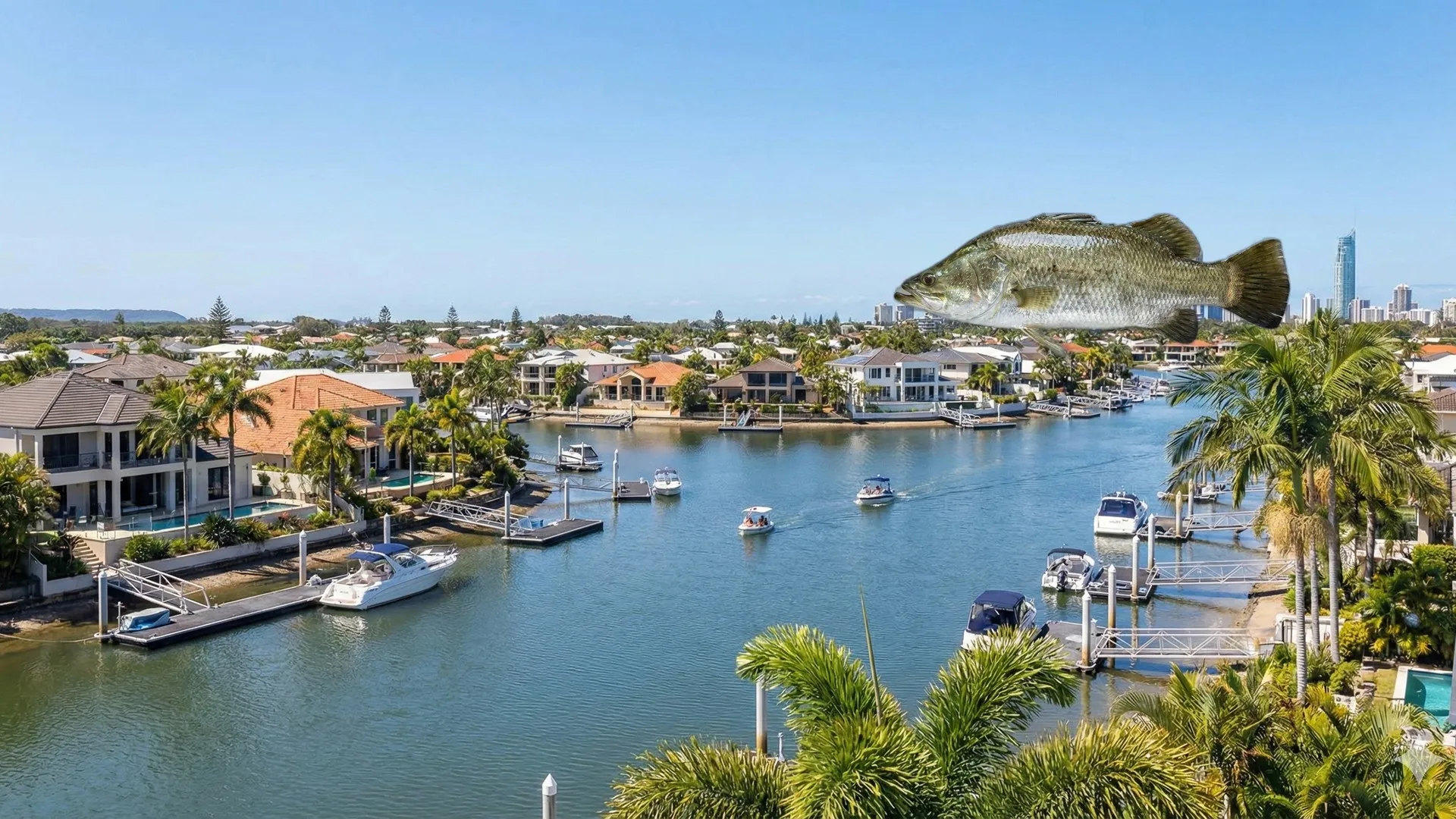
Target Species
Barramundi
Gold Coast Canals is one of the rising hotspots for Barramundi fishing in QLD, offering easy urban angling for fish in the 60-80cm range, particularly in the northern systems like Coomera and Hope Island.
For years, Hervey Bay was seen as the southernmost limit for regular Barramundi captures, but things have shifted. The Gold Coast canal systems have become a real “southern frontier” for this iconic species, thanks to stocking programs and warming waters. While you won’t usually find the metre-plus bruisers common in the Northern Territory, the Gold Coast offers a unique, technical fishery where “canal barra” averaging 50cm to 80cm are standard. These fish are sharp, structure-loving, and live right in the city, making them a great target for anglers who want to tangle with royalty without heading to the Top End.
Fishing the Gold Coast canals for Barramundi is nothing like the wild rivers up north. This is an urban battlefield where stealth, accurate casting, and reading artificial structure matter most. The fish here face heavy pressure and often stay wary, lurking under multi-million dollar pontoons and weaving through busy boat traffic. Yet, the payoff is huge for those who figure it out. The simple fact of launching a boat or walking the banks just minutes from a coffee shop and hooking a silver chrome slab is hard to beat.
This guide breaks down exactly how to tackle this specific fishery. We’re not covering general barra fishing, we’re talking about pulling fish from man-made waterways, dealing with clear water, and timing your run to match South East Queensland’s seasonal windows. Whether you’re a local looking to add a new target or a visitor hoping to tick off a barra, knowing the ins and outs of the canal systems is your first step to success.
Getting There
Barramundi
Lates calcarifer
Always check current NSW DPI regulations before fishing. Bag and size limits may change.
Understanding Gold Coast Canals: Location Intelligence
The most reliable areas are the northern canal systems, especially around Coomera River, Hope Island, Sanctuary Cove, and Paradise Point, where warmer water and less boat traffic create ideal conditions compared to the southern Broadwater.
To consistently catch Barramundi here, you need to understand the unique “location intelligence” of the Gold Coast waterways. Unlike natural estuaries, these canals are built environments. They act like massive heat sinks; the concrete walls, shallow sandy bottoms, and limited tidal flow in the back canals often keep water temperatures a few degrees warmer than the open ocean. Since Barramundi are tropical fish pushing their southern limit, they move into these warm zones, especially during the cooler months.
Location Essentials
The North-South Divide
Local knowledge shows a clear edge for the northern canal systems. The waterways off the Coomera River—like Sanctuary Cove, Hope Island, and the Santa Barbara canals—are the top spots. These areas connect directly to the Coomera River, which has been heavily stocked and supports a breeding population. In contrast, the southern canals around Surfers Paradise and Broadbeach, while holding the odd fish, are usually less productive for Barramundi due to heavy boat traffic, noise, and cooler water from the Seaway.
Structural Blueprints
In the canals, structure rules. Barramundi are ambush predators that use shade and cover to hide from both prey and anglers.
- Pontoons: These are the top target. A pontoon gives constant overhead cover and shade. Barra will sit deep under the pontoon during the day and move to the edges or front face at low light. The “pressure point” (the side where the current hits) is often where fish sit, waiting for bait to drift past.
- Bridges: Bridge pylons create eddies and pressure zones. At night, streetlights on bridges draw baitfish, which brings in Barramundi. The shadow line from the bridge on the water is a classic ambush zone.
- Rock Walls and Drains: Many canals have rock retaining walls or stormwater drains. Drains work best after rain or on a falling tide when they flush freshwater and nutrients into the system, sparking a feeding frenzy.
The “Salad” Factor
A unique feature of the Gold Coast canals is the presence of weed beds, locally known as “salad.” In clearer, shallower canals, Barramundi will cruise the edges of these weed beds just like in freshwater impoundments. Fishing the “salad” needs specific weedless rigging, but it can be deadly, especially when the sun is high and fish are hunting herring or mullet on the flats.
Water Clarity and Stealth
One key factor that sets Gold Coast fishing apart from the north is water clarity. These canals can be crystal clear, especially on the incoming tide. This makes the fish ultra-wary. If you roar up to a spot with a 2-stroke engine, the fish will shut down. Smart anglers use electric motors to sneak into position or drift with the breeze. Long casts are a must; you need to get your lure to the fish before they know you’re there. This clarity also shapes your gear choices, often calling for lighter fluorocarbon leaders (20-40lb) instead of the heavy lines used in murky northern rivers.
For more details on the broader region, check out our guide to Barramundi at Gold Coast: The Southern Frontier Guide, or explore other fishing spots in Queensland.
When Is the Best Time to Fish for Barramundi at Gold Coast Canals?
The prime season runs from September to April, with peak action during the warmer months of February and March, though you must respect the closed season from November 1st to January 31st on the East Coast.
Timing your session on the Gold Coast is more critical than almost anywhere else because these southern fish respond strongly to specific triggers. They’re heavily influenced by water temperature and tidal flow.
Seasonal Patterns
A Barramundi’s metabolism runs on temperature. In the Gold Coast canals, they go cold and slow when the water drops below 20°C.
- Spring (September - October): As the water warms, fish wake up and start feeding hard. This is a pre-spawn period where barra are aggressive and looking to bulk up.
- Summer (November - January): This is when the fish are most active, but it overlaps with the Queensland East Coast Barramundi Closed Season (midday 1 Nov to midday 1 Feb). You can’t target them during this time. If you hook one by accident while chasing Mangrove Jack, let it go straight away with as little harm as possible.
- Late Summer/Autumn (February - April): This is the “Golden Window.” The season reopens, the water is at its warmest (26–30°C), and the fish are post-spawn and hungry. Most locals agree this is your best shot at a trophy canal barra.
- Winter (May - August): Fishing is tough. The fish are still around but inactive. You might get a reaction bite with a super slow retrieve, but it’s usually better to go after other species.
Barramundi Seasonal Calendar
Tidal Influence
Tides ring the dinner bell in the canals.
- Run-In Tide: Usually the best time to fish. Clean, warm ocean water pushes in, firing up the fish. The top two hours before high tide are golden, especially over flats and shallow weed beds.
- Run-Out Tide: As water drains, baitfish get flushed out of drains and small creeks. Set up at the mouth of a drain or culvert. Watch your depth in the upper reaches though — it can go shallow fast.
- Tide Change: Slack water is often dead time. Use it to move spots or re-rig.
Day vs. Night
Low-light periods at dawn and dusk are best for surface luring, while night fishing around lit bridges and pontoons is highly effective as Barramundi lose their caution and hunt hard in the shadows.
- Dawn/Dusk: The “change of light” is magic hour. Topwater lures shine now. A surface walker twitched over a shallow weed bed at 5:30 AM is a heart-pounding way to fish.
- Night: The canals wake up after dark. Lights from homes and streets create clear feeding zones. Barramundi sit in the dark, watching into the light. Cast into the shadows and work your lure across the edge — strikes often come right at the line.
- Day: Daytime fishing is possible but tricky with boat traffic and wary fish. If you’re out in daylight, focus on deep structure, heavy shade under wide pontoons, or deep dredged holes.
Tide Times
Optimal Tide
Run-in tide, specifically the last 2 hours before high
Tide movement is critical for fish activity. Most species feed actively during tide changes, especially the run-in (incoming) tide.
Detailed hourly tide charts
Official tide predictions
7-day tide calendar
Tide Guide
Best for most species. Fish move in to feed as water rises.
Good for ambush predators. Baitfish get swept out.
Slower bite. Fish less active during slack water.
New/full moon. Bigger tidal range, more fish movement.
Moon Phase & Solunar
Moon phases influence fish feeding behavior. New and full moons create spring tides with stronger currents and increased fish activity.
Best Phases
- New Moon: Peak feeding activity, spring tides, excellent fishing
- Full Moon: Strong tides, night feeding, great for nocturnal species
- 3 Days Either Side: Extended peak period for maximum results
Major/Minor Periods
- Major Periods: Moon overhead/underfoot (2-3 hours)
- Minor Periods: Moon rise/set (1-2 hours)
- Best Times: Major period + dawn/dusk = explosive action
Weather Conditions
Check current conditions before heading out. Wind, swell, and barometric pressure significantly affect fish behavior.
Official forecasts, warnings & radar
Hourly wind speed & direction
Swell height, period & direction
The Lunar Edge
Plan your trips around the New Moon or Full Moon. The bigger tides during these phases move more bait, sparking stronger feeding runs. The three days before the full moon are often legendary for canal barra.
What Tackle Do You Need for Barramundi at Gold Coast Canals?
A medium-heavy spin outfit is ideal, typically a 6–10kg rod paired with a 3000–4000 size reel, spooled with 20–30lb braid and a 40lb fluorocarbon leader to handle the abrasive structures.
You don’t need the heavy rods built for 120cm impoundment fish, but you do need gear that can stop a 70cm barra from wrapping you around a pylon in seconds. The Gold Coast fishery is about “finesse power” — light enough to cast small lures precisely, but strong enough to pull fish from thick cover.
Rod and Reel
A spin setup is usually more versatile in the canals than a baitcaster, since it lets you skip lures under pontoons and handle lighter gear when needed.
- Rod: Go for a 6’6” to 7’0” graphite rod rated 6–10kg (medium-heavy). A fast action helps with accurate casts and solid hookups.
- Reel: A 3000 or 4000 size spinning reel with a smooth, strong drag is ideal. Brands like Shimano (Stradic/Saragosa) or Daiwa (BG/Saltist) are trusted go-to choices.
Line and Leader
- Main Line: 20lb to 30lb high-quality PE braid. You want thin diameter for longer casts, but enough strength to crank down hard when a fish makes a run for the pylons.
- Leader: This is where you win or lose. Use 40lb to 60lb fluorocarbon. In the clear canal water, fluorocarbon is a must for staying invisible. While 60lb might seem heavy, a barra’s rough mouth can cut through lighter leaders fast. If the water is crystal clear and the fish are spooky, drop to 30lb, but be ready to play them carefully.
For more tackle basics, see our tackle essentials guide.
Complete Tackle Specifications
| Component | Specification |
|---|---|
| Rod | 6'6" - 7'0" Graphite Spin, 6-10kg rating, Fast Action |
| Reel | 3000-4000 size spin reel, 7-9kg drag |
| Main Line | 20-30lb PE Braid (8-strand for casting distance) |
| Leader | 40-60lb Fluorocarbon (1.5m length) |
| Hooks | Strong gauge trebles (Owner ST-56 or BKK Raptor) |
| Lure Clip | Size 3-4 heavy duty snap |
| Soft Plastics | 4-6 inch paddle tails or jerk shads |
| Hard Bodies | Suspending minnows (70-100mm) |
Lure Selection for Canals
The baitfish in the canals are small — herring, mullet, and prawns. Match what’s on the menu.
- Suspending Minnows (Jerkin’ Minnows): Lures like the Jackall Squirrel 79 or Lucky Craft Pointer are deadly. Cast to a pontoon, crank it down, and PAUSE. The bite almost always hits on the pause.
- Soft Vibes: Samaki Vibelicious or Jackall Transams. Great for deeper holes or bridge pilings. Hop them off the bottom.
- Surface Walkers: Rapala Skitter Pop or Bassday Sugapen. Use these at first light over shallow weed beds.
- Prawn Imitations: Zerek Live Shrimp or Chasebaits Crusty Crab. Skip them deep under pontoons and let them sink naturally.
How Do You Rig for Barramundi?
The best rig for lure fishing is a simple braid-to-leader setup with an FG knot, connected to the lure using a loop knot or strong snap to let the lure move naturally.
Keep it simple. The more gear in the water, the easier it is for a cautious canal barra to spot something’s wrong.
Building the Perfect Lure Rig
- 1
Select Your Leader
Cut 1.5 metres of 40lb fluorocarbon leader. Avoid monofilament — it won’t stand up to the scrapes from pontoon fishing.
- 2
Tie the FG Knot
Join your braid main line to the leader with an FG knot. It's slim, slides through guides smoothly, and holds strong when casting.
- 3
Check for Weakness
Pull tight and trim the tag ends flush. Loose ends can grab weed or gunk.
- 4
Attach the Lure
Tie the leader straight to the lure's eye using a 'Lefty's Loop' knot. This gives the lure freedom to swim. Or, use a tough snap (like a Mustad Fastach) if you swap lures often.
- 5
Upgrade Your Hardware
CRITICAL: Most factory hooks on lures aren’t up to scratch for Barramundi. Swap split rings and trebles for 4X strong gear (e.g., BKK or Owner).
- 6
Test the Drag
Set your drag firm but able to slip under hard runs. You want to turn the fish’s head without pulling the hooks free.
- 7
Final Inspection
Check the first 30cm of your leader for nicks after every fish or snag. Retie if it’s worn.
For live baiting, a basic running sinker rig works best. Slide a size 4-6 ball sinker onto the main line, add a swivel, then tie on 60cm of 60lb leader and finish with a 5/0 or 6/0 circle hook. Hook live mullet through the lips or just behind the dorsal fin.
What Bait Works Best for Barramundi?
Live bait beats dead every time, with live mullet, herring, and prawns topping the list, while fresh mullet strips can work when live bait’s hard to get.
Lures are fun and test your skill, but live bait often gets the job done — especially for new anglers or when the barra aren’t chasing hard.
Bait Performance Analysis
| Live Mullet | Live Herring | Live Prawns | |
|---|---|---|---|
| Effectiveness Rating | Excellent (5/5) | Very Good (4/5) | Excellent (5/5) |
| Durability on Hook | High | Low (Fragile) | Medium |
| Scent Dispersion | Medium (Vibration) | High (Flash/Vibration) | High |
| Availability | Cast net in canals | Jigging around pylons | Cast net/Buy live |
| Best Use Conditions | Pontoons & Bridges | Deep holes & Drop-offs | Night fishing under lights |
The 'Poddy' Mullet Secret
The top bait for canal barra is a “poddy” mullet (10-15cm). They’re tough, stay lively on the hook, and kick out panic vibes that barra can’t ignore. Grab them with a cast net from shallow sandy spots in the canals before your session.
For more on bait presentation, check our Bait Guide.
When Is the Best Time to Fish for Barramundi at Gold Coast Canals?
The sweetest window for targeting Barramundi in the Gold Coast canals is from February to April, when water temperatures are highest (26-30°C) and the closed season has ended.
Understanding the timing for Gold Coast Barramundi is about more than just checking the clock; it’s about syncing up with three key factors: seasonality, tidal flow, and light phases. Because these fish are at the southern edge of their range, they’re far more finicky than their northern cousins. A drop of just two degrees in water temperature can shut down a bite completely, turning a hot spot into a ghost town.
The Seasonal Sweet Spot
While Barramundi live in the canals year-round, their activity swings wildly. The “metabolic window” for these fish opens when water temps climb above 24°C.
- The Closed Season (Nov 1 - Feb 1): It’s vital to respect the Queensland East Coast Barramundi Closed Season. During this time, Barramundi are spawning. Even if you see them chasing bait under lights in December, targeting them is illegal and unfair. If you hook one by accident while chasing Mangrove Jack, keep it in the water, unhook gently, and let it go straight away.
- The “Run-Off” (February - March): As the season opens on February 1st, the action often explodes. Late summer storms flush warm water and bait from the drains, sparking aggressive feeding. This is the best time to chuck bigger lures.
- The Autumn Peak (March - April): This is probably the finest time to fish. The weather settles, the water stays warm, and the fish are in top shape before winter. They feed hard to build up for the cooler months.
- Winter Dormancy (June - August): When water drops below 20°C, Barramundi go quiet. They hang deep under pontoons and hardly eat. It’s usually not worth targeting them during these months.
Barramundi Seasonal Calendar
Mastering the Tides
In the canal systems, the tide acts like a conveyor belt for food. Unlike the open ocean, water in the back of the canals can go stale.
- The Incoming Push: The most productive phase is the run-in tide, especially the middle two hours and the hour before high tide. Fresh, oxygen-rich ocean water pushes baitfish deep into the canals, pinning them against walls and the backs of pontoons.
- The “Colour Change”: Watch for the clear line where murky canal water meets clean ocean water rolling in. Barramundi often cruise this “colour change,” using the murk to ambush baitfish confused by the mixing flows.
- The Run-Out: While less effective for exploring, the run-out tide works well for “drain fishing.” Set up where a stormwater pipe or small creek flows into a main canal. As the level drops, bait gets pushed out, and Barramundi will sit just outside the flow, waiting for an easy feed.
Tide Times
Optimal Tide
Run-in tide, 2 hours before high water
Tide movement is critical for fish activity. Most species feed actively during tide changes, especially the run-in (incoming) tide.
Detailed hourly tide charts
Official tide predictions
7-day tide calendar
Tide Guide
Best for most species. Fish move in to feed as water rises.
Good for ambush predators. Baitfish get swept out.
Slower bite. Fish less active during slack water.
New/full moon. Bigger tidal range, more fish movement.
Light Phases: The Vampire Shift
Yes, night fishing is often more productive than day fishing in the canals because Barramundi use the cover of dark and artificial light shadows to ambush prey without being seen.
The Gold Coast canals get busy during the day, making the fish wary and reclusive. Once the sun dips and the jet skis head in, the waterways come alive.
- Artificial Light Lines: This is the urban angler’s secret edge. Bridge lights, pontoon security lamps, and streetlights shine beams onto the water. Predators will sit in the dark just beyond the edge of the light, watching for prawns or herring to drift into the bright zone. Cast your lure into the dark and pull it through the light. The strike usually comes right at the changeover.
- Dawn and Dusk: If you’d rather fish in natural light, the 45-minute window around sunrise and sunset is essential. This is “topwater time.” The wind’s usually calm, and Barramundi will leave cover to hunt over shallow sand flats beside the canals.
Moon Phase & Solunar
Moon phases influence fish feeding behavior. New and full moons create spring tides with stronger currents and increased fish activity.
Best Phases
- New Moon: Peak feeding activity, spring tides, excellent fishing
- Full Moon: Strong tides, night feeding, great for nocturnal species
- 3 Days Either Side: Extended peak period for maximum results
Major/Minor Periods
- Major Periods: Moon overhead/underfoot (2-3 hours)
- Minor Periods: Moon rise/set (1-2 hours)
- Best Times: Major period + dawn/dusk = explosive action
Weather Conditions
Check current conditions before heading out. Wind, swell, and barometric pressure significantly affect fish behavior.
Official forecasts, warnings & radar
Hourly wind speed & direction
Swell height, period & direction
The Solunar Trigger
Don’t overlook the moon. A New Moon means darker nights, which pushes fish to hunt tighter to structure and rely on vibration. On the flip side, a Full Moon lights up the canals, letting fish feed more by sight across the flats. The 3-4 days before a Full Moon often see the biggest fish caught, as the stronger tides drive more water (and bait) into the upper reaches of the Coomera and Nerang systems.
What Tackle Do You Need for Barramundi at Gold Coast Canals?
A 6-10kg spin outfit is the most versatile choice, paired with a 4000-size reel and 30lb braid, giving you accurate skip-casting under pontoons while keeping enough grunt to stop fish from reaching cover.
Rigging for “Canal Barra” is all about balance. You’re chasing a strong fish in tight spots, but the water’s often clear and the fish see plenty of lures. Heavy “impoundment style” gear (50lb braid, 80lb leader) is too clunky and obvious here. You need finesse with power.
The Rod: Precision Over Power
A spinning setup usually beats a baitcaster for this kind of fishing. Why? Because a lot of the game involves skipping light lures (like prawns or unweighted plastics) deep under pontoons.
- Length & Action: A 6’6” to 7’0” rod is ideal. Longer rods get tricky when casting around bridge pylons or narrow canals. You want a fast action blank (stiff tip) to set hooks in the Barramundi’s tough mouth, but it must load fast to cast light lures with control.
- Rating: A rod rated 6-10kg (12-20lb) hits the sweet spot. It handles the average 60-80cm fish well but gives you a shot if a 90cm+ bruiser shows up.
The Reel: Smooth Drag is Essential
A 3000 to 4000 size spinning reel is standard. The drag is the most important part. When a Barramundi realises it’s hooked, its first run is wild and often airborne. A sticky drag means lost fish or broken leaders. Make sure your reel has a top-quality carbon drag (e.g., Shimano Stradic, Daiwa Saltist, or Penn Slammer).
Line and Leader Strategy
- Main Line: Use 20lb to 30lb PE Braid. High-grade 8-strand braid is best because it’s smoother and quieter through the guides. Noisy 4-strand braid can actually spook cautious fish in quiet canals. The thin diameter of 20-30lb braid also slices through water better, helping your lures run deeper.
- Leader: This is where plenty of anglers get it wrong. You’ve got to use Fluorocarbon, not mono. Fluoro stands up better to scrapes (key when a fish rubs you on a concrete pylon) and vanishes underwater.
- Standard: 40lb Fluorocarbon.
- Finesse (Clear Water): 30lb Fluorocarbon (riskier, but pulls more bites).
- Heavy Structure: 50-60lb Fluorocarbon (for night sessions around rough bridges).
For more on picking the right gear, check out our tackle basics guide.
Complete Tackle Specifications
| Component | Specification |
|---|---|
| Rod | 6'6" - 7'0" Graphite Spin, 6-10kg rating, Fast Action |
| Reel | 3000-4000 size spin reel, 7-9kg drag pressure |
| Main Line | 20-30lb PE Braid (8-strand preferred) |
| Leader | 40-60lb Fluorocarbon (minimum 1.5m length) |
| Hooks | Upgrade to 4X Strong (BKK Raptor-Z or Owner ST-56) |
| Sinker | Running sinker (Size 4-6) for live baiting only |
| Swivels | Size 4 high-strength barrel swivel (black) |
| Lure Clip | Mustad Fastach or Decoy Egg Snap (Size 3-4) |
How Do You Rig for Barramundi?
For lure fishing, a direct braid-to-leader FG knot with a loop knot to the lure is essential for strength and action; for live bait, a simple running sinker rig allows the bait to swim naturally.
In the high-stakes environment of the canals, a knot failure is gutting. The connection between your soft braid and hard leader is the weakest link.
Building the Bulletproof Lure Rig
- 1
Select Leader Material
Cut approximately 1.5 metres of 40-60lb fluorocarbon leader. Do not use monofilament as it lacks the abrasion resistance needed for pontoon fishing.
- 2
Tie the FG Knot
Connect your braid main line to the leader using an FG knot. This slim knot passes through guides easily and is the strongest connection for casting. If you struggle with the FG, a 'Double Uni' knot is a passable alternative, though less streamlined.
- 3
Check for Weakness
Pull tight and trim the tag ends flush. Any loose tag ends can catch weed or debris, ruining the lure's action.
- 4
Attach the Lure
Tie the leader directly to the lure's tow point using a 'Lefty's Loop' knot. This allows the lure to swim freely. Alternatively, use a high-strength snap (like a Mustad Fastach) if you change lures frequently.
- 5
Upgrade Your Hardware
CRITICAL: Most stock hooks on store-bought lures are too weak for Barramundi. Replace split rings and treble hooks with 4X strong hardware (e.g., BKK Raptor-Z or Owner ST-56). A standard hook will straighten in seconds.
- 6
Test the Drag
Set your drag so it is firm but will give line under a hard surge. You need to turn the fish's head, but not rip the hooks out.
- 7
Final Inspection
Check the first 30cm of your leader for scuffs after every fish or snag encounter. Retie immediately if damaged.
What Bait Works Best for Barramundi?
Live bait is vastly superior to dead bait in the canals, with live poddy mullet (10-15cm) and live prawns being the most effective options for tempting wary fish.
While lure fishing gets the glory, live baiting is the most reliable way to hook up with Barramundi in the canals. These fish are lazy opportunists; a struggling mullet pinned near a pylon is often too good to refuse.
Bait Performance Analysis
| Live Mullet | Live Herring | Live Prawns | |
|---|---|---|---|
| Effectiveness Rating | Excellent (5/5) | Very Good (4/5) | Excellent (5/5) |
| Durability on Hook | High | Low (Fragile) | Medium |
| Scent Dispersion | Medium (Vibration) | High (Flash) | High |
| Availability | Cast net in canals | Jigging around pylons | Cast net/Buy live |
| Best Use Conditions | Pontoons & Bridges | Deep holes & Drop-offs | Night fishing under lights |
The 'Poddy' Mullet Secret
The absolute best bait for a canal barra is a “poddy” mullet (10-15cm). They are hardy, stay alive for a long time on the hook, and emit panic vibrations that Barramundi can’t resist. You can catch these with a cast net in the shallow, sandy corners of the canals or near boat ramps before your session.
How to Fish Live Bait
The presentation must be natural. Use a running sinker rig:
- Thread a small ball sinker (size 4-6) onto your main line.
- Tie a swivel below it to act as a stopper.
- Attach 60-80cm of 60lb fluorocarbon leader.
- Tie on a 5/0 to 7/0 Circle Hook (Mustad Demon or Gamakatsu).
- Hooking: Hook the mullet lightly through the lips (for current) or just behind the dorsal fin (for still water).
- Placement: Cast close to structure but give the fish room to swim. Put the rod in the holder and engage the baitrunner or loosen the drag. When a barra eats, it inhales the bait whole. Do not strike immediately. Let the line come tight and the rod load up—the circle hook will find the corner of the jaw automatically.
For more details on bait presentation, see our Bait Guide.
How Do You Catch Barramundi at Gold Coast Canals?
Success comes down to quiet approaches and precise casting; skip-cast lures deep under pontoons or bridges, use a twitch-and-pause retrieve to trigger strikes, and fight the fish hard to keep it away from structure.
Landing a Gold Coast Barramundi on a lure is a tough test that means nailing three stages: the cast, the retrieve, and the fight.
1. The Cast: Accuracy is Everything
This isn’t open-water fishing. You’re aiming at specific shadows.
- Skip Casting: This is the most useful skill you can pick up. You’ve got to skip your lure (usually a prawn imitation or soft plastic) under the pontoon or bridge, sliding it into the dark zone where the fish are lying. If your lure lands 2 metres short of the pontoon, you likely won’t get a bite.
- The “plop”: Unlike bream fishing where silence matters, a small “plop” can sometimes grab a barra’s attention, like a prawn jumping on the surface. But slamming a heavy lure onto a pontoon roof will scare every fish for blocks.
2. The Retrieve: The Art of the Pause
Barramundi are ambush hunters. They won’t chase a lure across the canal.
- Hardbodies (Jerkbaits): Cast past the structure or under it. Crank the reel 3-4 times to get the lure down deep. Then, STOP. Let the lure hang still for 3, 5, or even 10 seconds. Give it a sharp twitch, then pause again. The bite almost always comes when the lure’s not moving.
- Soft Vibes: Cast to the base of a pylon. Let it hit the bottom. Lift the rod tip fast to send the lure up 1 metre, then let it fall back on a loose line. Watch your line closely—if it jerks or goes slack early, set the hook hard!
- Surface Lures: Use a “walk the dog” action. Twitch-twitch-pause. That pause is key.
3. The Fight: Controlled Chaos
When a Barramundi hits, it makes a suction sound like a shotgun blast underwater—the famous “boof.”
- The Hookset: If you’re using lures, strike hard and fast. Barra have tough, bony mouths. You need to drive those hooks home.
- The Jump: Barramundi are known for their leaps. When you feel the line rise quick, the fish is about to jump. “Bow to the King”—drop your rod tip low and to the side to give slack. If you keep the line tight while the fish shakes its head in the air, the heavy lure might pop free.
- The Steering: Once the fish is back in the water, put strong side pressure on. Don’t lift the rod straight up; keep it low and steer the fish away from the pylons. If you feel the line scraping on structure, hit the free-spool right away. Sometimes the fish will swim out if the pressure’s off.
What Are the Rules for Fishing at Gold Coast Canals?
In Queensland, Barramundi have a minimum size limit of 58cm and a maximum size limit of 120cm, with a bag limit of 5 per person, and a strict closed season applies on the East Coast from midday 1 November to midday 1 February.
The Gold Coast fishery is delicate and tightly regulated. Following the rules isn’t optional—fisheries officers patrol these canals often by boat and on foot.
Critical Safety Considerations
- Boat Traffic: The biggest risk in the canals is other boats. Big cruisers and jet skis often race around blind corners. Always stay on the starboard side and use lights at night.
- Stonefish & Stingrays: If you’re wading the flats or sandbanks near canal mouths, shuffle your feet. Stonefish live in the Broadwater and their sting is a medical emergency.
- Bull Sharks: The canals hold plenty of Bull Sharks, especially in summer. Don’t clean fish at the water’s edge and never swim in the canals, particularly at dawn, dusk, or night.
- Private Property: You can fish the water, but you can’t step onto private pontoons or jetties. That’s trespassing. Cast at the pontoon, but don’t climb on it.
Conservation and Ethics
- Catch and Release: While it’s legal to keep them, most local anglers let canal barra go to protect the population. These fish live here year-round, not just passing through, and losing a pontoon’s fish can take years to fix.
- Handling: Use a rubber landing net to save their slime coat. Hold the fish with two hands under the belly—never dangle a big barra by its jaw (lip grippers), as this can hurt its spine and kill it.
- Tagging: Many Gold Coast barra carry tags for research. If you catch a tagged fish, note the number, length, and spot, then report it to Suntag or QLD Fisheries.
Check current rules at state fisheries.
Your Questions About Barramundi Fishing at Gold Coast Canals
What is the best time to fish at Gold Coast Canals?
The most productive fishing happens during the "shoulder seasons" of February-April and September-October, especially around dawn, dusk, and night sessions. While you can catch fish year-round, the peak fishing hours are closely tied to low light. The middle of the day is usually tough due to boat traffic and clear water. Plan your trips for the first two hours of the run-in tide, ideally matching up with sunrise or sunset.
Is Gold Coast Canals suitable for beginners?
Yes, the canals are suitable for beginners using live bait, but lure fishing can be tricky due to the accuracy needed. For beginner friendly fishing, stick to live baiting with mullet or prawns. It takes less skill than lure casting. However, be ready for frustration—Barramundi are moody fish. Don’t be discouraged if you don’t hook one on your first trip; learning the key holding spots takes time.
Do I need a boat to fish at Gold Coast Canals?
A boat or kayak is highly recommended to reach the best structures, but limited shore fishing is possible from public parks and bridges. Land-based fishing is restricted because most canal frontage is private property. However, you can still fish well from public access points like the bridges at Paradise Point, the parklands at Santa Barbara (Hope Island), and the rock walls near the Coomera River mouth. A kayak is a great, quiet way to reach the pontoons without the cost of a boat.
Where are the best specific spots at Gold Coast Canals?
The northern systems are the real hot spots, particularly the canals branching off the Coomera River around Sanctuary Cove, Hope Island, and Monterey Keys. Focus your efforts on "intercept points"—places where main channels meet smaller canals. The bridges along the Pacific Motorway (M1) crossing the Coomera River are also well-known fishing marks for holding fish, especially at night under the lights.
What size Barramundi can I expect?
The average catch size in the canals is between 50cm and 70cm, with fish over 80cm seen as a trophy for the system. While metre-plus fish are caught every year, they’re the exception, not the norm. The Gold Coast fishery has solid numbers of "schoolie" size fish. If you’re after a true trophy fish (100cm+), you’re better off targeting the deeper holes in the Coomera River main channel instead of the tight canals.
Is there parking available at Gold Coast Canals?
Yes, there’s plenty of parking at public boat ramps and parks, but street parking in residential areas needs care to avoid blocking driveways. For access to the northern canals, the best boat ramp with trailer parking is at the Coomera River (Shippys) or the Paradise Point boat ramp. If you're land-based, check Google Maps for public parks—these almost always have designated parking bays.
Can I fish at night at Gold Coast Canals?
Night fishing is probably the most effective way to target canal Barramundi, as they’re less wary and feed actively under artificial lights. Night fishing tips: Stay quiet. Sound travels fast through water, especially at night. Turn off your sounder in shallow water (the clicking can spook fish). Target "shadow lines" under bridge lights or street lamps—Barra sit in the dark and ambush prey moving into the light.
Where can I buy bait near Gold Coast Canals?
There are several major tackle stores and service stations near the boat ramps that sell frozen bait, but live bait works best when caught fresh. For bait shops, "The Tackle Warehouse" at Coorparoo (if coming from Brisbane) or local Gold Coast stores like "Gold Coast Fishing Tackle" in Southport are solid choices. But for top results, bring a cast net and catch your own live mullet in the shallows near the boat ramp before you start.
What are the current bag and size limits?
The legal size range is 58cm to 120cm, with a bag limit of 5 fish per person, though most canal anglers go catch and release. Strict regulations apply. The 120cm max size protects large breeding females. Remember the closed season (Nov 1 - Feb 1). Always check the QLD Fisheries app for the latest legal limits before you cast.
Is Gold Coast Canals family-friendly for fishing?
Yes, the calm waters and many public parks make it very safe for kids fishing, as long as they’re supervised near the edge. The canals are sheltered from ocean swells, so no seasickness for the little ones. Safe fishing spots for families include the sandy beaches at Paradise Point or the parklands at Damian Leeding Memorial Park (Coomera Lake), which also holds Barramundi.
What should I bring for a fishing session?
Bring a medium spin rod, a landing net (essential), pliers for unhooking, polarized sunglasses, and insect repellent for the evenings. Your fishing checklist should also include a "brag mat" (measuring mat) for photographing your catch on the deck instead of holding it up. A good headlamp is key for night sessions, and bring plenty of water—Gold Coast summers are humid and can leave you drained.
How crowded does Gold Coast Canals get?
The waterways can get extremely busy with recreational boats and jet skis on weekends, so early mornings or weekdays are the best times to avoid crowds. To find quiet fishing times, try midweek evenings. The "Sunday Arvo" period is often hectic with party boats and cruisers, making fishing hard and risky. If you must fish weekends, launch before dawn and be off the water by 9 AM.
Latest Fishing Reports
Stay updated with the latest catches, conditions, and hot tips from Gold Coast Canals. Check these sources for recent reports filtered by location and species.
Fishraider
Community fishing reports and catch logs
Fishing World
Professional fishing reports and news
Tackle World
Local tackle shop reports and tips
NSW DPI
Official recreational fishing reports
Fishingmonthly
Monthly fishing magazine and reports
Hooked Up
Video fishing reports and tips
Pro Tip: Filter Reports
When browsing reports, search for "Gold Coast Canals" or nearby landmarks. Look for reports from the last 7-14 days for the most relevant information. Pay attention to tide times, weather conditions, and successful techniques mentioned.
Share Your Catch
Caught something at Gold Coast Canals? Share your success with the community! Upload your catch photos and reports to help other anglers.
Disclaimer: Fishing regulations can change. Always verify the latest rules with the Queensland Department of Agriculture and Fisheries before your trip. The information provided here is based on historical patterns and local knowledge.
The Gold Coast canals offer a unique urban fishing adventure that rivals many remote locations. Whether you’re skipping prawns under a multi-million dollar mansion or live-baiting a bridge pylon at midnight, the thrill of hooking a “Chromeie” in the city is unmatched.
Explore more fishing spots in the area, learn about other species like Mangrove Jack that share these waters, or brush up on your skills with our fishing basics guide. Good luck, and tight lines!
Quick Info
- Location
- Gold Coast Canals
- Coordinates
- -27.4700, 153.0300
- Difficulty
- advanced
- Target Species
- Barramundi
Conditions
Check local weather and tide conditions before heading out.