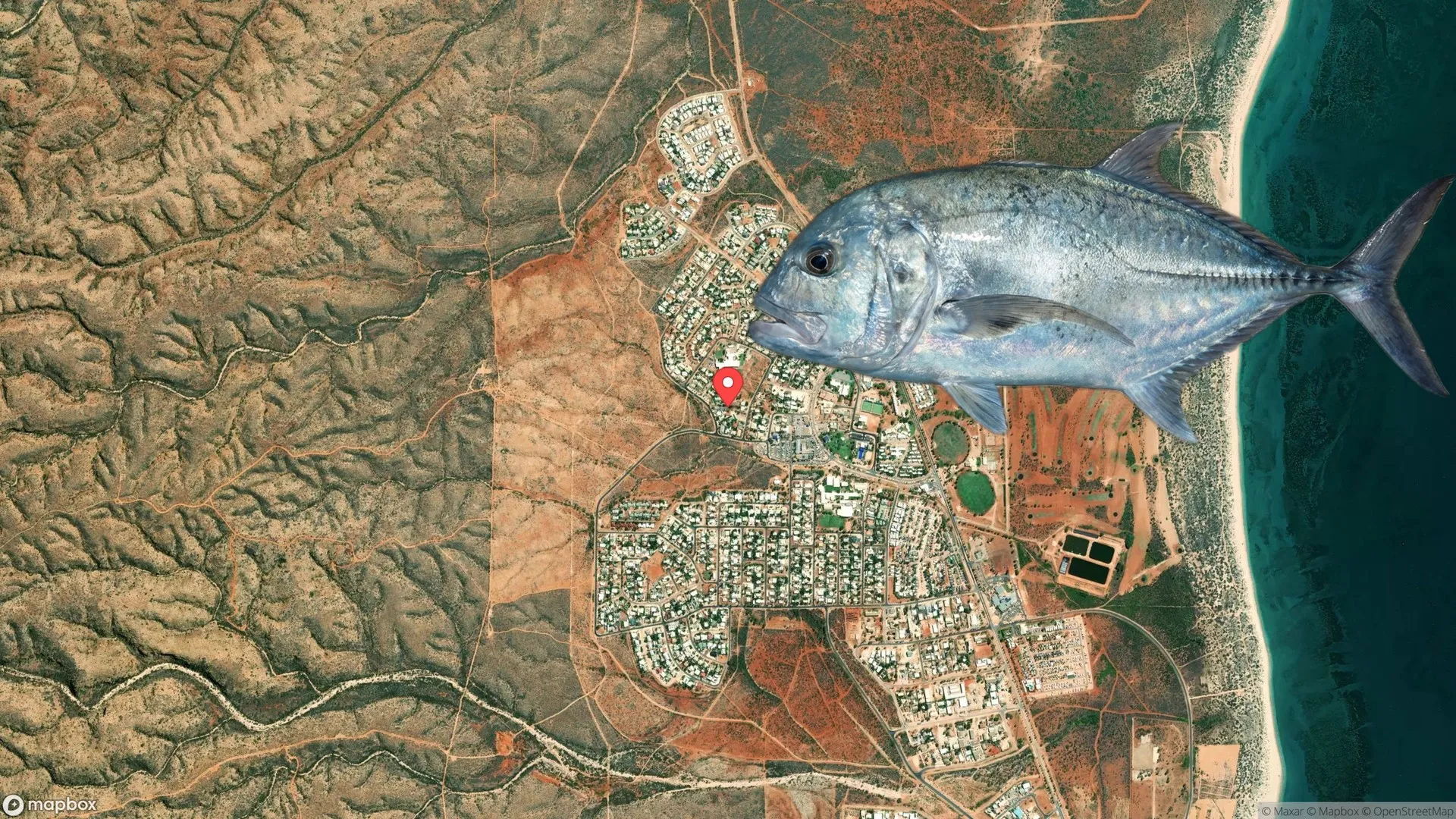
Target Species
Giant Trevally
Exmouth is widely regarded as one of the top spots for Giant Trevally (GT) fishing in WA, offering real chances to hook trophy fish up to 40kg from shore or boat. The meeting of the Exmouth Gulf and Ningaloo Reef creates a rich mix of habitats where you can sight-cast to fish on the flats or battle brutes around deep reef structure.
If there’s a stretch of the Australian coast that shouts “GT country,” it’s Exmouth. Sitting at the tip of the North West Cape, this remote fishing hotspot is where desert meets reef, forming a hunting ground for one of the ocean’s fiercest predators: the Giant Trevally. For anglers, the draw isn’t just the size of the fish—though 30kg to 40kg fish are common here—it’s how close you can get. Unlike other top GT locations that need long offshore runs, Exmouth gives you a solid shot at a dream fish with your boots on the sand or from a small tinny just a few kays out.
The layout here is special. On one side, the Exmouth Gulf acts as a giant nursery full of bait and prowling predators. On the other, the Ningaloo Reef shelters a shallow lagoon perfect for sight fishing, then plunges into deep water. This mix means GTs aren’t just around—they’re in charge. Whether you’re casting stickbaits over coral bommies, popping along the reef edge, or running live bait near the pier, the strikes are fast and hard.
But fishing here demands respect—for the reef and the fish. Coral cuts deep, currents run strong, and GTs are smart. They know every hole and will snap your line in seconds if you’re not ready. This guide will help you stack the odds in your favour, from reading the Cape’s tricky tides to picking the heavy gear needed to stop a charging brute.
Getting There
Giant Trevally
Caranx ignobilis
Always check current NSW DPI regulations before fishing. Bag and size limits may change.
Understanding Exmouth: Location Intelligence
The best spots to catch GT in Exmouth are the Exmouth Gulf for big roaming fish and the Ningaloo Reef edge for structure-based fights. Top areas include the waters near the Navy Pier, the flats at Bundegi, and the reef passes at Tantabiddi and the Muiron Islands.
To catch Giant Trevally in Exmouth, you need to know the different “zones” that shape the fishery. The North West Cape works like a funnel, pushing nutrient-packed water between the Indian Ocean and the Exmouth Gulf. That flow is what drives GT action.
Location Essentials
The Gulf Side vs. The Ocean Side
The Exmouth Gulf is often called “prawn soup,” cloudy and packed with life. Here, GTs hunt the flats and channel edges. The water’s usually flat, but spotting fish can be tough in the murk. Spots like Bundegi shine because they sit right where the Gulf meets the ocean. The sanctuary zone line at Bundegi is a known patrol route for big fish. Shore anglers can wade these flats, but watch for sharks that often follow the trevally.
On the Ocean Side (Ningaloo Reef), the water’s glass-clear. This is sight-fishing country. The lagoon inside the reef is shallow, often 1-4 metres deep, with scattered coral bommies. GTs here move in packs, sometimes riding behind stingrays or sharks to grab prey that gets kicked up. The “passes” in the reef—gaps where ocean swells push through—are high-energy zones. Places like Tantabiddi and the South Passage are classic ambush spots. The surge stuns baitfish, and GTs wait in the wash for an easy feed.
Key Structure and Terrain
The terrain in Exmouth is tough. Limestone and coral mean your line is at risk the moment a fish runs.
- Reef Edges: The drop-offs on the western side hold the biggest fish. They cruise the “white water” where waves slam onto the reef.
- The Navy Pier: While fishing on the pier is limited to licensed charters, the water around it is famous. The structure works like a giant FAD (Fish Aggregating Device), drawing some of the heaviest GT concentrations on the coast.
- Rocky Headlands: Spots like the Lighthouse area and wreck sites give shore anglers access to deep water. The rocks are slippery and sharp, but they let you cast to pelagics without a boat.
Why GTs Thrive Here
The area’s biology feeds big predators. The Leeuwin Current brings warm water down the coast, and the layout creates strong tidal flows. These flush baitfish out of mangroves and lagoons. Locals often call the channels draining the flats “drive-in restaurants.” As the tide drops, water—and bait—is forced from the shallows into deeper gutters. GTs know this and stack up at the mouths. If you find a gutter draining a large flat on an outgoing tide, you’re in the strike zone.
For those looking to explore more fishing spots in the region, understanding these tidal movements is key. It’s not just about showing up—it’s about being there when the water’s on the move.
Shore-Based Opportunities
One of the most common questions is whether you need a boat. While a boat gets you to the outer reef, shore fishing at Exmouth is legendary. Oysters, Five Mile Beach, and Pebble Beach are 4WD-accessible and offer shots at cruising fish. The trick for shore anglers is to keep moving. Don’t camp in one spot if the fish aren’t biting. Walk the beaches, watch for nervous water (baitfish skipping on the surface), and cast at shadows. The “wash” around rocky points at the tip of the Cape is also a solid spot to throw poppers, but watch the swell.
Reading the Water
When fishing the flats inside the reef, watch for “rays of hope.” GTs in Exmouth often follow big stingrays. As the ray digs in the sand for crabs, the GTs dart in to grab what escapes. If you see a large black ray moving through the shallows, drop a lure right on its back—there’s likely a monster trevally close behind.
When Is the Best Time to Fish for GT at Exmouth?
The best time to catch Giant Trevally in Exmouth is from late spring through to autumn, with December to April being the prime window. During these months, water temperatures between 26°C and 29°C spark aggressive feeding behaviour, though early mornings and late afternoons are consistently productive year-round.
Timing your trip to Exmouth can be the difference between a fishing trip of a lifetime and a week of frustration. While GTs are around all year, their habits shift dramatically with the seasons and tides.
Seasonal Patterns
The warmer months are usually best for GT action. As the water warms in late spring (October/November), the fish get more active on the flats. This pre-cyclone period often brings calm mornings ideal for popping.
Summer (December - February) is hot, both in air temperature and fishing intensity. This is when the “big dogs” come out to play. But you’ve got to handle the heat and keep an eye on cyclone forecasts. The water’s at its warmest, and the fish are full of energy, feeding hard.
Autumn (March - May) is probably the most comfortable time to fish. Winds often ease, and the water stays warm enough to keep GTs on the bite. April is especially favoured by local guides as a top month, matching up with runs of Queenfish and Spanish Mackerel.
Winter (June - August) can be slower for surface fishing as the water cools, but big fish still get hooked. This time is better suited to bait fishing or jigging over deeper structure rather than counting on topwater strikes.
Giant Trevally Seasonal Calendar
Tidal Influence: The Critical Factor
In Exmouth, the tide rules everything. The tidal range can be huge, and moving water decides where the fish set up.
- Outgoing Tide: This is usually the best time to target the “drains” and channels off the flats. As the water drops, bait gets funnelled into deeper channels where GTs lie in wait. The last two hours of the outgoing tide are often the “golden window” for pier and channel fishing.
- Incoming Tide: Perfect for working the flats. As the tide rises, GTs move into shallow water to hunt crabs and baitfish. This is prime time for sight casting.
- Slack Water: Often the bite shuts down completely. Use this time to re-rig or move spots.
Tide Times
Optimal Tide
Outgoing tide for channels; Incoming tide for flats
Tide movement is critical for fish activity. Most species feed actively during tide changes, especially the run-in (incoming) tide.
Detailed hourly tide charts
Official tide predictions
7-day tide calendar
Tide Guide
Best for most species. Fish move in to feed as water rises.
Good for ambush predators. Baitfish get swept out.
Slower bite. Fish less active during slack water.
New/full moon. Bigger tidal range, more fish movement.
Moon Phase & Solunar
Moon phases influence fish feeding behavior. New and full moons create spring tides with stronger currents and increased fish activity.
Best Phases
- New Moon: Peak feeding activity, spring tides, excellent fishing
- Full Moon: Strong tides, night feeding, great for nocturnal species
- 3 Days Either Side: Extended peak period for maximum results
Major/Minor Periods
- Major Periods: Moon overhead/underfoot (2-3 hours)
- Minor Periods: Moon rise/set (1-2 hours)
- Best Times: Major period + dawn/dusk = explosive action
Time of Day
You can catch them any time, but dawn and dusk are the go-to times for GTs. Low light gives the fish the edge over baitfish. In the clear waters of Ningaloo, bright midday sun can make GTs wary and less likely to chase lures. That said, on deeper shoals or the murkier Gulf side, midday bites still happen if the tide’s moving.
Weather Conditions
Check current conditions before heading out. Wind, swell, and barometric pressure significantly affect fish behavior.
Official forecasts, warnings & radar
Hourly wind speed & direction
Swell height, period & direction
What Tackle Do You Need for GT at Exmouth?
You need heavy-duty gear to land GTs in Exmouth, specifically a PE 6-8 (80lb) setup for boat fishing and a PE 4-5 (50lb) rig for shore casting. A high-quality spinning reel with a strong drag system, matched to a 9-10ft rod for shore or a 7-8ft rod for boat, is essential to stop fish from reaching the coral.
If you show up in Exmouth with your regular bream or flathead gear, you’re going to get smashed. The GTs here are powerful, hard-charging fish that live in a world of razor-sharp coral. Your gear needs to be tough, dependable, and able to apply serious pressure.
Rod and Reel Selection
For shore-based angling, casting distance matters most. You want a rod around 9 to 10 feet long rated for PE 4-6 (approx 50-60lb braid). It should have a fast tip to punch lures into the wind but plenty of backbone to turn a fish before it finds structure.
- Reel: A 10000 to 14000 size spinning reel is standard. Brands like Shimano (Saragosa, Stella) or Daiwa (Saltist, Saltiga) are top picks because their gears handle the strain.
For boat fishing, you can go shorter and heavier. A 7ft to 8ft rod rated for PE 8-10 (80-100lb) is common when throwing big poppers.
- Reel: A 14000 to 18000 size reel fits the job. You need a drag that can be set to 15kg+ of pressure and hold firm.
Line and Leader
This is where many fights are lost.
- Main Line: Top-grade braid is essential. 50lb is the bare minimum for shore, while 80lb to 100lb is normal for boat work.
- Leader: Abrasion resistance is critical. A twisted leader or a long FG knot tied to 100lb-150lb fluorocarbon or tough monofilament is a must. The leader should be long enough (1.5m - 2m) to shield the main line from tail beats and reef, but short enough to cast well.
For more tackle basics, see our tackle essentials guide.
Complete Tackle Specifications
| Component | Specification |
|---|---|
| Shore Rod | 9-10ft heavy spin, PE 4-6 rating |
| Boat Rod | 7-8ft heavy popping rod, PE 8-10 rating |
| Reel | 10000-18000 size, 15kg+ drag capacity |
| Main Line | 50lb (Shore) to 100lb (Boat) Braid |
| Leader | 100lb-150lb Fluorocarbon or Nylon |
| Hooks | 4/0-6/0 heavy duty singles or trebles (barbless preferred) |
| Lures | 130mm-200mm Poppers and Stickbaits |
| Connections | FG Knot for braid-to-leader; Chain knot for swivels |
Fly Fishing Tackle
Exmouth is also a world-class fly destination. If you’re chasing GT on fly, you’re stepping into what some locals call “self-punishment”, but the payoff is incredible. You’ll need a 10-12 weight rod, a reel with a sealed drag built to stop a truck, and a tropical intermediate or floating line. The flies are usually big baitfish patterns (GT Brush Flies) tied on 6/0 strong hooks.
How Do You Rig for GT?
To prevent cut-offs, use a long, high-abrasion leader of at least 100lb test connected via an FG knot, which runs through guides smoothly. Make sure your drag is set tight enough to turn the fish’s head fast after the strike, as letting a GT charge into the reef usually means a broken line.
Rigging for GT isn’t about finesse; it’s about removing weak spots. Every knot must be spot on. One slipped knot or a corroded split ring will end in heartbreak.
Building the Perfect Popping Rig
- 1
The FG Knot
Connect your braid main line to your heavy leader using an FG knot. This is the strongest, slimmest connection that flows through guides well.
- 2
Select Your Lure
Choose a popper or stickbait. Ensure the split rings and hooks are upgraded to heavy-duty hardware (e.g., Owner Hyper Wire rings).
- 3
The Connection Knot
Attach the lure to the leader. A loop knot (like the Lefty's Loop) allows the lure to swim freely, but for 100lb+ leader, a crimp or a chain knot to a solid ring is often safer.
- 4
Check Your Drag
Pull line off the reel with a scale. For PE8 gear, you want 8-10kg of drag at strike, increasing as the spool empties.
- 5
Flatten the Barbs
Crushing the barbs on your hooks is highly recommended. It ensures better hook penetration on the hard jaw of a GT and makes releasing the fish (or removing a hook from yourself) much easier.
- 6
Test the System
Pull hard on the lure (hook it to a fence) to ensure no knots slip before you cast.
- 7
Safety Check
Ensure you have pliers and gloves handy. Handling a thrashing GT with trebles is dangerous.
For more details on tying these specific connections, check out our fishing knots guide.
What Bait Works Best for GT?
Surface lures are the top choice for targeting GT in Exmouth, especially big cup-faced poppers and stickbaits that spark aggressive reaction strikes. While live baits like fusiliers or mullet can work when fish are slow or deep, topwater lures let anglers cover more ground and trigger the GT’s instinct to chase surface commotion.
In the high-stakes game of Exmouth GT fishing, your offering sets the tone. Unlike reef species that key in on scent, Giant Trevally hunt by sight and vibration. They go for panic, noise, and speed. A well-drifted live bait will rarely be ignored, but most GTs here are caught on artificials, especially topwater lures.
The Topwater Hierarchy: Poppers vs. Stickbaits
The popper versus stickbait debate never ends, but in Exmouth, you’ll want both rigged and ready.
Cup-Faced Poppers: These are your noise machines. In the chop of the Exmouth Gulf or along the rough reef edge at Tantabiddi, a big popper (150mm–200mm) makes a loud “bloop” and trail of bubbles that pulls fish up from below. The sound imitates a baitfish struggling on the surface.
- Best Conditions: Choppy water, low light, or when fishing deep edges (10m+).
- Local Favourite: 130g–150g poppers in “Red Head” or “Fusilier” patterns.
Stickbaits: These lures are more subtle. They need a sweep of the rod to swim in an “S” pattern just under the surface. Stickbaits shine in the calm, clear waters inside the Ningaloo lagoon where a loud popper might spook cautious fish. They’re also easier to work for long sessions, cutting down on angler fatigue.
- Best Conditions: Glassy days, shallow flats (1–3m), or when fish follow but won’t commit to poppers.
- Local Favourite: Sinking stickbaits in natural colours like “Flying Fish” or “Garfish”.
Live Baiting
When the surface bite dies, usually midday or on slack tide, live baiting becomes the go-to. A live fusilier, mullet, or whiting rigged on a circle hook and drifted over a bommie will almost always get a bite. But hook-up rates can be lower than with lures, and gut-hooking is a risk, so circle hooks are essential for catch-and-release.
Bait & Lure Performance Analysis
| Large Popper (180mm+) | Sinking Stickbait | Live Fusilier | Soft Plastic (7-9 inch) | |
|---|---|---|---|---|
| Effectiveness Rating | 5/5 (High Aggression) | 4/5 (Finesse) | 5/5 (Natural) | 3/5 (Subsurface) |
| Durability on Hook | Excellent (Hard Body) | Excellent (Hard Body) | Poor (One hit only) | Low (Tears easily) |
| Attraction Radius | Maximum (Noise/Splash) | Medium (Visual) | High (Vibrations/Scent) | Low (Visual) |
| Availability | Tackle Shops | Tackle Shops | Must catch fresh | Tackle Shops |
| Best Use Conditions | Choppy water, deep reef edges | Calm flats, clear water, shy fish | Mid-day, shut-down bite | Jigging deep schools, weary fish |
Match the Hatch
In Exmouth, the main baitfish are often Garfish and Fusiliers. If you see long, skinny ripples on the surface, the GTs are likely hunting Garfish—switch to a pencil popper or a slim stickbait. If you see clouds of blue/yellow fish on the sounder, they are Fusiliers—use a deeper-bodied popper or a blue/silver pattern.
How Do You Catch GT at Exmouth?
The best technique for casting to GT in Exmouth is “sight casting,” where you spot cruising fish or structure and place your lure 3-5 metres ahead of the target’s path. Once the lure lands, an immediate, aggressive retrieve is crucial to trigger a reaction strike before the fish has time to inspect the lure.
Catching a GT in Exmouth is a full-body game that mixes hunting, casting, and wrestling. It’s not a lazy afternoon. Whether you’re wading the flats at Bundegi or drifting the back of the reef, success comes down to three moments: the presentation, the strike, and the fight.
Phase 1: The Presentation and Retrieve
Sight Casting on the Flats: When fishing the clear shallows inside Ningaloo Reef, you’re on the hunt. Polarised sunglasses are essential. Watch for dark shapes, “nervous water” (ripples moving against the current), or the sudden turquoise flash of a GT’s flank.
- The Cast: Lead the fish. Cast well ahead of the pack. Drop it on their heads and they’ll vanish.
- The Retrieve: Start winding the instant the lure hits the water. GTs are fast; a still lure looks like junk. For stickbaits, use a “sweep-pause-sweep” rhythm. For poppers, a steady “chug-wind-chug” creates the right chaos.
Blind Casting the Reef Edge: When working the deep drop-offs or “white water” where swell smashes the reef, you’re calling fish up from below.
- The Cast: Send your lure as close to the breaking waves or reef as you can.
- The Retrieve: Make it loud. You want to irritate the fish. Use long, hard sweeps to make the popper throw a bucket of water. Pause briefly to let it settle, then rip it again. That pause is often when the hit comes.
To avoid spooking GT in clear water, downsize your lures to 130-160mm stickbaits and use natural, translucent colours instead of bright flashy patterns. Make long casts to stay outside their vision, and avoid landing the lure on the school; cast past and ahead, bringing the lure into view smoothly.
Phase 2: The Strike
This is where most newcomers get it wrong. A GT strike is brutal—a sudden blast of white water.
- Don’t Strike on the Splash: When you see the explosion, keep winding. GTs often miss the first pass or slap the lure with their tail. If you strike at the splash, you’ll pull it away from them.
- Wait for the Weight: Keep reeling until you feel the solid pull of the fish on the rod.
- The Hook Set: Once you feel that weight, strike hard. Then strike again. You need to drive thick hooks into a bony jaw. This is “setting the hooks.”
Phase 3: The Fight
To fish around structure without losing gear, run a near-locked drag and apply heavy side pressure right after hook-up to turn the fish’s head away from the reef. Use the rod’s lower section (the backbone) to lift the fish, “short-stroking” instead of high-sticking, which gives the fish leverage to dive.
Once hooked, a GT has one aim: make it to the reef and snap you off.
- The First 10 Seconds: This is the danger zone. You can’t give ground. Set your drag so tight you can barely pull line by hand. Hold the rod low and to the side to apply full pressure.
- Boat Handling: If you’re on a boat, the skipper should drive away from the reef straight away, pulling the fish into deeper, open water.
- Short Stroking: Avoid “high sticking” (lifting the rod to 90 degrees). That puts weak pressure on the fish and risks breaking the rod. Use “short strokes”—lift the rod fast from horizontal to 45 degrees, then wind down quickly as you drop the tip. This keeps the fish’s head up and confused.
Shore-Based Specifics
Landing a GT from the shore at spots like the Oysters or Lighthouse Bay is much tougher than from a boat. You can’t drag the fish away from the reef.
- Mobility: Be ready to run down the beach to keep your line angle in your favour.
- The Wash: Use the waves. When the fish is tired and in the shallows, wait for a wave to push it up onto the sand or rocks. Never try to lift a heavy fish out with the rod.
The Tease Technique
If you’re fishing with a mate, try the “bait and switch.” One angler casts a hookless popper to tease the fish in. When a pack of GTs chases the teaser to the boat or shore, the second angler drops a fly or small lure right into the mix. This often works when fish are picky, or to target a big fish in the school.
What Are the Rules for Fishing at Exmouth?
Yes, Exmouth is home to the Ningaloo Marine Park, which includes sanctuary zones (green zones) where all fishing is strictly banned. It’s your job to know these lines—they’re enforced hard; popular spots like the Mandu Sanctuary and parts of the Bundegi Sanctuary are off-limits.
Exmouth is a bucket-list spot because the ecosystem is protected. The Ningaloo Marine Park is a World Heritage site, and rules are tightly enforced by the Department of Primary Industries and Regional Development (DPIRD). Not knowing the rules won’t save you here.
Sanctuary Zones
The key rule in Exmouth is knowing where you stand. The park is split into zones:
- Recreational Zones (Yellow): Most fishing is allowed.
- Sanctuary Zones (Green): “Look but don’t take.” No fishing. These zones often cover top reef areas. You must have gear stowed when moving through in a boat.
- Shore Based Zones: Some green zones allow shore fishing in set areas, but check the maps first.
Bag and Size Limits
GTs fall under “Large Pelagic Finfish” in WA.
- Bag Limit: There’s usually a mixed species limit (often 3 fish across the group), but GT rules are special. In most cases, catch and release is strongly pushed—GTs don’t eat well and are prized for sport.
- Edibility: GTs can carry Ciguatera, especially bigger ones. They’re respected as sport fish, not table fish. The local scene is 99% catch and release for this species.
For the latest rules, always check our fishing regulations page or the official Recfishwest app before you head out.
Critical Safety Considerations
- Sharks (The Tax Man): Exmouth has plenty of Tiger, Bull, and Whaler sharks. When fighting a GT, sharks may try to steal your fish. If one shows, free-spool your reel to let the GT dive (if depth allows) or tighten up and land it fast. Don’t drag it out. If sharks won’t back off, move spots.
- Reef Hazards: The limestone coast is razor sharp. Rock boots or tough shoes are mandatory for shore fishing. A fall here can cause serious cuts.
- Dehydration: The Exmouth sun is fierce. Carry at least 4 litres of water per person, even for short sessions.
- Stonefish: When wading the flats, shuffle your feet. Stonefish are common and their sting is excruciating and potentially deadly.
Advanced Strategies for the Fussy Giant
Jigging is a highly effective vertical fishing technique for GT in Exmouth, particularly when fish are holding deep on the pressure edge of the Ningaloo Reef or around isolated shoals in the Gulf. Using 200-300g knife jigs worked with a high-speed mechanical retrieve can trigger reaction strikes from fish that aren’t chasing surface poppers.
While the surface explosion on a popper is the image everyone wants, the truth is fish aren’t always looking up. When the sun’s high, the water’s glassy, or the pressure’s been heavy, you’ve got to adapt. This is where advanced methods like jigging and soft plastics set the experts apart from those going home empty.
Vertical Jigging the Drop-offs
The western edge of the Ningaloo Reef drops from 10 metres to 60 metres quickly. GTs often patrol these drop-offs, sitting in the current breaks.
- The Technique: Position the boat up-current of the structure. Drop a 200g to 300g metal jig (like a Halco Laser Pro or Williamson Abyss) to the bottom. Once it hits, crank the handle as fast as you can while pumping the rod—this is “mechanical jigging.” The erratic, fleeing motion of the jig fires up a predatory response.
- The Gear: You need a dedicated jigging rod (PE 5-8) which is shorter and more parabolic than a popping rod. This helps absorb the rhythm of the jigging action and the shock of the strike.
Soft Plastics and Stickbaits
When GTs are feeding on smaller bait or spooked by big poppers, downsizing is crucial.
- Soft Plastics: Large 7-9 inch soft plastics (like jerk shads) rigged on heavy-duty jig heads (1oz - 3oz) are deadly. Cast them over shallow reef flats or into the wash. Let them sink for a few seconds, then work them back with an erratic “twitch-twitch-pause” retrieve. This mimics a dying baitfish and often seals the deal with fussy fish.
- Sinking Stickbaits: If the fish are following your popper but not committing, switch to a sinking stickbait straight away. Cast it past the fish, let it sink, and use a long, sweeping retrieve. The subtle shimmer of a sinking stickbait often turns a “looker” into a “eater.”
The Figure-Eight Maneuver
GTs in Exmouth are famous for following a lure right to the rod tip. Never just lift your lure out. When the lure gets close to the boat or shore, dip your rod tip into the water and draw a big “figure eight” pattern. This keeps the lure moving and can spark a strike just metres from your feet. Be ready—the hit at this range is heart-stopping and will test your drag instantly.
Boat Positioning and Teamwork
Successful GT fishing is a team effort. The skipper’s role is just as important as the angler’s.
- The Approach: Never drive over the spot you plan to fish. Approach from up-wind or up-current and drift into position. Engine noise kills the bite in shallow water.
- The Fight: Once a fish is hooked, the skipper must act fast. If the fish is heading for the reef, the boat needs to reverse or motor into deep water to pull the fish away from structure. This “tow truck” method is often the only way to land 30kg+ fish on the reef edge.
For more on boat handling and safety, check our fishing safety guide.
Survival Guide: Hazards and Conservation
If stung by a stonefish, get out of the water fast and soak the wound in hot water (as hot as you can handle without burning) to break down the venom. Head straight to Exmouth Hospital—antivenom might be needed for bad reactions.
Exmouth is a remote wilderness. The beauty of the place is matched by its raw, untamed risks. Being ready isn’t just about landing fish; it’s about making sure you get home safe to talk about it.
Marine Hazards
- Stonefish: These are everywhere on the reef flats and around the marina rocks. They blend in perfectly. Never walk on the reef barefoot—always wear thick-soled booties. When wading, use the “stingray shuffle”—slide your feet instead of stepping. This nudges creatures away before you stand on them.
- Sharks: The shark numbers here are strong and they mean business. Bull sharks hunt the gulf, and Tiger sharks patrol the reef edge. Don’t trail your catch off the boat or kayak. If you’re wading with a fish on a stringer (which isn’t smart for GT fishing anyway), you’re asking for trouble.
- Currents and Rips: The water around the Cape tip (Bundegi to the Lighthouse) can surge hard. Shore anglers must watch for sudden “surge” on the rock ledges. Never turn your back on the sea.
Catch and Release Best Practices
GTs are the reef’s apex predators. They grow slowly and are prized for the fight they give. Killing a big GT is rarely accepted in the Exmouth fishing scene.
- Barbless Hooks: Crush your barbs—it makes unhooking quicker and safer for both you and the fish.
- Minimize Air Time: A GT’s organs rely on water for support. Hoisting a heavy fish by the jaw can injure it inside. Hold it level with one hand under the belly and one on the tail. Keep it in the water as much as possible.
- Reviving: After a long battle, a GT will be spent. Hold it by the tail in the current (facing into the flow) and move it gently until it pulls away strong. Don’t let go of a fish that rolls over—it’ll be shark bait in seconds.
Emergency Contacts
- Exmouth Hospital: (08) 9949 3666
- Volunteer Marine Rescue (VMR) Exmouth: Radio Channel VHF 16 or 21. Phone: (08) 9949 2182.
- Police: 131 444 or 000 for emergencies. Always log your trip with VMR if heading out by boat.
Your Questions About Giant Trevally Fishing at Exmouth
What is the best time to fish at Exmouth?
The peak fishing hours for GT in Exmouth are typically dawn and dusk, specifically the first hour of light and the last hour before sunset. While these low-light periods offer the most aggressive surface strikes, tide changes can trigger feeding windows at any time of day. Fishing the "change of light" combined with a tide turn is the ultimate scenario.
Is Exmouth suitable for beginners?
Exmouth can be tough for absolute beginners targeting GT due to the power of the fish and the sharp terrain, but it’s beginner-friendly for other species. For novice anglers wanting to catch a GT, hiring a guide is highly recommended. They can provide the heavy tackle and boat handling skills needed to land these fish, turning a tough challenge into a solid learning experience.
Do I need a boat to fish at Exmouth?
No, you don’t need a boat; Exmouth is famous for its world-class land-based fishing options. Shore fishing from spots like the Oysters, the Marina rock wall, and the beaches along the cape regularly produces GTs. However, a boat opens up the outer reef edge and untouched bommies, greatly boosting your catch rate.
Where are the best specific spots at Exmouth?
The best specific hot spots for GT include the tip of the North West Cape (Bundegi), the reef passes at Tantabiddi, and the waters around the Navy Pier. While the Navy Pier itself is restricted, the surrounding waters are accessible by boat. For shore anglers, "The Oysters" and the flats inside the lagoon are reliable fishing marks.
What size GT can I expect?
The average catch size for GT in Exmouth is between 15kg and 25kg, which is considered a trophy fish in many other parts of the world. Fish over 30kg are common, and monsters past 40kg—true "100lb club" contenders—are hooked every season. Be ready for a battle that pushes your limits.
Is there parking available at Exmouth?
Yes, access is generally excellent with sealed roads and plenty of parking at major boat ramps like Tantabiddi and Bundegi. Most popular shore fishing locations also have designated parking areas. However, some remote beach tracks along the west side may need a 4WD vehicle to reach safely.
Can I fish at night at Exmouth?
Yes, night fishing can be productive, especially for bait fishing, but it’s less popular for targeting GTs on lures. GTs will feed at night, particularly under a full moon, but sight casting is impossible. Night fishing tips usually involve soaking large baits, but watch out—shark activity jumps after dark.
Where can I buy bait near Exmouth?
You can buy bait and tackle at the main tackle stores in Exmouth town centre, such as Tackle World Exmouth and Blue Water Tackle. These bait shops also offer solid local knowledge on what’s biting and where. It’s always worth stopping in to get the latest report before heading out.
What are the current bag and size limits?
The current rules for GT fall under the large pelagic category, but catch and release is the norm. Always check the legal limits on the DPIRD website or app, as rules can change. Protecting these slow-growing apex predators is key to the fishery’s future.
Is Exmouth family-friendly for fishing?
Yes, Exmouth has plenty of safe fishing spots for kids, especially inside the marina and along the calm gulf beaches. While chasing giant GTs on the reef edge might be too intense for young children, the town beaches offer great whiting and bream fishing, making it a perfect family spot.
What should I bring for a fishing session?
Your fishing checklist should include heavy tackle, plenty of water, high-SPF sunscreen, polarised sunglasses, and a first-aid kit. Essential gear also includes a solid pair of pliers for unhooking fish and tough footwear for walking on sharp limestone rocks.
How crowded does Exmouth get?
Exmouth can get busy during the peak season (April to August), so the best times to dodge crowds are early mornings or shoulder seasons like late November. However, the coastline is vast. Even during busy times, a short drive or boat ride will usually find you a quiet session and a patch of water to yourself.
What is the best retrieve speed for GT lures?
The best retrieve speed varies, but a fast, jerky pull works best for poppers to make splash and noise, while stickbaits need a slower, sweeping rhythm. If a fish follows but won’t bite, speed up. A fleeing baitfish doesn’t slow down. Only slow right down when using sinking stickbaits for cautious fish—sometimes a “dying” pause triggers the strike.
Should I use single hooks or treble hooks?
Single hooks (inline singles) are now the go-to for GT fishing—they hook cleanly in the jaw corner and are far safer to remove than trebles. Trebles can grab more on slashing hits but hurt the fish more and are risky for you when unhooking. For catch and release, big singles (5/0 - 7/0) are the smarter, kinder pick.
What colour sunglasses lens is best for Exmouth?
For the shallow flats, a copper or amber lens is best—it lifts contrast and helps you see fish over sand or coral. Blue mirror lenses cut glare better offshore, but for spotting fish in the lagoon, amber is the top choice.
Can I eat Giant Trevally?
They’re technically edible, but GTs are poor eating—dark, bloody meat—and bigger ones carry a real risk of Ciguatera poisoning. They’re respected purely as a sport fish. If you want a feed, go for Spangled Emperor, Coral Trout, or Spanish Mackerel in the same zones.
Is trolling effective for GT?
Yes, trolling deep divers (like Halco Laser Pros) along the reef edge is a solid way to find GTs, especially when moving between casting spots. Run at 6-8 knots to cover water. Once you hook up trolling, stop and start casting poppers—there are likely more fish hanging nearby.
Can I catch GT on fly in Exmouth?
Yes, Exmouth is a world-class saltwater fly destination, but you’ll need heavy 10-12 weight gear and solid casting skills to beat the wind and handle the fish. Flats fishing for GT on fly is the ultimate test. Bring big patterns like GT Brush Flies or NYAPs.
Should I hire a guide or do it myself (DIY)?
Booking a guide for at least one day is a smart move to learn local tricks and safe reef routes, even if you plan to DIY the rest of your trip. Local guides know exactly where GTs sit on each tide. One day with a pro can save you days of guesswork.
Is there mobile reception at the fishing spots?
Telstra signal is strong in town and reaches Bundegi and the Marina, but gets spotty to none as you head south along the reef toward Yardie Creek. If you're going deep into the Gulf or far down the west side, a satellite phone or EPIRB is essential safety gear.
Can I camp near the GT spots?
Yes, there are campgrounds along the Ningaloo coast (like Osprey Bay, Yardie Creek, and Pilgramunna) that put you right on the edge of top GT water. Book these early through the Parks and Wildlife Service (DBCA) site—they fill fast in peak season.
How do I clean my gear after an Exmouth trip?
You must rinse all reels, rods, and lures with fresh water after every session—Exmouth’s salt and heat eat tackle faster than most places. Focus on line rollers of spinning reels and the guides on your rod. A quick spray of protectant (like Inox or Tackle Guard) on the reel body helps too.
What is the best knot for connecting braid to leader?
The FG knot (Fine Grip) is the top pick for GT fishing—it’s the strongest and its slim shape slips through guides when casting. For more knot help, check our fishing knots page.
Are there crocodiles in Exmouth?
They’re very rare, but saltwater crocs have been seen in Exmouth Gulf and near the marina, so stay alert—though sharks are a much bigger daily worry. It’s not like the Kimberley, but always be careful when wading in murky water or gutting fish at the shoreline.
Latest Fishing Reports
Stay updated with the latest catches, conditions, and hot tips from Exmouth. Check these sources for recent reports filtered by location and species.
Fishraider
Community fishing reports and catch logs
Fishing World
Professional fishing reports and news
Tackle World
Local tackle shop reports and tips
NSW DPI
Official recreational fishing reports
Fishingmonthly
Monthly fishing magazine and reports
Hooked Up
Video fishing reports and tips
Pro Tip: Filter Reports
When browsing reports, search for "Exmouth" or nearby landmarks. Look for reports from the last 7-14 days for the most relevant information. Pay attention to tide times, weather conditions, and successful techniques mentioned.
Share Your Catch
Caught something at Exmouth? Share your success with the community! Upload your catch photos and reports to help other anglers.
Disclaimer: Fishing regulations in Western Australia are subject to change. The information provided in this guide is accurate as of the time of writing, but anglers must always verify current bag limits, size limits, and sanctuary zone boundaries with the Department of Primary Industries and Regional Development (DPIRD) before fishing. OnlyCatch takes no responsibility for fines or penalties incurred.
Exmouth is a destination that demands respect—from the power of its fish to the fragility of its reef. Whether you’re a seasoned popper-chucker or a first-timer keen to get onto a GT, the Ningaloo Coast delivers a fishing experience like no other. Gear up, stay sharp, and enjoy the fight.
For more on rigging up, check out our fishing rigs guide, or explore other species guides to see what else you can hook up on the reef.
Quick Info
- Location
- Exmouth
- Region
- Ningaloo Coast, WA
- Coordinates
- -21.9300, 114.1200
- Difficulty
- advanced
- Target Species
- Giant Trevally
Conditions
Check local weather and tide conditions before heading out.