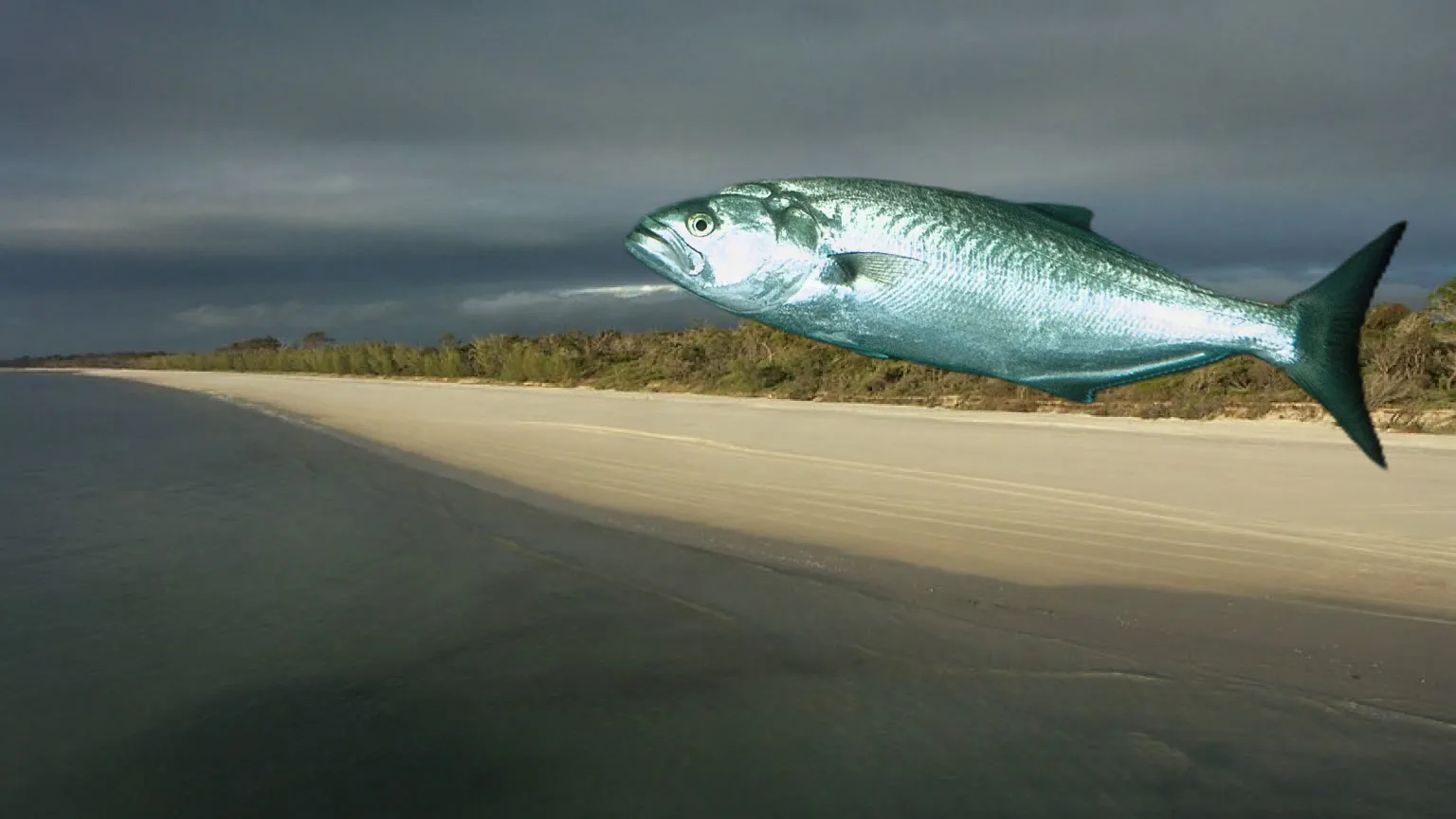
Target Species
Tailor
Fraser Island (K’gari) represents the absolute pinnacle of beach fishing on the Australian east coast.
Fraser Island (K’gari) is one of the best spots for Jumbo Greenback Tailor fishing in QLD, offering access to massive schools of migrating fish and deep, well-formed beach gutters that hold trophy-sized greenbacks over the cooler months.
For generations, adventurous fishos have made the annual pilgrimage to these wild, wind-swept sands. What draws them is not just the stunning scenery of the world’s largest sand island, but the chance to stand in the wash at the change of light and tussle with a genuine greenback: a tailor that has grown past the standard chopper size to exceed five, six, or even eight kilograms. These larger specimens earn their greenback name from the deep, emerald-green coloration along their broad backs, a distinct contrast to the silvery-blue of younger fish.
This wild environment demands respect, preparation, and a solid understanding of how predatory fish behave in heavy surf. In this guide, you will learn how to read the beach to find the most productive gutters, select the perfect tackle and baits, and employ local techniques that have been refined over decades on the sand. Whether you are a seasoned beach angler or planning your very first trip to the island, understanding these elements is the key to turning a quiet session into an unforgettable angling experience.
Getting There
Tailor
Pomatomus saltatrix
Always check current NSW DPI regulations before fishing. Bag and size limits may change.
Understanding Fraser Island (K’gari): Location Intelligence
To consistently catch jumbo greenback tailor on K’gari, you must understand how the island’s dynamic coastal geography works. The eastern beach is a constantly shifting environment shaped by heavy swells, strong sweep, and wind-driven currents. This is not a static fishery: a gutter that produces trophy fish on Monday might be completely filled with sand by Thursday.
To find the fish, you must master the WD rule: Whitewater and Deepwater. Jumbo tailor are highly efficient ambush predators. They do not like to cruise in clear, calm water where they are visible to birds and larger predators like sharks. Instead, they patrol the edges of turbulent zones. Look for areas where waves break heavily over an outer sandbar, creating a thick blanket of highly oxygenated, bubbly whitewater. This foam provides excellent cover. Directly adjacent to this breaking water, there must be a deepwater channel or gutter. The tailor hide in the deep, darker water, waiting for baitfish to be disoriented by the breaking waves on the shallow bar. When a baitfish gets washed off the bank into the deep water, the tailor strike with incredible speed.
[Outer Ocean Swell]
       │
       ▼
[Outer Sandbar]  <-- Waves break here, creating Whitewater (Foam & Cover)
       │
       ▼
[Deep Gutter]    <-- Tailor patrol this Deepwater zone, waiting for prey
       │
       ▼
[Beach Shoreline] <-- Where you stand to cast
The island’s beach features several key structures that influence where these gutters form. Rocky headlands like Poyungan Rocks, Yidney Rocks, and the massive formations at Indian Head and Waddy Point act as natural barriers. They deflect the coastal sweep, creating deep, semi-permanent gutters on their northern and southern sides.
However, traveling around these rocky zones requires careful planning. For instance, Poyungan Rocks often develops a low tide gutter that restricts 4WD beach transit, forcing drivers to use the alternative inland bypass track. Always check local beach condition reports before setting out.
Further north, the headlands of Indian Head and Waddy Point are legendary fish magnets, but they are subject to strict seasonal closures. No fishing of any kind is permitted from 400 metres south of Indian Head to 400 metres north of Waddy Point from midday on 1 August to midday on 30 September each year. This closure is designed to protect spawning aggregations of tailor, ensuring the long-term health of the fishery. Outside of this closure, these rocky ledges offer spectacular fishing, though they require extreme caution due to slippery rocks and powerful ocean swells.
When searching for productive gutters along the open stretches of 75 Mile Beach, look for key visual indicators. Polarized sunglasses are essential gear for this task. Walk or drive slowly along the upper beach and look for patches of dark blue or dark green water close to the shore, which indicate depth. Compare this to the light yellow or pale green of shallow sandbanks. The ideal gutter has a clear entry point from the open ocean, allowing tailor to enter on the rising tide, and a distinct back bank where waves are actively breaking to create that crucial whitewater cover.
Location Essentials
When Is the Best Time to Fish for Jumbo Greenback Tailor at Fraser Island (K’gari)?
The best time to fish for jumbo greenback tailor at Fraser Island (K’gari) is during the low light periods of dawn and dusk, especially when these times coincide with the last two hours of a run-up tide. This combination of rising water and dimming light encourages large tailor to leave the deeper offshore waters and enter the shallow beach gutters to feed aggressively.
While dawn and dusk are the classic peak periods, night fishing is also highly productive for the largest greenbacks. Under the cover of darkness, these big, wary fish lose much of their caution and patrol the very edges of the shore, sometimes hunting in water less than a metre deep.
Tidal movement is the single most important factor when planning your daily sessions. A run-up tide is ideal because it fills the dry sand gutters with fresh, highly oxygenated water, bringing baitfish like garfish and hardyheads close to the beach. The tailor follow this food source directly into the whitewater. If you can find a deep gutter that remains fishable at high tide, focus your efforts on the two hours before the high tide and the first hour of the run-back.
Weather patterns also play a major role in your success. The peak tailor season on K’gari runs from July to October, a period when westerly winds settle the inshore waters along the eastern beach. These offshore winds flatten the heavy surf, clearing up the water and allowing you to spot the deep gutters and sandbanks easily.
A unique local phenomenon occurs near the massive sand dunes along the beach, such as The Cathedrals. Because these towering dunes block the afternoon sun, shadows fall across the beach and gutters much earlier than the official sunset. This artificial dusk triggers the evening bite up to an hour earlier than in open areas, giving smart anglers a head start on the action.
Tailor Seasonal Calendar
Tide Times
Optimal Tide
Last two hours of the run-up tide coinciding with dawn or dusk
Tide movement is critical for fish activity. Most species feed actively during tide changes, especially the run-in (incoming) tide.
Detailed hourly tide charts
Official tide predictions
7-day tide calendar
Tide Guide
Best for most species. Fish move in to feed as water rises.
Good for ambush predators. Baitfish get swept out.
Slower bite. Fish less active during slack water.
New/full moon. Bigger tidal range, more fish movement.
Moon Phase & Solunar
Moon phases influence fish feeding behavior. New and full moons create spring tides with stronger currents and increased fish activity.
Best Phases
- New Moon: Peak feeding activity, spring tides, excellent fishing
- Full Moon: Strong tides, night feeding, great for nocturnal species
- 3 Days Either Side: Extended peak period for maximum results
Major/Minor Periods
- Major Periods: Moon overhead/underfoot (2-3 hours)
- Minor Periods: Moon rise/set (1-2 hours)
- Best Times: Major period + dawn/dusk = explosive action
Weather Conditions
Check current conditions before heading out. Wind, swell, and barometric pressure significantly affect fish behavior.
Official forecasts, warnings & radar
Hourly wind speed & direction
Swell height, period & direction
The Dune Shadow Advantage
When fishing the eastern beach, set up in front of the tallest sand dunes like The Cathedrals. The sun sets behind these dunes early, casting a shadow over the gutters and starting the evening bite up to an hour before the rest of the beach.
What Tackle Do You Need for Jumbo Greenback Tailor at Fraser Island (K’gari)?
To catch jumbo greenback tailor at Fraser Island (K’gari), you need a heavy-duty surf casting outfit featuring a 12 to 13.6-foot medium-heavy surf rod paired with either a traditional Alvey sidecast reel or a 4000 to 8000 size spinning reel. This setup must be spooled with 15 to 30-pound monofilament or braid line to handle heavy sinkers and powerful fish in strong sweeps.
Surf fishing on K’gari demands specialised gear that can withstand both the harsh saltwater environment and the physical demands of casting heavy rigs into the wind. A long rod is essential not just for casting distance, but to keep your line clear of the breaking shore waves. A 12-foot rod is a great all-rounder, but a 13.6-foot rod gives you the best clearance over the shore dumpers.
When it comes to reels, the Alvey sidecast remains a legendary choice on the island. Its simple, open design is virtually indestructible, meaning a dunk in the saltwater or a drop in the sand will not ruin your day. If you prefer modern spin reels, choose a high-quality model with excellent sealing and a smooth drag system.
Your choice of line depends on your reel and personal preference. Monofilament line is highly favoured by Alvey users because its stretch acts as a shock absorber in the heavy surf and resists abrasion against the sandbanks. Braid is excellent on spinning reels for maximum casting distance and direct contact with the fish, but you must use a long monofilament or fluorocarbon leader to prevent the sharp teeth of the tailor from slicing your main line. For more on selecting the right gear for the surf, check out our tackle basics guide.
Complete Tackle Specifications
| Component | Specification |
|---|---|
| Rod | 12 to 13.6ft medium-heavy surf rod, rated 6-10kg |
| Reel | 6 to 6.5 inch Alvey sidecast, or 4000-8000 spinning reel |
| Main Line | 15-20lb monofilament (for Alveys) or 20-30lb PE braid |
| Leader | 30-40lb fluorocarbon or tough monofilament, 1 to 1.5 metres |
| Hooks | Three 6/0 or four 4/0 ganged hooks (Mustad 4200D or similar) |
| Sinker | Size 3 to 6 star or ball sinkers, adjusted for the beach sweep |
| Swivels | Size 4 to 6 heavy-duty crane or barrel swivels |
| Rig Type | Running sinker rig or a heavy-duty paternoster rig |
How Do You Rig for Jumbo Greenback Tailor?
The most reliable rig for jumbo greenback tailor is a ganged hook rig consisting of three 6/0 or four 4/0 hooks linked together, fished on a running sinker setup. This rig is designed to present a whole pilchard perfectly straight while protecting your leader from the tailor’s razor-sharp teeth.
Tailor are notorious for attacking their prey tail-first and possess triangular, razor-sharp teeth that will make short work of standard monofilament leaders. Ganged hooks solve both of these problems. By linking several hooks together, you cover the entire length of the bait, ensuring a hookup no matter where the fish strikes, while the metal shanks of the hooks act as a natural wire trace to prevent bite-offs.
When constructing your rig, you can choose between a running sinker rig and a paternoster rig. The running sinker is the go-to setup for most beach conditions, allowing the bait to drift naturally with the current. However, if you are fishing in a heavy sweep that constantly drags your bait down the beach, a paternoster rig with a heavy pyramid or star sinker at the bottom will help anchor your bait in the strike zone. To learn more about constructing these setups, read our guide on fishing rigs.
Building the Perfect Ganged Pilchard Rig
- 1
Select Your Leader
Cut a 1-metre length of tough 40-pound monofilament or fluorocarbon leader material. This provides excellent abrasion resistance against the sand.
- 2
Prepare the Ganged Hooks
Take three 6/0 hooks. Insert the point of one hook through the eye of the next, and use pliers to carefully close the eye over the shank, linking them together.
- 3
Tie the Leader to the Hooks
Use a strong knot, such as a Uni knot, to secure one end of your leader to the eye of the top hook in your gang.
- 4
Add a Quality Swivel
Tie a heavy-duty size 4 barrel swivel to the other end of your leader. This helps prevent line twist caused by the bait spinning in the surf.
- 5
Thread the Sinker
On your main line coming from the rod, thread a running ball or star sinker. Choose a size just heavy enough to hold bottom in the current.
- 6
Connect Main Line to Swivel
Tie your main line directly to the free eye of the swivel using a reliable knot like the Clinch or Uni knot.
- 7
Rig the Bait
Insert the top hook of the gang through the eye of a whole pilchard, the middle hook through the body, and the bottom hook near the tail, keeping the bait straight.
What Bait Works Best for Jumbo Greenback Tailor?
The single most effective bait for jumbo greenback tailor at Fraser Island (K’gari) is a whole, fresh Western Australian pilchard presented on a ganged hook rig. Other highly productive baits include fresh garfish, sea mullet fillets, and long, oily strips of bonito.
While frozen bait works well, fresh bait is always superior when targeting trophy-sized greenbacks. Many experienced anglers start their session by doing the ‘pippy shuffle’ on the wet sand at low tide to gather fresh pippies, which they use to catch dart and whiting. These smaller fish can then be filleted to create incredibly fresh, oily baits that big tailor cannot resist. For a detailed breakdown of bait preparation, see our bait guide.
If you are using pilchards, a great local tip is to salt them down before your trip. Generously coating your pilchards in coarse rock salt a few days before fishing draws out the excess moisture, making the flesh much tougher. This helps the bait stay on the hooks during long, forceful casts and prevents small pickers like dart from tearing the bait apart before a big tailor finds it.
Tailor are visual hunters that rely heavily on scent and vibration. Oily fish baits like mullet and bonito release a strong scent trail in the whitewater, drawing fish from the deep outer edges of the gutter right to your feet.
Bait Performance Analysis
| WA Pilchards | Fresh Garfish | Mullet Fillets | |
|---|---|---|---|
| Effectiveness Rating | Excellent | Excellent | Very Good |
| Durability on Hook | Moderate (Better if salted) | High | Very High |
| Scent Dispersion | High | Moderate | Excellent |
| Availability | Very Easy to Buy | Must be caught or bought fresh | Easy to buy at local bait shops |
| Best Use Conditions | All surf and gutter conditions | Clear water and long-casting situations | Rough surf, heavy sweep, and night fishing |
The Tail-Pinch Berley Trick
Tailor almost always attack their prey tail-first. Before casting out your rigged pilchard, pinch off the very end of the pilchard’s tail and toss it into the water at your feet. This releases an immediate burst of fresh oil and scent into the gutter, acting as a natural berley to draw the school closer.
How Do You Catch Jumbo Greenback Tailor at Fraser Island (K’gari)?
Catching jumbo greenback tailor at Fraser Island (K’gari) requires casting your bait or lure directly into the turbulent whitewater of a beach gutter and maintaining a steady retrieve to mimic injured baitfish.
To consistently land these big ocean predators, you must master the art of reading the beach and adapting your presentation to the surf conditions. The key is finding the zones where tailor feed, which almost always involves structure, cover, and movement.
Casting Strategy and Bait Placement
When you stand on the beach, look for the classic “WD” rule: Whitewater and Deepwater. Jumbo greenbacks use the whitewater as cover to ambush baitfish that are disoriented by the breaking waves.
Your casting goal is to place your bait or lure just past the breaking wave on the far edge of the gutter. If you are using a whole pilchard on ganged hooks, cast across the current and let the swell naturally wash your rig back through the deeper channel of the gutter. Keep a semi-taut line as the bait drifts. If you leave too much slack in your line, you will miss the strike, and your rig will quickly wash ashore or get buried in the sand.
For those casting metal slugs or stickbaits, cast at an angle to the beach, retrieving the lure across the current. A fast, skipping retrieve that breaks the surface occasionally is highly effective when tailor are actively feeding on the surface. If the fish are holding deeper, let the lure sink for a few seconds before starting a rapid, steady retrieve.
Bite Detection and Hookset
Tailor are notorious for their lightning-fast, aggressive strikes. They typically attack their prey tail-first, which is why they so often bite pilchards clean in half just behind the hook.
When fishing with bait, you will often feel a couple of sharp, rapid taps. Do not strike immediately on these initial taps. These are often smaller fish or the initial strike of a larger tailor disabling the bait. Wait until you feel the rod tip load up with a heavy, continuous pull. Once the rod bends, set the hook with a firm, sweep of the rod upward and backward.
When casting metal lures, the bite is unmistakable. The rod will suddenly double over as the fish hits the moving lure at high speed. In this scenario, there is no need for a violent hookset. The speed of your retrieve combined with the momentum of the fish will easily set the hooks.
Fighting and Landing Strategies
Once hooked, a jumbo greenback tailor will put up a spectacular, clean fight. They are highly acrobatic and will frequently leap out of the water, shaking their heads violently to throw the hooks.
To prevent the fish from throwing the hook during a jump, keep your rod tip low and maintain constant pressure. Never give a tailor slack line. If the fish runs toward you, wind as fast as possible to keep the line tight.
Landing a heavy tailor through the shore break requires patience. Do not try to muscle a big fish against a receding wave, as the weight of the water combined with the fish will easily snap your leader or pull the hooks. Instead, hold steady pressure while the wave retreats. As the next swell rolls in, use the momentum of the incoming wave to slide the fish up onto the wet sand. Walk down and secure the fish quickly, keeping your fingers well clear of those razor-sharp teeth.
What Are the Rules for Fishing at Fraser Island (K’gari)?
Fishing for tailor at Fraser Island (K’gari) is governed by a strict daily bag limit of 20 fish per person and a minimum legal size limit of 35 centimetres.
Understanding the local laws is vital to protecting the delicate marine environment of K’gari and ensuring the sustainability of this top fishery.
Current Queensland Regulations
Fisheries Queensland strictly monitors the tailor population. Anglers must adhere to the 35 centimetre minimum size limit, measured from the tip of the snout to the tail. The daily possession limit is 20 tailor per person.
There is also a critical seasonal fishing closure that all visitors must respect. No fishing of any kind is permitted from 400 metres south of Indian Head to 400 metres north of Waddy Point from midday on 1 August to midday on 30 September each year. This closure is designed to protect spawning aggregations of tailor around the rocky headlands. You can check current regulations at the state fisheries website before planning your trip.
Conservation and Best Practices
To maintain the quality of the fishery, practicing responsible catch and release is highly encouraged:
- Handle with Care: Always use wet hands or a wet towel when handling fish you plan to release to protect their slime coating.
- Use Single Hooks: Consider replacing treble hooks on your metal lures with single inline hooks to minimise damage to the fish’s mouth.
- Dispatch Quickly: If keeping fish for the table, dispatch them instantly using the iki jime method or a firm blow to the head, bleed them immediately in the surf, and place them straight onto ice.
- Limit Your Keep: Only keep what you need for a fresh meal. Tailor flesh does not freeze well and quickly becomes mushy if kept frozen.
Critical Safety Considerations
Fraser Island (K’gari)‘s eastern beach is a wild, remote environment with significant hazards. Be aware of the strong sweep currents that can pull an angler off their feet in seconds. Never wade past knee-deep when fishing the surf, especially at night when large sharks are highly active close to shore.
The sand tracks can change rapidly, and Poyungan Rocks or Eli Creek can become impassable at high tide. Always carry a recovery kit, traction boards, and a tyre pressure gauge. In an emergency, dial 000, but be aware that mobile coverage is extremely limited outside of major resort areas. For more general advice on staying safe on the coast, read our fishing safety guide.
Your Questions About Jumbo Greenback Tailor Fishing at Fraser Island (K’gari)
What is the best time to fish at Fraser Island (K’gari)?
The best time to fish for jumbo greenback tailor at Fraser Island (K’gari) is during the winter and spring months, specifically from July to October, during the dawn and dusk periods.
These peak fishing hours align with the annual tailor migration up the coast. Fishing the last two hours of the run-up tide during the change of light will consistently yield the best results, as the rising water allows larger fish to enter the shallow beach gutters to feed.
Is Fraser Island (K’gari) suitable for beginners?
Yes, Fraser Island (K’gari) is suitable for beginners, provided they fish the safer, shallower gutters during daylight hours and travel with experienced four-wheel drivers.
While the remote nature of the island can be challenging, the abundance of fish makes it a highly rewarding destination. Beginners should start with basic shore fishing setups in well-formed, protected gutters before attempting to fish near the high-energy zones or rocky headlands.
Do I need a boat to fish at Fraser Island (K’gari)?
No, you do not need a boat to fish at Fraser Island (K’gari), as the vast majority of the best tailor fishing is done directly from the beach.
Land-based fishing is the primary method here, with anglers driving along the eastern beach highway to locate active gutters. A standard surf casting outfit allows you to reach the productive zones without ever needing to launch a vessel.
Where are the best specific spots at Fraser Island (K’gari)?
The best specific spots for tailor on Fraser Island (K’gari) include the gutters around Happy Valley, Poyungan Rocks, Eli Creek, and the beach stretches just south of Indian Head.
These hot spots consistently form deep, holding gutters that attract baitfish. Always check the local tracks and beach conditions, as sand movement constantly reshapes these gutters from week to week.
What size Jumbo Greenback Tailor can I expect?
While standard tailor average between 40 and 50 centimetres, jumbo greenback tailor regularly exceed 70 centimetres and can weigh over 4 kilograms.
Any tailor over 60 centimetres is locally referred to as a greenback due to the distinct dark green coloration they develop as they mature. These trophy fish are exceptionally strong and will test your knots and tackle to the limit.
Is there parking available at Fraser Island (K’gari)?
There are no formal paved parking lots on the eastern beach of Fraser Island (K’gari), as the beach itself serves as the main highway where you park directly on the sand.
When parking to fish, always pull up above the high-tide mark and clear of the main traffic flow. Ensure your vehicle is parked on firm sand to prevent getting bogged as the tide rises.
Can I fish at night at Fraser Island (K’gari)?
Yes, night fishing is highly productive for jumbo tailor, but it requires extra caution due to the lack of visibility and increased shark activity.
Using a high-quality headlamp is essential for rigging and landing fish after dark. Many of the largest greenbacks patrol the shallow gutters under the cover of darkness, making large, oily baits like bonito strips highly effective.
Where can I buy bait near Fraser Island (K’gari)?
You can buy bait on the island at the general stores located at Eurong, Happy Valley, Cathedral Beach, and Orchid Beach.
These local outlets stock frozen pilchards, squid, and basic tackle. However, for the freshest bait, you can gather your own pippies directly from the wet sand along the mid-tide mark using the classic “pippy shuffle.”
What are the current bag and size limits?
The current Queensland regulations specify a minimum size limit of 35 centimetres and a daily bag limit of 20 tailor per person.
These legal limits are strictly enforced by Queensland Boating and Fisheries patrols on the island. Always measure your catch from the snout to the tip of the tail to ensure compliance.
Is Fraser Island (K’gari) family-friendly for fishing?
Yes, Fraser Island (K’gari) is a fantastic family-friendly fishing destination, offering kids the chance to catch whiting and flathead in the calm, shallow gutters.
While the surf can be rough, the smaller gutters closer to the beach are perfect for kids fishing with light gear. Families should stick to the safer, central beach areas and avoid the deep, fast-flowing gutters near the headlands.
What should I bring for a fishing session?
Your essential fishing checklist should include a 12-foot surf rod, a sidecast or large spin reel, ganged hooks, a sand spike, a headlamp, and a quality bait bucket.
You should also pack warm windproof clothing, polarized sunglasses to help spot gutters, and a reliable tape measure to verify your catch. Carrying a basic first-aid kit is also highly recommended.
How crowded does Fraser Island (K’gari) get?
Fraser Island (K’gari) can become highly crowded during the peak school holiday periods in June and July, as well as during the annual tailor run in August.
To find quiet fishing times, plan your trips during mid-week periods outside of school holidays. Because the eastern beach stretches for over 100 kilometres, you can almost always find a productive, private gutter if you are willing to drive a little further.
Latest Fishing Reports
Stay updated with the latest catches, conditions, and hot tips from Fraser Island (K'gari). Check these sources for recent reports filtered by location and species.
Fishraider
Community fishing reports and catch logs
Fishing World
Professional fishing reports and news
Tackle World
Local tackle shop reports and tips
NSW DPI
Official recreational fishing reports
Fishingmonthly
Monthly fishing magazine and reports
Hooked Up
Video fishing reports and tips
Pro Tip: Filter Reports
When browsing reports, search for "Fraser Island (K'gari)" or nearby landmarks. Look for reports from the last 7-14 days for the most relevant information. Pay attention to tide times, weather conditions, and successful techniques mentioned.
Share Your Catch
Caught something at Fraser Island (K'gari)? Share your success with the community! Upload your catch photos and reports to help other anglers.
Disclaimer: Fishing regulations, beach access conditions, and track closures on Fraser Island (K’gari) can change rapidly. Always check the latest updates from Queensland National Parks and Fisheries Queensland before departing. For more information on local angling, explore more fishing spots in the region, read our detailed species guides, or brush up on your skills with our fishing basics guide.
Quick Info
- Location
- Fraser Island (K'gari)
- Coordinates
- -25.2500, 153.1500
- Difficulty
- intermediate
- Target Species
- Tailor
Conditions
Check local weather and tide conditions before heading out.